Artwork
The Industrious 'Prentice Alderman of London,the Idle one brought before him & impea ch'd by his Accomplice
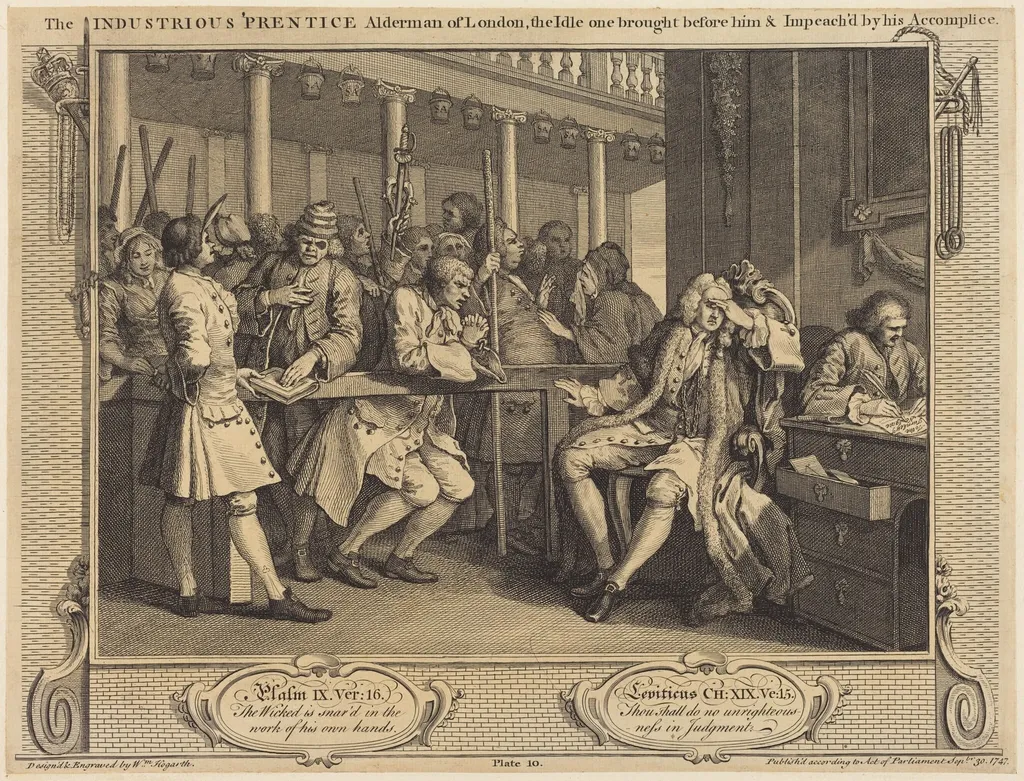
The Industrious 'Prentice Alderman of London,the Idle one brought before him & impea ch'd by his Accomplice is an ink print by the Baroque artist William Hogarth. It dates from 1747 and is held in the collection of the National Gallery of Art.
About this work
Overview
Hogarth, trained as an engraver, used the medium to reach a broad public audience, blending narrative clarity with social critique.
Created in 1747, this print by William Hogarth combines etching and engraving to depict a moralizing courtroom scene. It is part of a series examining the consequences of labor and idleness in 18th-century London. Hogarth, trained as an engraver, used the medium to reach a broad public audience, blending narrative clarity with social critique. The work reflects his commitment to visual storytelling as a tool for ethical reflection.
Subject & Meaning
The scene portrays an idle apprentice brought before his former master, now an alderman, and accused by an accomplice. The contrast between the slumped, guilty youth and the upright, authoritative judge underscores a moral dichotomy: diligence versus laziness. Biblical inscriptions at the base reinforce the theme, framing idleness as a sin and industry as a virtue. The crowded courtroom, filled with onlookers, suggests public scrutiny and communal judgment.
Technique & Style
Hogarth employed fine, precise lines typical of etching and engraving to render textures—wrinkled fabric, furrowed brows, crumpled papers—with sharp clarity. The composition is densely packed, guiding the viewer’s eye through gestures and expressions. The lack of ornate decoration in the setting focuses attention on the figures and their emotional states. His method prioritized legibility and narrative immediacy over decorative flourish.
History & Provenance
The print was produced during Hogarth’s most prolific period of social satire, following the success of series like A Harlot’s Progress. It was widely distributed as a standalone print, accessible to middle-class buyers who could afford engraved images. Original impressions were sold individually or in sets, often collected by those interested in moral instruction and contemporary life. Its survival in multiple institutional collections attests to its enduring circulation.
Context
In mid-18th-century London, apprenticeships were central to economic life, and idleness among them was seen as a threat to social order. Hogarth’s work responded to public anxieties about moral decay and economic productivity. The legal setting reflects contemporary civic structures, where magistrates like aldermen enforced moral codes. Biblical references in the print align with prevailing religious attitudes that linked labor with divine favor.
Legacy
Hogarth’s print contributed to a tradition of visual moralizing that influenced later social commentary in art and print culture. Its combination of realism, narrative structure, and ethical framing became a model for satirical illustration. While not widely exhibited today, it remains a key example of how printmaking could serve as both art and civic discourse in Enlightenment Britain.
Artist & collection
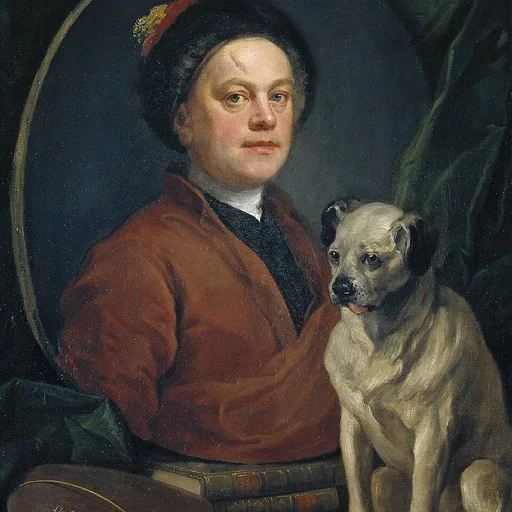
Artist
William Hogarth (; 10 November 1697 – 26 October 1764) was an English painter, engraver, satirist, cartoonist and writer.

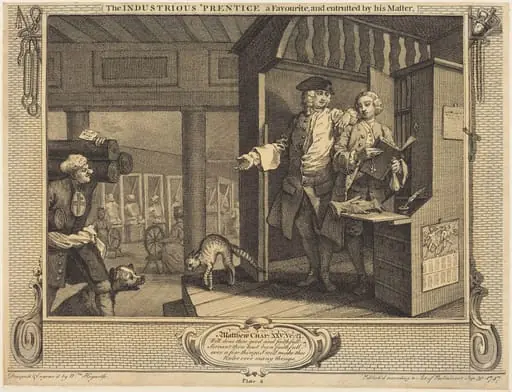 The Industrious 'Prentice a Favorite, and entrusted by his Master
 The Effects of Idleness and Industry, exemplified in the conduct of two fellow-'prentices
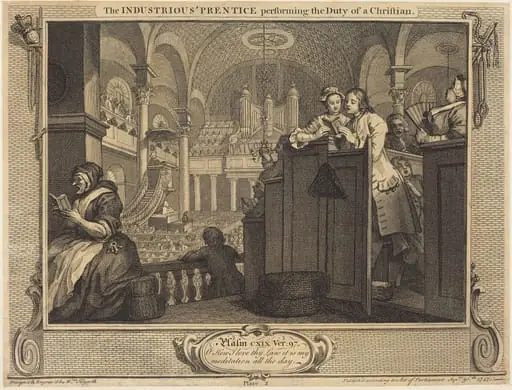 The Industrious 'Prentice performing the Dutyof a Christian
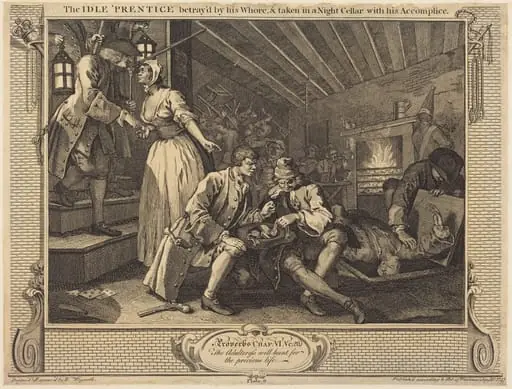 The Idle 'Prentice betray'd by his Whore, & taken in a Night Cellar with his Accomplice
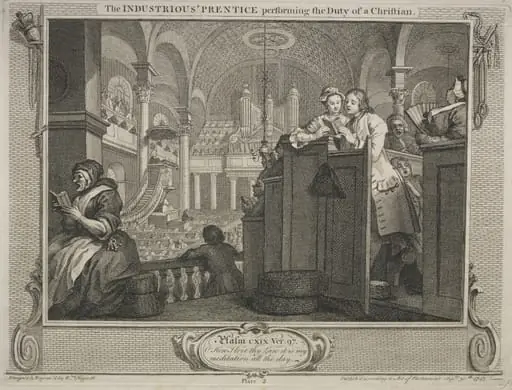 Industry and Idleness: The Industrious Prentice Performing the Duty of a Christian
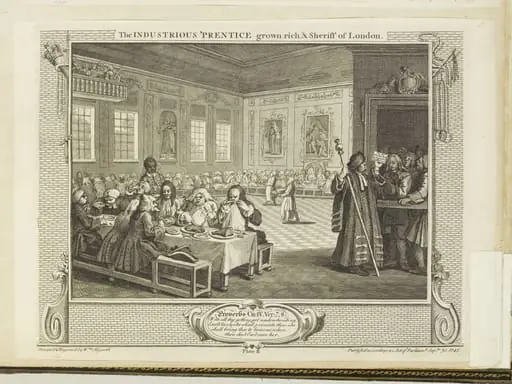
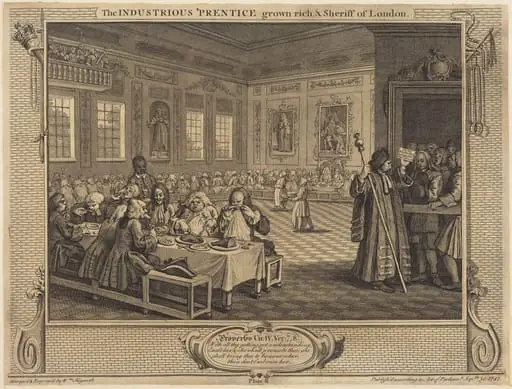 The Industrious 'Prentice grown rich & Sheriff of London