Artwork
Death's Coat of Arms
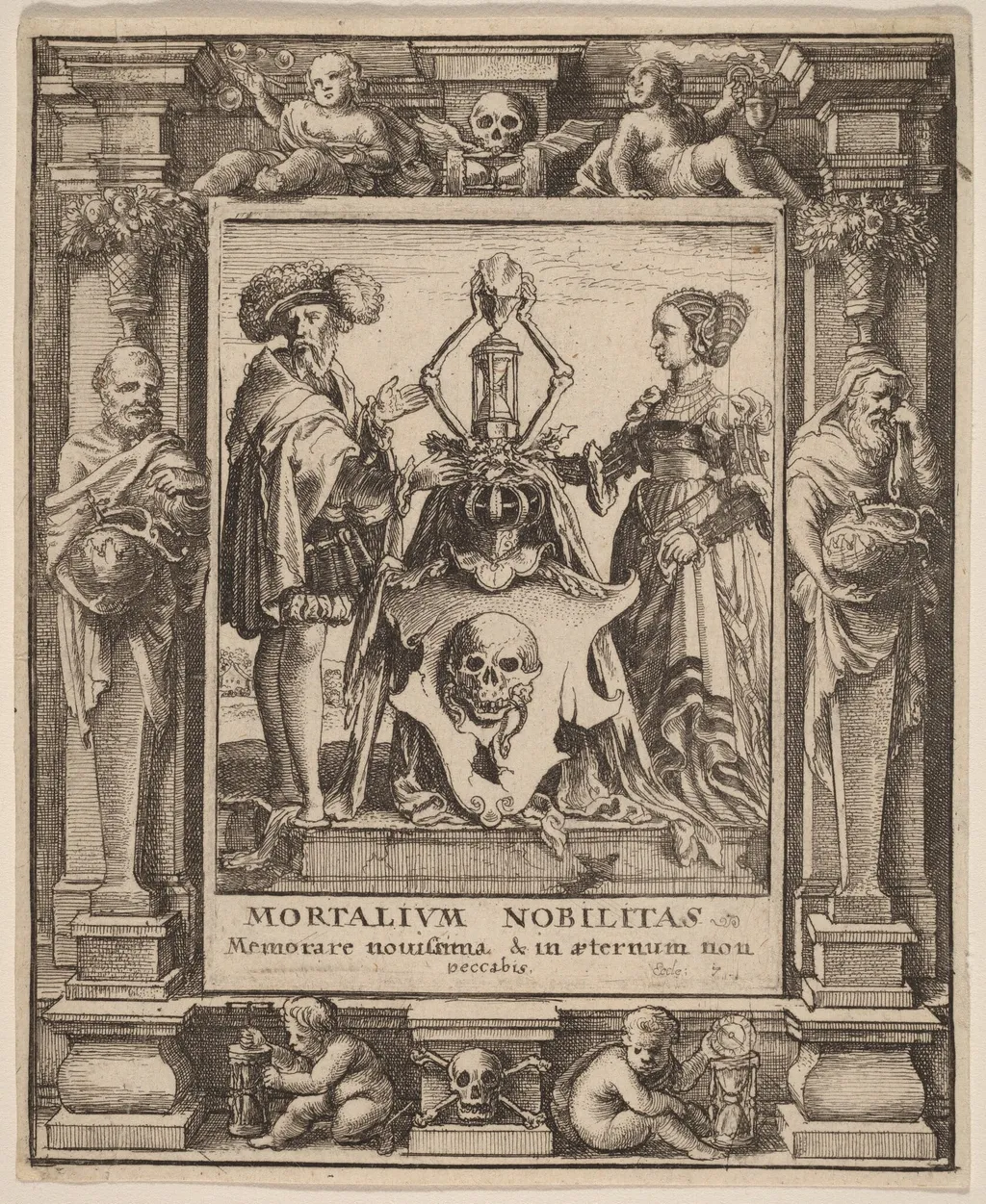
Death's Coat of Arms is an ink print by the Baroque artist Wenceslaus Hollar. It dates from 1651 and is held in the collection of the National Gallery of Art.
About this work
Overview
Created in 1651, *Death’s Coat of Arms* is an etching by the Czech-born printmaker Wenceslaus Hollar, who spent much of his career in England.
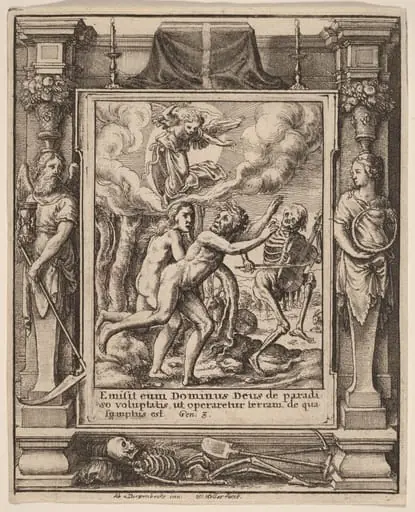
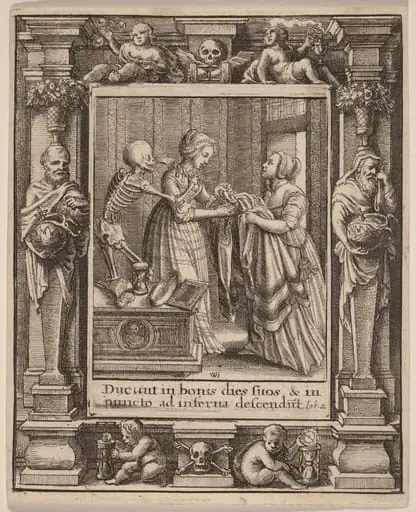
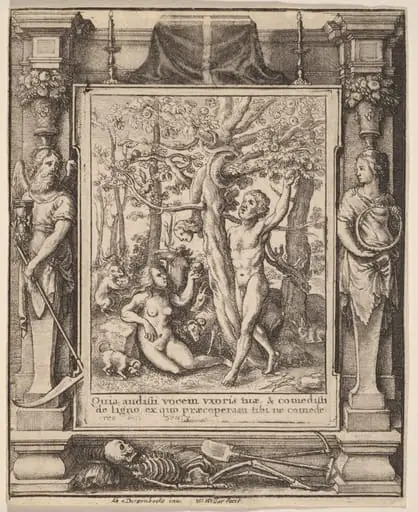
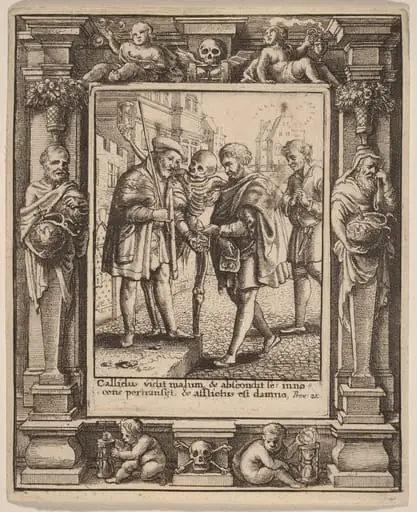
Created in 1651, *Death’s Coat of Arms* is an etching by the Czech-born printmaker Wenceslaus Hollar, who spent much of his career in England. The composition centers on a shield bearing a skull, a lantern and a crown, flanked by two elaborately dressed figures. Above, cherubic beings hold a skull and books, while a densely populated border frames the scene with numerous miniature characters surrounding a classical columned structure.
Subject & Meaning
The central shield functions as a visual memento mori, reminding viewers that mortality spares no rank. The Latin inscription *Mortalium Nobilitas*—"nobility of mortals"—reinforces this theme, suggesting that even the most privileged are subject to death. The surrounding border, titled *Democritus and Heraclitus*, juxtaposes the laughing philosopher of happiness with the weeping philosopher of change, underscoring contrasting attitudes toward the inevitability of death.
Technique & Style
Hollar employed fine line work characteristic of his etching practice, achieving intricate detail in both the central tableau and the crowded marginalia. The crispness of the lines and the careful modulation of light and shadow reveal his skill in rendering textures, from the sheen of clothing to the translucence of the skull’s bone. The composition balances a central focal point with a bustling periphery, a hallmark of his meticulous approach to printmaking.
History & Provenance
Produced during Hollar’s London period, the print reflects his engagement with English patrons and the city’s intellectual circles. Though the work was originally issued with a decorative border, it later appeared in collections of prints documenting the era’s moralizing imagery. Hollar died in London, where he was interred, and the etching has since been catalogued under the Pennington reference 233A, confirming its place in scholarly inventories.
Context
The mid‑17th century saw a proliferation of vanitas and memento mori motifs across European art, often linked to the turbulence of civil war and plague. Hollar’s etching aligns with this tradition, yet it distinguishes itself by integrating philosophical figures—Democritus and Heraclitus—into the moral message, reflecting contemporary debates about optimism, pessimism, and the transience of worldly status.
Artist & collection
Artist
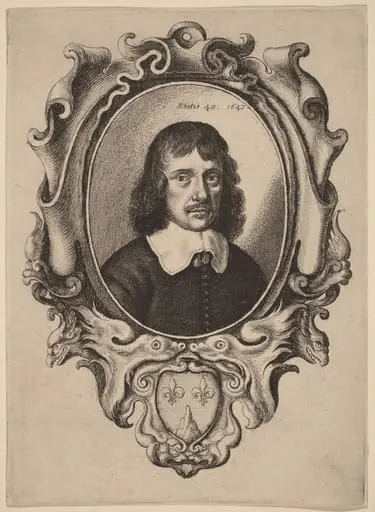
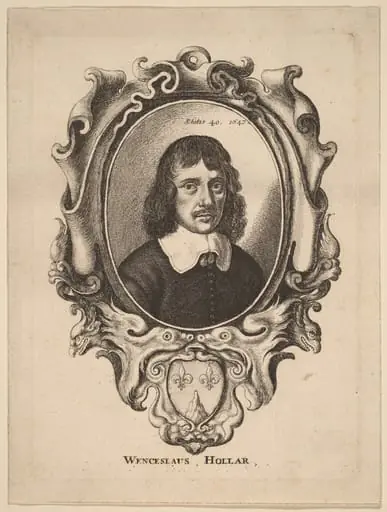
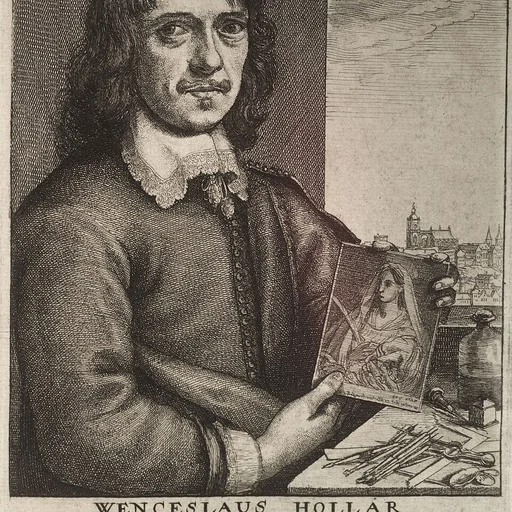
Wenceslaus Hollar (Czech: Václav Hollar (Czech pronunciation: ), German: Wenzel Hollar; 23 July 1607 – 25 March 1677) was a Czech engraver, etcher and painter.