Artwork
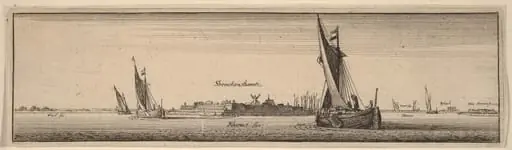
View of Shenckenschantz
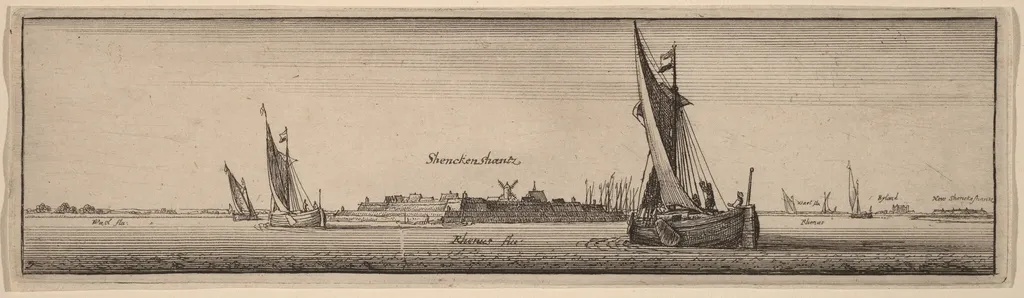
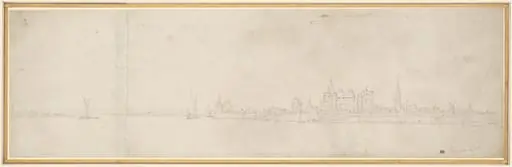
View of Shenckenschantz is an ink print by the Baroque artist Wenceslaus Hollar. It dates from 1647 and is held in the collection of the National Gallery of Art.
About this work
This etching shows a walled town near a river, with houses and windmills crowding close walls.
This etching shows a walled town near a river, with houses and windmills crowding close walls.
Hollar made it in 1647, but the scene feels older—buildings lean, shadows stretch.
Look for the tiny church steeple in the center.
His work is full of quiet details you miss at first glance.
You almost feel the wind pushing at those windmill sails.
Next, check out Wenceslaus Hollar’s other etchings of towns.
Overview
Wenceslaus Hollar’s 1647 etching *View of Schenkenschantz* presents a compact fortified settlement situated beside a river. The composition foregrounds a dense cluster of houses and windmills pressed against the town’s defensive walls, while a modest church steeple rises near the centre. Hollar’s hand renders the scene with a calm, observational tone, inviting close inspection of its architectural and topographical details.
Subject & Meaning
The print depicts the Dutch stronghold of Schenkenschantz, emphasizing its military architecture—curtain walls, bastions, and a riverine approach—alongside everyday civic life. By juxtaposing defensive structures with domestic dwellings and working windmills, Hollar conveys the coexistence of fortification and livelihood in a region frequently contested during the mid‑seventeenth‑century wars.
Technique & Style
Executed as an etching, the work relies on fine line work and delicate cross‑hatching to model light, shadow, and texture. Hollar’s characteristic precision yields a clear sense of depth: the receding walls, the tilt of buildings, and the elongated shadows suggest a specific time of day. Minute details—such as the turning sails of windmills—demonstrate his meticulous observational approach to urban vedute.
History & Provenance
Created while Hollar was residing in England, the print was likely issued as part of a series of city views that the artist produced for a European market. Original impressions were circulated among collectors of topographical prints in the late seventeenth century; later holdings include several major museum collections that acquired the work through 19th‑century acquisitions of Hollar’s oeuvre.
Context
The image was made during a period of recurring conflict in the Low Countries, when fortified towns such as Schenkenschantz played crucial roles in regional defense. Hollar’s depiction reflects contemporary interest in documenting strategic sites, serving both as a visual record for military observers and as a curiosity for patrons fascinated by the geography of war‑torn Europe.
Artist & collection
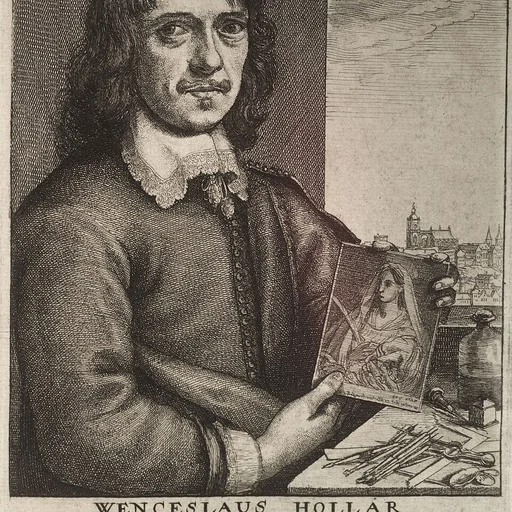
Artist
Wenceslaus Hollar (Czech: Václav Hollar (Czech pronunciation: ), German: Wenzel Hollar; 23 July 1607 – 25 March 1677) was a Czech engraver, etcher and painter.