Artwork
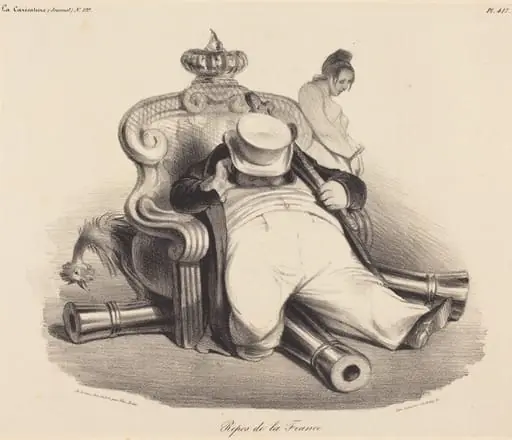
The Repose of France
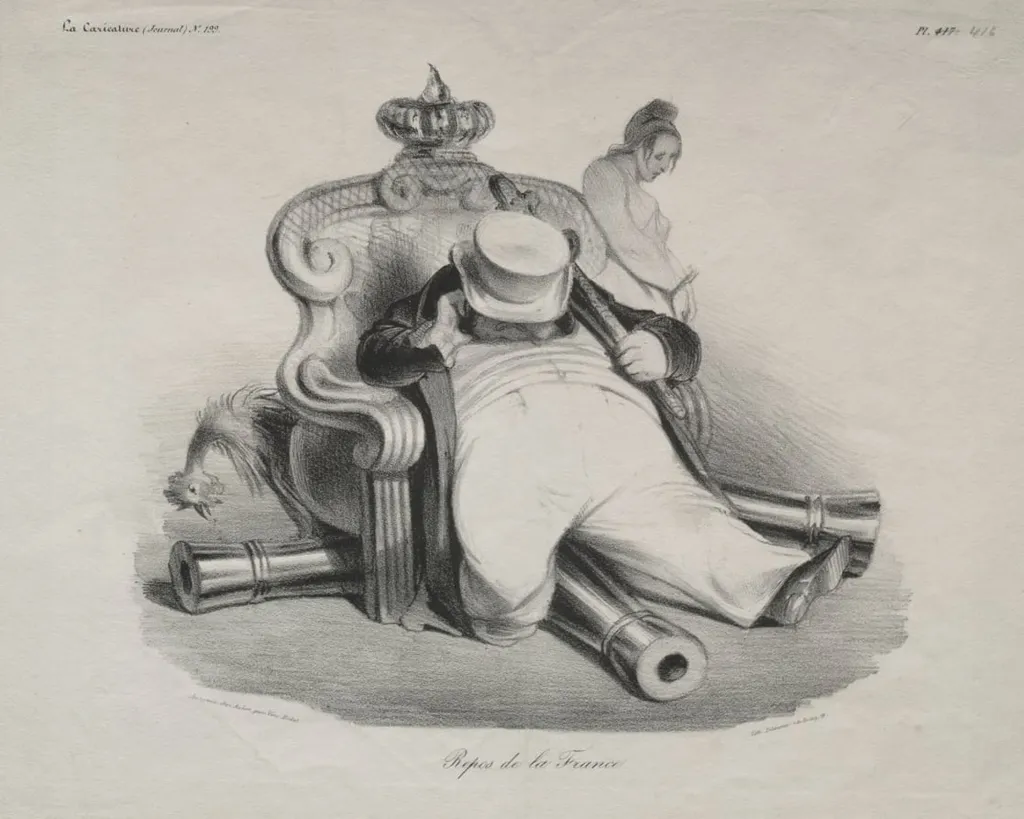
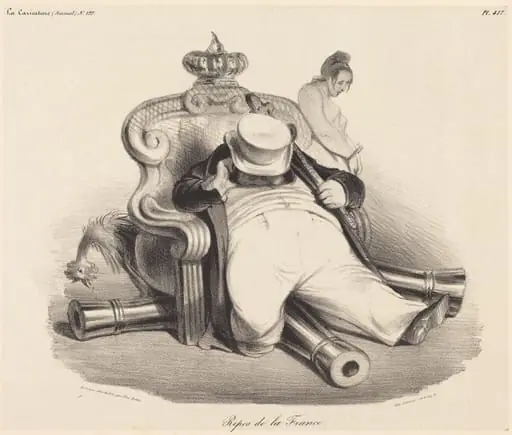
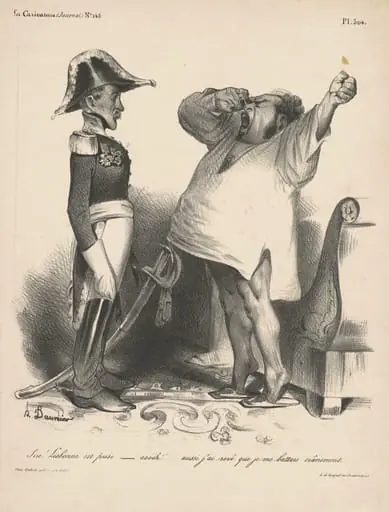
The Repose of France is a print by the Romanticist artist Honoré Daumier. It dates from 1834 and is held in the collection of the Cleveland Museum of Art. This lithograph, published in La Caricature No.
About this work
Check out the work of artist Honoré Daumier (French, 1808–1879) for more like this.
The painting shows a woman sitting, representing France.
She's surrounded by symbols of the country.
The woman is wearing a crown and holding a scepter, which are symbols of power and authority, and there are broken chains at her feet, which may indicate freedom.
This detail suggests the artist is commenting on the state of France at the time.
The broken chains could represent the end of monarchic rule.
Check out the work of artist Honoré Daumier (French, 1808–1879) for more like this.
Overview
This lithograph, published in La Caricature No. 199 as plate 417, presents an allegorical figure of France in repose. Created by Honoré Daumier, it uses symbolic elements to reflect political conditions during the July Monarchy. The image is not a literal portrait but a visual commentary, embedding national identity within a seated, regal woman surrounded by emblems of sovereignty and liberation.
Subject & Meaning
The central figure embodies France as a crowned woman holding a scepter, evoking monarchical tradition. At her feet, broken chains suggest the recent overthrow of absolutist rule, possibly referencing the 1830 July Revolution. Her relaxed posture contrasts with the tension of political transition, implying a nation in a moment of fragile calm—neither fully secure nor entirely free from underlying instability.
Technique & Style
Daumier employed lithography to achieve sharp contrasts and expressive line work, typical of his political illustrations. The composition is simplified yet potent, with minimal background detail to focus attention on the allegorical figure. The rendering of fabric and metal objects is stylized, prioritizing symbolic clarity over naturalism, aligning with the satirical tradition of 19th-century French periodicals.
History & Provenance
The print was issued in 1834 during a period of heightened political censorship under Louis-Philippe’s regime. La Caricature, known for its sharp critiques of the monarchy, frequently featured Daumier’s work. Though the journal was suppressed in 1835, this plate survived as part of a broader archive of satirical prints documenting public dissent and the evolving identity of the French Republic.
Context
Produced amid rising tensions between liberal reformers and the monarchy, the image responds to the unstable legitimacy of the July Monarchy. The broken chains allude to the fall of Charles X, while the crown and scepter hint at lingering monarchical symbolism. Daumier’s work often navigated legal boundaries, using allegory to evade direct censorship while still conveying subversive messages to the public.
Legacy
Daumier’s allegorical prints, including this one, helped define the visual language of political satire in France. His ability to distill complex social commentary into accessible imagery influenced later generations of cartoonists and illustrators. Though created for ephemeral publication, such works are now recognized as vital records of 19th-century political consciousness and the power of visual journalism.
Artist & collection
Artist
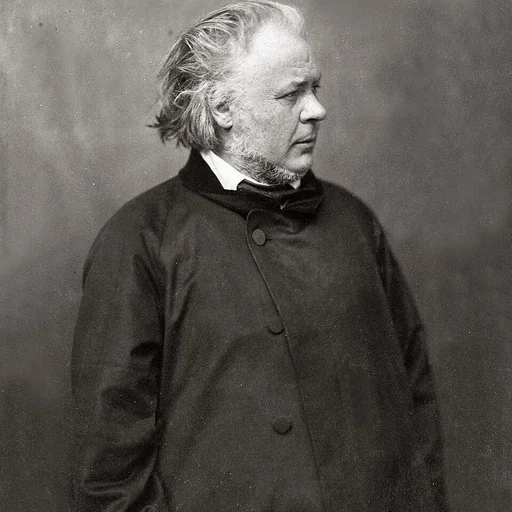
Honoré-Victorin Daumier was a French painter, sculptor, and printmaker, whose many works offer commentary on the social and political life in France, from the Revolution of 1830 to the fall of the Second French Empire in 1870.