Artwork
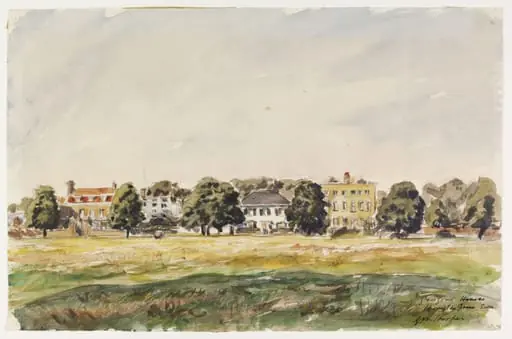
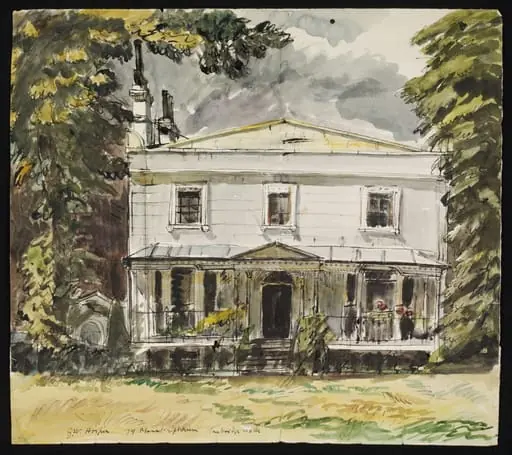
Sudbrooke House, Petersham
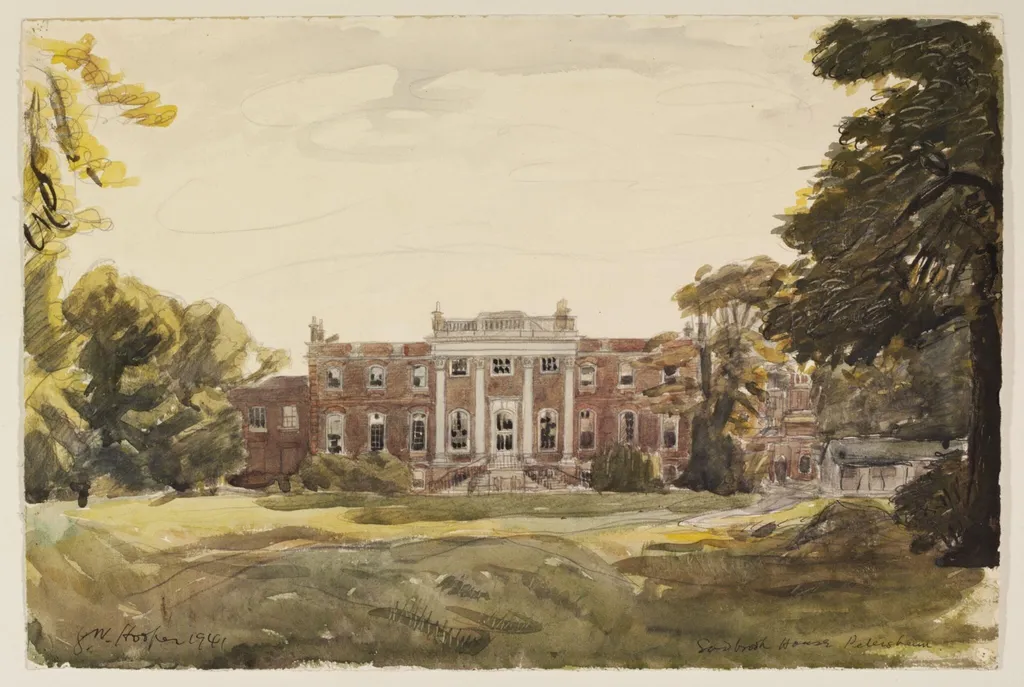
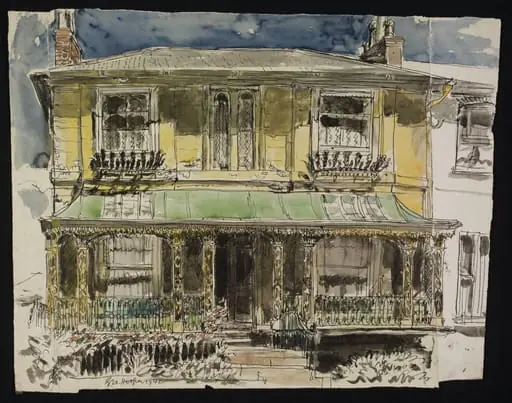
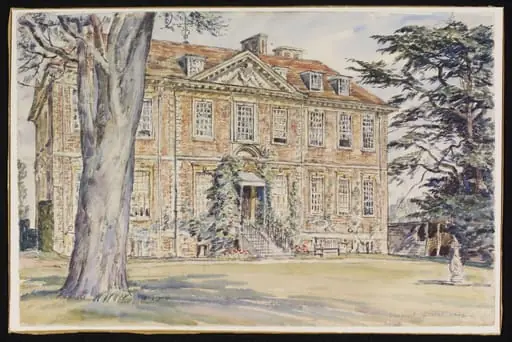
Sudbrooke House, Petersham is a watercolor work on paper by Hooper. It dates from 1941 and is held in the collection of the Victoria and Albert Museum.
About this work
The artist signed it in the corner—"Hooper, 1941"—and wrote the name *Sudbrooke House, Petersham*.
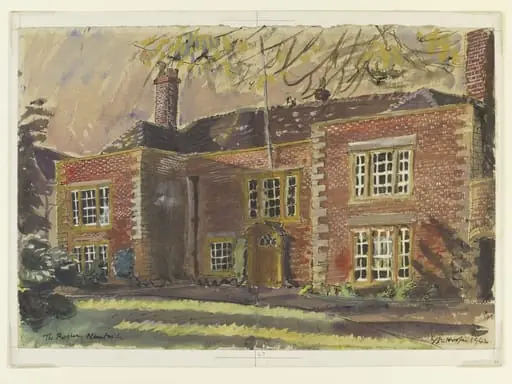
This painting shows a big red-brick house with white trim, surrounded by trees and a grassy yard. The sky is pale, and the trees have yellow-green leaves. A path leads up to the front door, and there’s a fence along the bottom edge.
The artist signed it in the corner—"Hooper, 1941"—and wrote the name *Sudbrooke House, Petersham*. The brushstrokes are loose, almost sketchy, giving it a quick, impressionistic feel.
If you like this style, check out the Victoria and Albert Museum for more works like it.
Overview
Painted in 1941, this watercolour by Hooper captures Sudbrooke House, an 18th-century residence in Petersham, Surrey. Created as part of the Recording Britain project, the work belongs to a national effort to visually archive England’s architectural heritage amid wartime threats. The piece is signed and dated by the artist in the lower corner, alongside the subject’s title, affirming its documentary purpose.
Subject & Meaning
Sudbrooke House, with its symmetrical portico and formal approach, represents a quiet emblem of English country architecture. The painting does not idealize the structure but records it with quiet precision, emphasizing its place within a natural landscape. The surrounding trees and open yard suggest a tranquil, enduring presence, contrasting with the uncertainty of the wartime era in which it was made.
Technique & Style
Hooper employed loose, fluid brushwork to convey the house and its setting with a sense of immediacy. The watercolour medium allowed for transparent layers, capturing the pale sky and the subtle shift in leaf tones. The fence at the foreground and the path leading to the entrance guide the viewer’s eye without rigid detail, reflecting an impressionistic approach that values atmosphere over architectural exactitude.
History & Provenance
The painting was produced under the Recording Britain initiative, funded by the Pilgrim Trust and overseen by Sir Kenneth Clark. Launched in 1939, the project commissioned artists to document at-risk sites before they could be lost to bombing or urban change. Hooper’s work entered the collection of the Victoria and Albert Museum, where it remains part of a broader archive of wartime visual documentation.
Context
During the Second World War, cultural preservation became a national priority. Recording Britain responded to fears of losing historic buildings by mobilizing artists to record them in situ. The project favored watercolours for their portability and sensitivity, and focused on vernacular architecture and rural scenes—subjects seen as emblematic of English identity under threat.
Legacy
Hooper’s watercolour contributes to a lasting visual record of England’s architectural landscape during a time of upheaval. The Recording Britain collection, now held at the V&A, continues to serve as a resource for historians and artists interested in mid-20th-century heritage. This work exemplifies how art functioned not as decoration, but as quiet testimony to place and memory.
Artist & collection
Artist
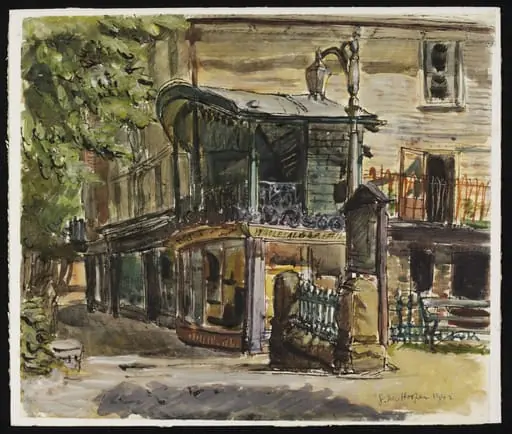
This artist painted quiet streets and brick buildings in watercolor during the early 1940s.