Artwork
Portul Amalfi
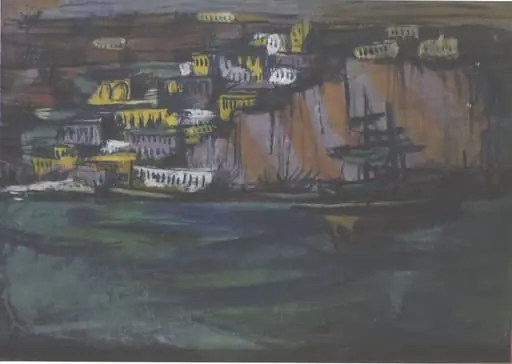
Portul Amalfi is an unspecified painting by Marcel Janco. It dates from 1950 and is held in the collection of the Gavrila Simion Eco-Museum Research Institute Tulcea.
About this work
Overview
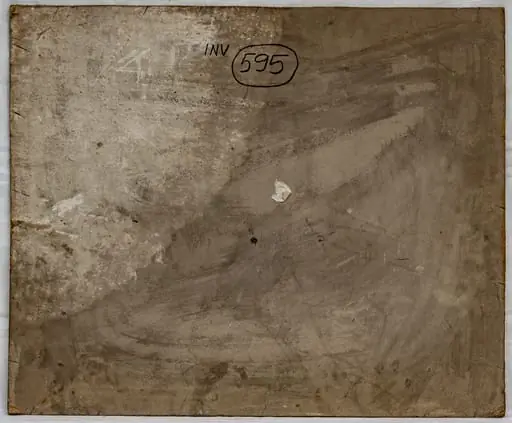
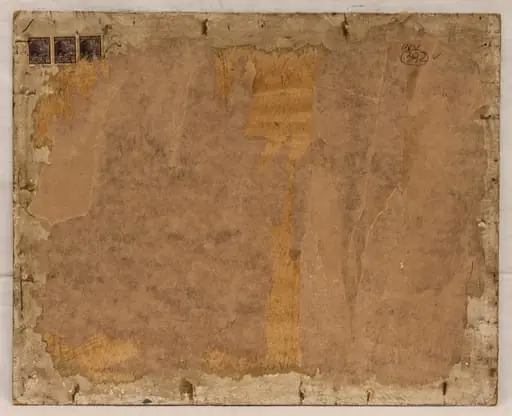
Portul Amalfi / Marină, circa 1950, is a painting by Marcel Janco, currently housed at the Museum of Ethnography. The work's condition is notably deteriorated.
Subject & Meaning
Despite its title suggesting a depiction of a harbor or sea scene (possibly referencing Amalfi), the painting's faded state obscures any discernible subjects or narrative, leaving interpretation speculative.
Technique & Style
Characterized by thin paint application, the work reveals the canvas in places. The surface exhibits roughness, with dirt, damage, and faint, indistinct dark smudges that may represent figures or objects.
History & Provenance
Created around 1950 by Marcel Janco, the painting is part of the Museum of Ethnography's collection.
Created around 1950 by Marcel Janco, the painting is part of the Museum of Ethnography's collection. Further biographical context: Marcel Janco (1887-1982) was a Romanian-Israeli artist, known for his contributions to Dadaism and his role in the development of the Cabaret Voltaire in Zurich. His work often explored the intersection of abstract and figurative elements, though 'Portul Amalfi / Marină' does not clearly exemplify these traits due to its state.
Context
While Janco's broader oeuvre reflects his involvement in Dadaism and abstract tendencies, 'Portul Amalfi / Marină' itself, due to its condition, does not clearly align with or illuminate these aspects of his work.
Legacy
The painting's impact or influence is not readily discernible due to its deteriorated condition, which hampers a clear understanding of its artistic intent or contribution to Janco's legacy.
Artist & collection
Artist
Marcel Janco painted still lifes and portraits in the early 20th century, blending bold colors and geometric shapes.
Museum
Gavrila Simion Eco-Museum Research Institute Tulcea
Continue through works from the same source collection.
 Peisaj dobrogean cu căruță
 Peisaj cu casă
 Blocuri noi în Constanța
 Peisaj
 Cană cu flori
 Piață din Tulcea
 Lectura
 Hora
Hora Peisaj cu copaci printre care se văd acoperișurile gri și roșii. În dreapta, printre copaci, se ridică înalt turnul alb al unei biserici. În plan îndepărtat, blocuri, în spatele cărora se ridică furnale profilate pe un deal înalt albastru. Cerul învolburat albastru-violet. Copacii colorați în culorile toamnei. Semnat și datat cu negru, stânga jos: Craiu (19)70 ?.
 Fabrica de cherestea
 Casa conspiratorului Ticovschi
 Marină