Artwork
O fată ștergând de praf statuia lui Venus din Millo
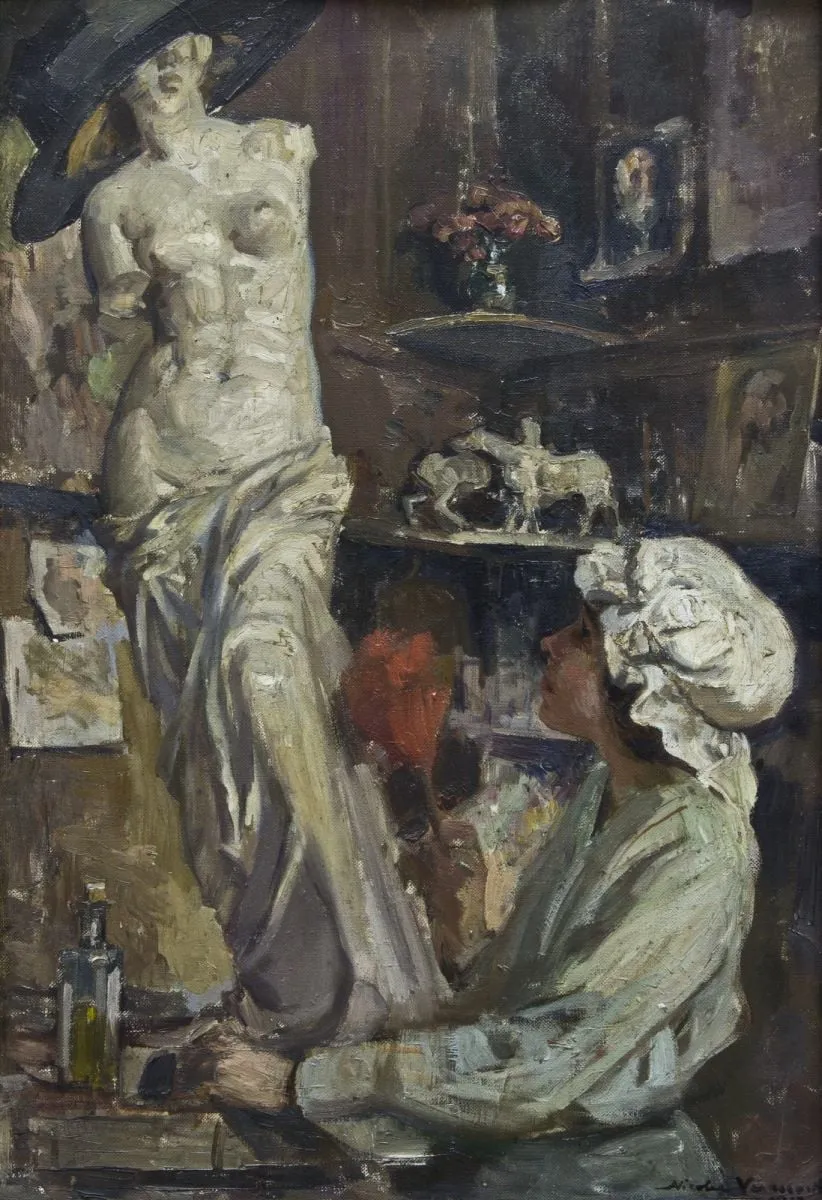
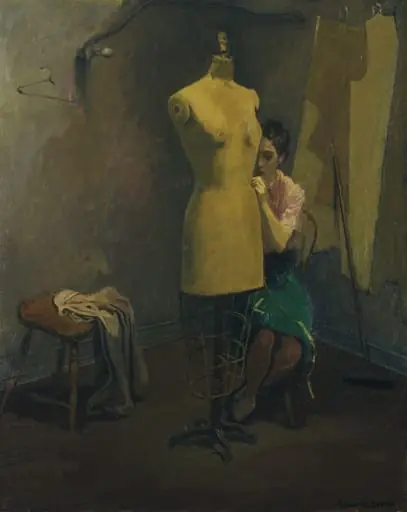
O fată ștergând de praf statuia lui Venus din Millo is an unspecified painting by the Symbolist artist Nicolae Vermont. It dates from 1912 and is held in the collection of the National Museum of Art of Romania.
About this work
Overview
Painted in 1912 by Nicolae Vermont, this work depicts a quiet moment of domestic labor intersecting with classical antiquity.
Painted in 1912 by Nicolae Vermont, this work depicts a quiet moment of domestic labor intersecting with classical antiquity. A woman in a simple white cap tends to a marble statue of Venus, her attention fixed on the act of cleaning. The setting is a dim, cluttered studio filled with objects that suggest both scholarly curiosity and artistic practice, including jars, a skull, and unfinished canvases.
Subject & Meaning
The scene juxtaposes the timeless ideal of the Venus statue with the humble, transient act of dusting. The woman’s focused demeanor implies reverence, yet her role as a laborer underscores the everyday maintenance required to preserve cultural artifacts. The contrast between the eternal form and the mortal hand suggests themes of impermanence, care, and the quiet labor behind cultural preservation.
Technique & Style
Vermont employs thick, textured brushwork, using impasto to build surface depth and tactile presence. The heavy application of paint gives weight to the statue’s form and the woman’s clothing, while the dim interior is rendered with muted tones and shadowed contours. The roughness of the technique contrasts with the smooth marble of the statue, enhancing the physicality of the scene without idealizing it.
History & Provenance
Created during Vermont’s mature period, the painting reflects his interest in introspective, intimate scenes drawn from studio life. It was likely painted in Bucharest, where he maintained a studio and engaged with Symbolist and Realist traditions. The work remained in Romanian collections after its completion, documented in early 20th-century exhibition records but never widely reproduced.
Context
In early 20th-century Romania, artists increasingly turned to domestic and studio interiors as subjects worthy of serious attention. Vermont’s painting aligns with broader European trends that elevated ordinary moments, yet it diverges by embedding classical mythology within a gritty, unromanticized space—rejecting both academic grandeur and sentimentalism.
Legacy
Though not widely known outside Romania, the painting is recognized for its subtle psychological depth and technical restraint. It stands as an example of how Romanian modernism engaged with European currents while maintaining a distinct, contemplative voice. Its focus on labor and preservation continues to resonate in discussions of art’s material and social conditions.
Artist & collection
Artist
If you like scenes of daily life painted with a quiet eye, try Nicolae Vermont’s work.