Artwork
Dragon d'or
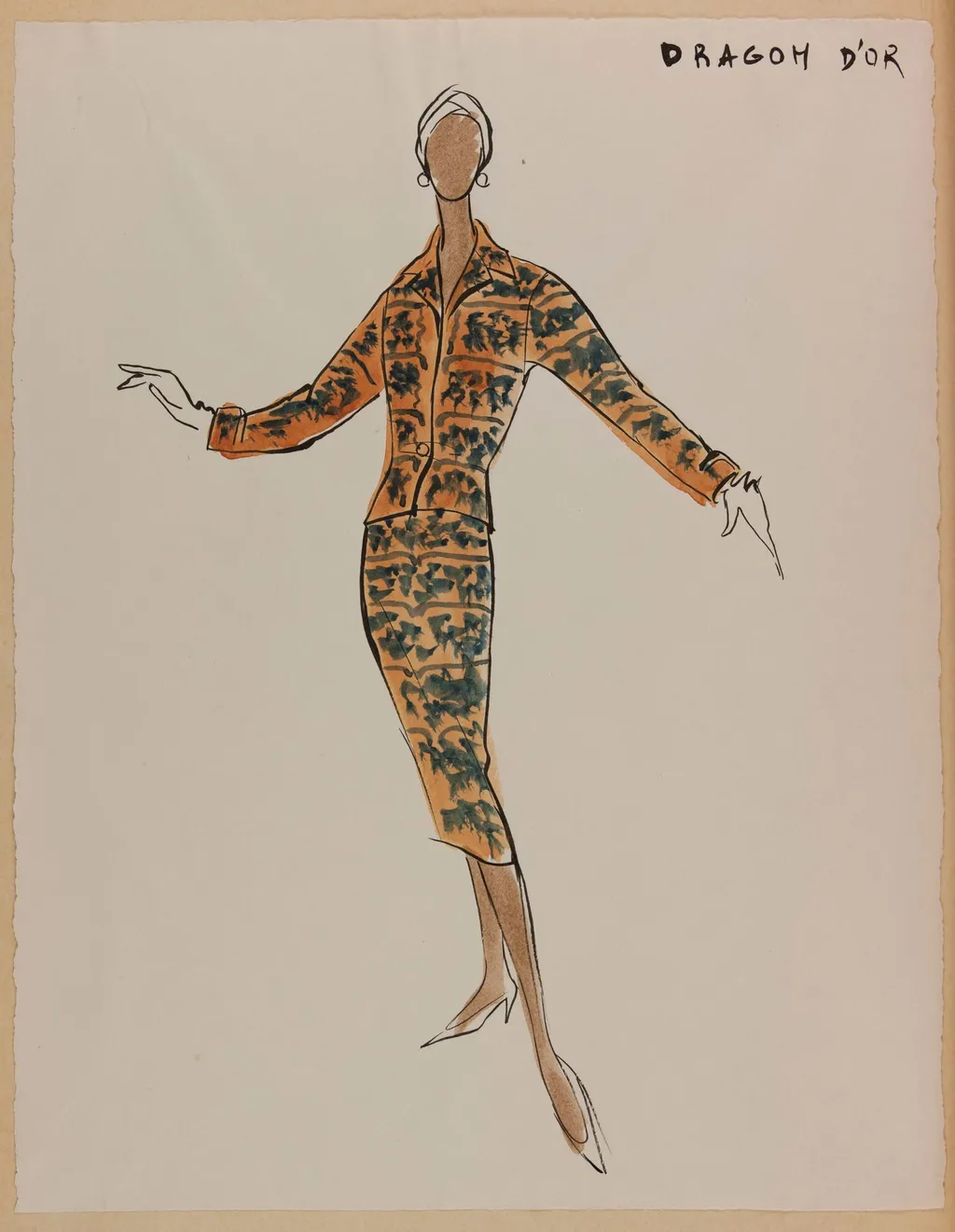
Dragon d'or is a drawing by Marie-Louise Carven. It dates from 1956 and is held in the collection of the Palais Galliera - Musée de la Mode de la Ville de Paris.
About this work
Overview
Its bold leaf motif in brown and green contrasts with the unadorned paper background, reflecting Carven’s preference for clean forms and graphic patterns.
Created around 1956, *Dragon d'or* is a fashion sketch by Marie-Louise Carven, founder of the Parisian label established in 1945. The drawing captures a one-piece garment with short sleeves and a collar, rendered in swift, assured lines. Its bold leaf motif in brown and green contrasts with the unadorned paper background, reflecting Carven’s preference for clean forms and graphic patterns. The sketch’s immediacy suggests it was a working design, not a finished presentation.
Subject & Meaning
The figure depicted wears a loose, flowing jumpsuit, suggesting ease of movement and practicality. The outstretched arms imply a natural, unposed posture, reinforcing Carven’s focus on wearable, everyday elegance. The leaf pattern, while stylized, evokes organic vitality without ornamentation. This aligns with her philosophy of designing for the modern woman—refined yet unencumbered, prioritizing comfort without sacrificing visual interest.
Technique & Style
Carven rendered the design with rapid, confident ink lines, capturing form without excessive detail. The absence of shading or background elements directs focus to the garment’s silhouette and pattern. The bold, flat colors of the foliage contrast sharply with the white paper, a deliberate choice to emphasize structure over realism. This approach mirrors her ready-to-wear ethos: clarity, efficiency, and visual impact achieved through minimal means.
History & Provenance
The sketch originates from Carven’s personal design archive, produced during the peak of her ready-to-wear innovation in the mid-1950s. As one of the first French designers to champion accessible fashion, her studio produced numerous such sketches for production. *Dragon d'or* likely served as a template for a garment in her 1956 collection, though no surviving garment with this exact pattern has been documented.
Context
In postwar Paris, fashion was shifting from haute couture exclusivity toward practical, mass-producible designs. Carven, alongside contemporaries like Jacques Heim, helped define this transition. Her use of gingham, lace, and bold prints catered to a growing middle class seeking stylish yet affordable clothing. *Dragon d'or* exemplifies this cultural pivot—elegant, yet designed for daily life, not ceremonial display.
Legacy
Carven’s emphasis on fit for petite frames and functional elegance influenced later generations of designers focused on wearable art. Though *Dragon d'or* remains a private sketch, its aesthetic—clean lines, graphic patterns, and restrained detail—echoes in contemporary minimalist fashion. Her legacy lies not in spectacle, but in redefining what daily dress could be: thoughtful, unpretentious, and quietly distinctive.
Artist & collection
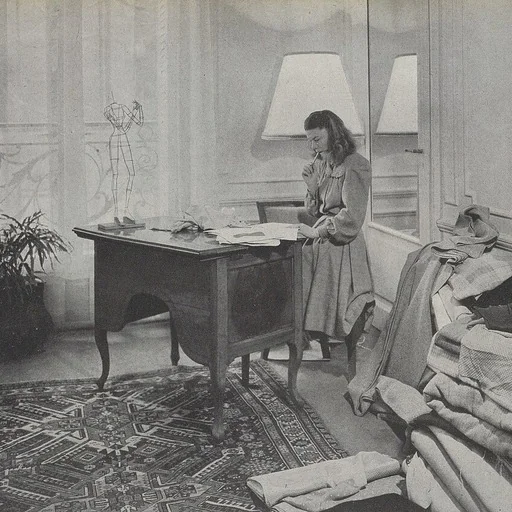
Artist
Marie-Louise Carven (31 August 1909 – 8 June 2015), born Carmen de Tommaso, was a French fashion designer who founded the house of Carven in 1945.
Museum
Palais Galliera - Musée de la Mode de la Ville de Paris
Continue through works from the same source collection.
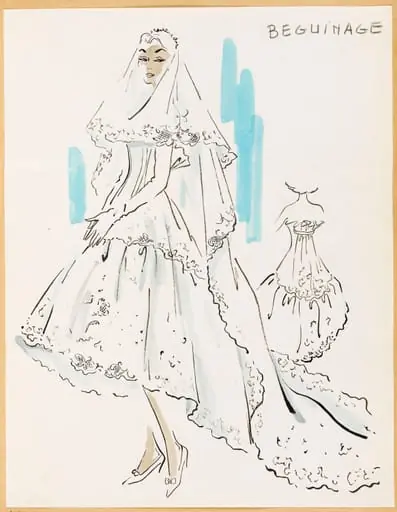
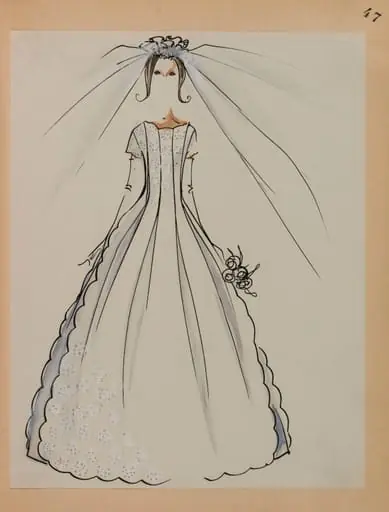 Robe de mariée festonnée et son voile
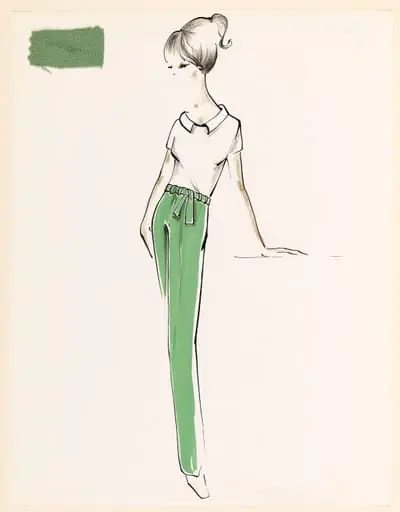 Haut blanc à manches courtes et pantalon vert à ceinture nouée
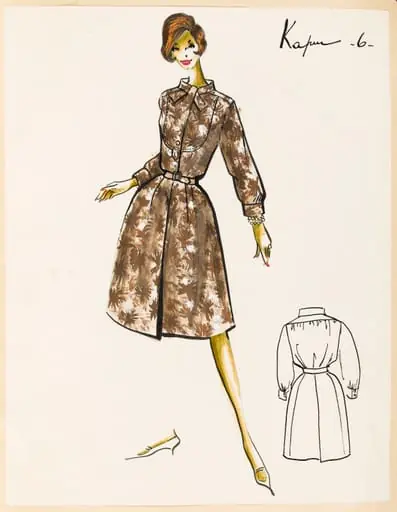 Kapur
Kapur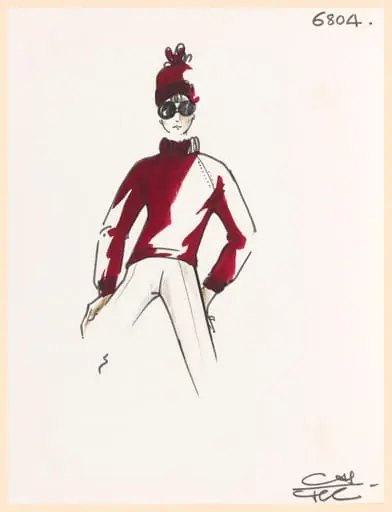 Pull-over à manches longues pourpre, bonnet assorti, pantalon et lunettes de soleil
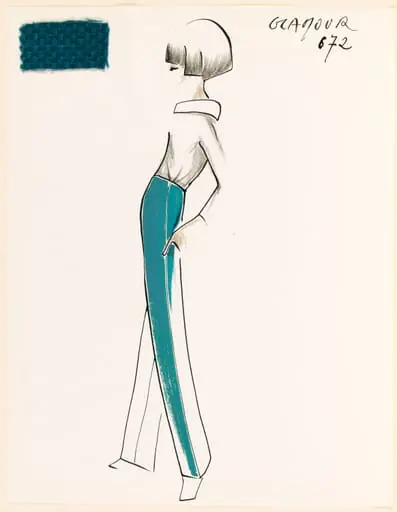 GLAMOUR
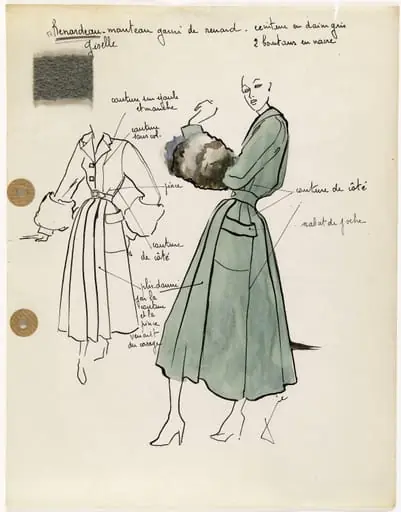 'Renardeau'
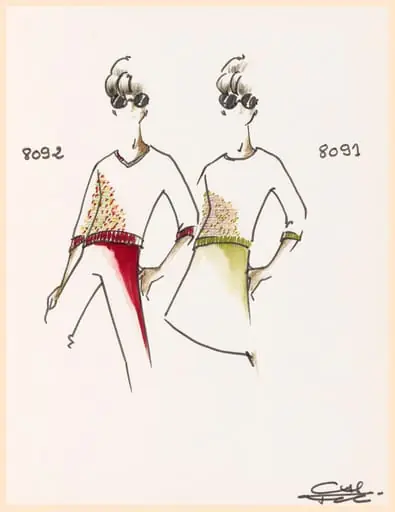 Pull-over à manches trois quarts et à encolure V à motifs multicolores, pantalon cerise et lunettes de soleil
 Béguinage