Artwork
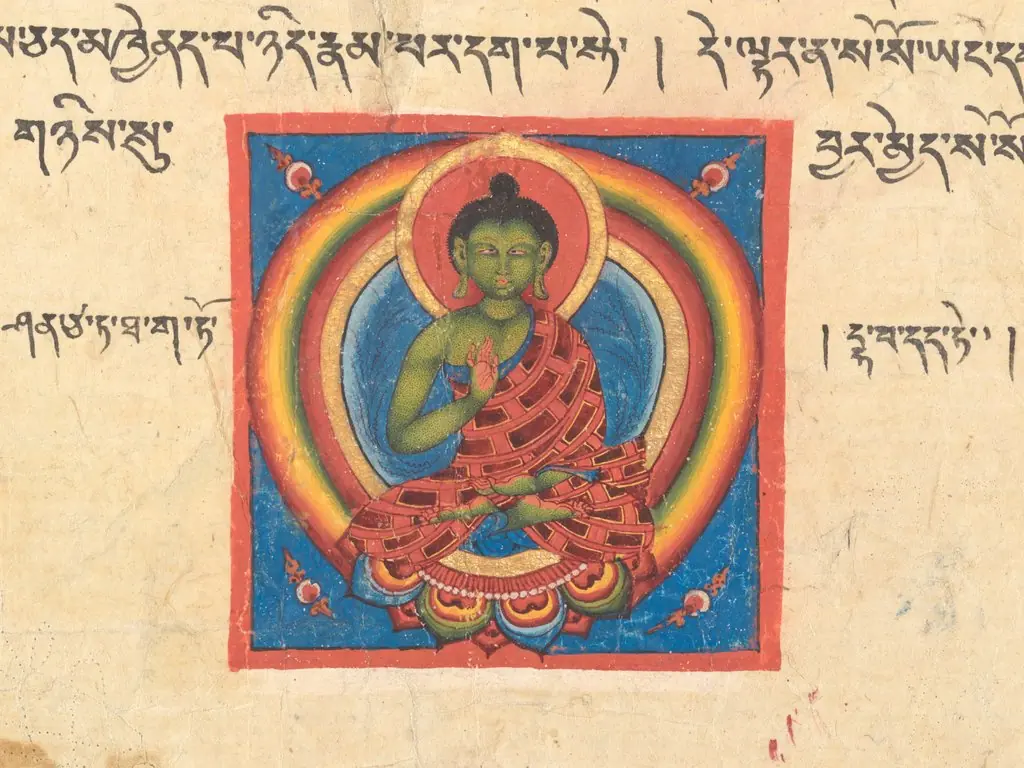
Text, folio 4 (recto), from a Manuscript of the Perfection of Wisdom in Eight Thousand Lines (Ashtasahasrika Prajnaparamita-sutra)

Text, folio 4 (recto), from a Manuscript of the Perfection of Wisdom in Eight Thousand Lines (Ashtasahasrika Prajnaparamita-sutra) is an unspecified painting. It dates from 1119 and is held in the collection of the Cleveland Museum of Art.
About this work
Overview
The overall composition reflects a traditional format for illuminated religious texts, serving both didactic and devotional purposes.
This folio, designated as folio 4 (recto), originates from a manuscript of the Ashtasahasrika Prajnaparamita-sutra, also known as the Perfection of Wisdom in Eight Thousand Lines. The artwork combines painted imagery with textual elements. It features three circular illustrations depicting seated figures, interspersed with columns of script. The overall composition reflects a traditional format for illuminated religious texts, serving both didactic and devotional purposes.
Subject & Meaning
The manuscript fragment presents a visual and textual exposition of Buddhist teachings. The red-robed figures, depicted in a cross-legged posture with serene expressions, likely represent Buddhist teachers or revered saints, embodying spiritual wisdom. The accompanying text, written in an ancient script, presumably Sanskrit, elaborates on the principles of the Prajnaparamita-sutra, a foundational Mahayana Buddhist scripture concerning the nature of reality and enlightenment.
Technique & Style
The artwork employs a distinctive visual style, characterized by three circular painted sections set against a dark blue-green ground. The figures are rendered with simplicity, their calm faces conveying a meditative state. Gold and brown script columns separate these painted roundels. The physical condition of the folio, with its worn and slightly torn edges, indicates its age and historical use as a scroll or part of a larger codex.
Artist & collection

 Fragment of a Prajnaparamita Sutra manuscript folio
 Perfection of Wisdom in Eight Thousand Lines: Ashtasahasrika Prajnaparamita: Top Cover
 Prajnaparamita flanked by a white female figure and a white bodhisattva, folio 90 (recto), from a Manuscript of the Perfection of Wisdom in Eight Thousand Lines (Ashtasahasrika Prajnaparamita-sutra)
 Perfection of Wisdom in Eight Thousand Lines: Ashtasahasrika Prajnaparamita: Decorated Leaf
 Perfection of Wisdom in Eight Thousand Lines: Ashtasahasrika Prajnaparamita
 Perfection of Wisdom in Eight Thousand Lines: Ashtasahasrika Prajnaparamita: Decorated Leaf
 Perfection of Wisdom in Eight Thousand Lines: Ashtasahasrika Prajnaparamita: Decorated Leaf (recto)
 Perfection of Wisdom in Eight Thousand Lines: Ashtasahasrika Prajnaparamita: Back Cover
 Text, Folio 5 (recto), from a Manuscript of the Perfection of Wisdom in Eight Thousand Lines (Ashtasahasrika Prajnaparamita-sutra)
 Text, folio 3 (recto), from a Manuscript of the Perfection of Wisdom in Eight Thousand Lines (Ashtasahasrika Prajnaparamita-sutra)
 Text, Folio 8 (recto), from a Manuscript of the Perfection of Wisdom in Eight Thousand Lines (Ashtasahasrika Prajnaparamita-sutra)