Artwork
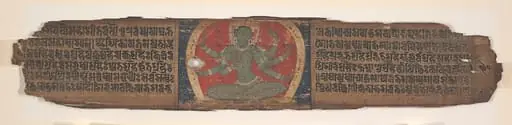
Three female figures, folio 89 (verso), from a Manuscript of the Perfection of Wisdom in Eight Thousand Lines (Ashtasahasrika Prajnaparamita-sutra)

Three female figures, folio 89 (verso), from a Manuscript of the Perfection of Wisdom in Eight Thousand Lines (Ashtasahasrika Prajnaparamita-sutra) is an unspecified painting by Unknown. It dates from 1119 and is held in the collection of the Cleveland Museum of Art.
About this work
Overview
" Rendered on paper, it depicts three seated female figures, each rendered in a distinct hue—red, blue, and orange—against a background of calligraphic text.
The fragment is a painted folio from a Buddhist manuscript of the Ashtasahasrika Prajnaparamita‑sutra, the "Perfection of Wisdom in Eight Thousand Lines." Rendered on paper, it depicts three seated female figures, each rendered in a distinct hue—red, blue, and orange—against a background of calligraphic text. The composition is organized in a linear, book‑like format typical of devotional scrolls.
Subject & Meaning
Each woman is shown cross‑legged on a stylized lotus, a symbol of purity and spiritual awakening. One hand rests on the knee while the other grasps a small object, possibly a ritual implement or offering, suggesting a contemplative or devotional gesture. The trio may represent emanations of a bodhisattva or attendant figures associated with the Prajnaparamita teachings.
Technique & Style
The images are executed in opaque pigments applied with fine brushes, producing vivid yet slightly muted colors that have faded with age. Outlines are defined by delicate ink work, and the figures are set against a field of dense Sanskrit or Tibetan script, integrated into the visual plane. The overall aesthetic reflects the miniature painting tradition of East Asian Buddhist manuscripts.
History & Provenance
This folio, numbered 89 verso, originates from a larger codex that once contained the complete eight‑thousand‑line sutra. The manuscript shows signs of extensive handling: surface wear, faded pigments, and small perforations where it was likely bound or displayed. Its current location is the collection of the Cleveland Museum of Art, where it is preserved as part of the museum’s Asian religious art holdings.
Artist & collection

 Domestic Scene
 Giacomo and Cardinal Marco, investing Andrea, Abbot of San Zeno, with his Benefice
 The Nymph of Fontainebleau
 Portrait of a Woman
 Madonna and Child with Saints in the Enclosed Garden
 Venus and Minerva
 Family Group of Four on Sofa
 Wall painting from Room H of the Villa of P. Fannius Synistor at Boscoreale
 Text, folio 3 (recto), from a Manuscript of the Perfection of Wisdom in Eight Thousand Lines (Ashtasahasrika Prajnaparamita-sutra)
 Prajnaparamita flanked by a white female figure and a white bodhisattva, folio 90 (recto), from a Manuscript of the Perfection of Wisdom in Eight Thousand Lines (Ashtasahasrika Prajnaparamita-sutra)
 Perfection of Wisdom in Eight Thousand Lines: Ashtasahasrika Prajnaparamita: Decorated Leaf (recto)
 Perfection of Wisdom in Eight Thousand Lines: Ashtasahasrika Prajnaparamita
 Text, Folio 5 (recto), from a Manuscript of the Perfection of Wisdom in Eight Thousand Lines (Ashtasahasrika Prajnaparamita-sutra)
 Perfection of Wisdom in Eight Thousand Lines: Ashtasahasrika Prajnaparamita: Decorated Leaf
 Perfection of Wisdom in Eight Thousand Lines: Ashtasahasrika Prajnaparamita: Decorated Leaf
 Prajnaparamita flanked by two female figures, folio 1 (verso), from a Manuscript of the Perfection of Wisdom in Eight Thousand Lines (Ashtasahasrika Prajnaparamita-sutra)
 Untitled
 Prajnaparamita flanked by a white female figure and a white bodhisattva, folio 90 (recto), from a Manuscript of the Perfection of Wisdom in Eight Thousand Lines (Ashtasahasrika Prajnaparamita-sutra)