Artwork
Text: Folio 2 (verso), from a Kalpa-sutra
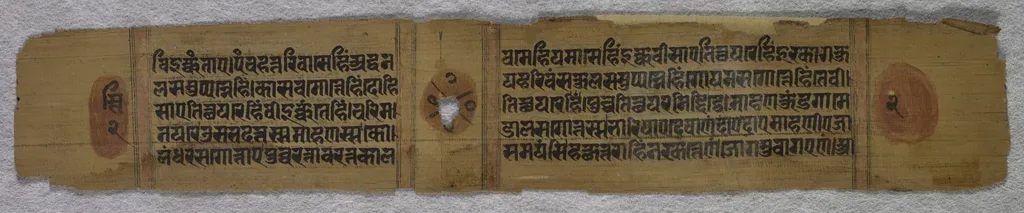
Text: Folio 2 (verso), from a Kalpa-sutra is an unspecified painting by Unknown. It dates from 1275 and is held in the collection of the Cleveland Museum of Art. This fragment originates from a folio of the Kalpa-sutra, a Jain religious manuscript.
About this work
Overview
The verso side displays handwritten text in a regional Indic script, executed in black ink on aged paper with a yellowish-brown hue.
This fragment originates from a folio of the Kalpa-sutra, a Jain religious manuscript. The verso side displays handwritten text in a regional Indic script, executed in black ink on aged paper with a yellowish-brown hue. A circular red-and-black medallion separates two textual blocks. The paper exhibits natural fiber texture and a torn edge, suggesting physical handling and age. Its form aligns with manuscript traditions preserved in South Asian religious contexts.
Subject & Meaning
The text contains passages from the Kalpa-sutra, a canonical Jain scripture detailing the lives of the Tirthankaras and monastic rituals. Though the specific content is not legible here, its structure reflects liturgical organization. The central medallion likely served as a visual divider between sections, possibly marking transitions in recitation or doctrinal themes. Its presence underscores the manuscript’s devotional function.
Technique & Style
The script is rendered in a precise, ornate calligraphic hand typical of western Indian manuscript production. Ink lines show controlled brushwork with subtle flourishes, indicating skilled scribes. The red-and-black circular mark was applied with care, possibly using a stamp or hand-drawn template. The paper’s rough texture and visible fibers suggest handmade rag paper, consistent with pre-modern Indian manuscript materials.
History & Provenance
This folio likely belonged to a larger codex produced in Gujarat or Rajasthan between the 14th and 16th centuries. Its survival as a single fragment implies separation from its original binding, possibly through later collection or dispersal. The Cleveland Museum of Art holds similar Jain manuscripts, suggesting a shared provenance or acquisition history within institutional collections of South Asian art.
Context
Manuscripts like this were used in ritual recitation and monastic study within Jain communities. Their production required collaboration among scribes, illustrators, and patrons, often commissioned by wealthy lay followers. The use of durable materials and careful script reflects the sacred status of the text. Such fragments, though incomplete, preserve the material culture of Jain religious practice in medieval India.
Legacy
This fragment contributes to the understanding of Jain manuscript traditions, particularly in script variation and book conservation practices. Its survival highlights the endurance of textual culture despite physical degradation. Modern scholars rely on such pieces to reconstruct textual transmission, artistic conventions, and the material conditions of religious literacy in pre-colonial India.
Artist & collection

 Domestic Scene
 Giacomo and Cardinal Marco, investing Andrea, Abbot of San Zeno, with his Benefice
 The Nymph of Fontainebleau
 Portrait of a Woman
 Madonna and Child with Saints in the Enclosed Garden
 Venus and Minerva
 Family Group of Four on Sofa
 Wall painting from Room H of the Villa of P. Fannius Synistor at Boscoreale
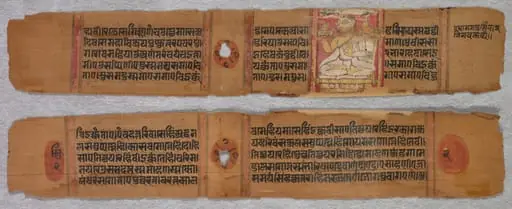 Folio 2, from a Kalpa-sutra: A Monk Preaching (recto); Text (verso)
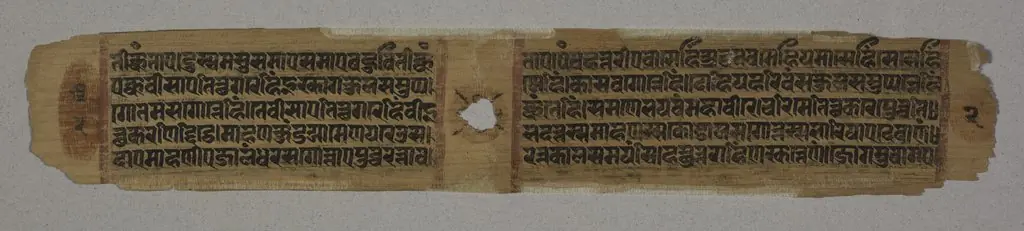 Folio 2 (verso), from a Kalpa-sutra and Story of Kalakacharya
 Folio 2 (verso), from a Kalpa-sutra and Story of Kalakacharya
 Leaf from a Jain Manuscript: Kalpa-sutra (recto)
 Leaf from a Jain Manuscript: Kalpa-sutra
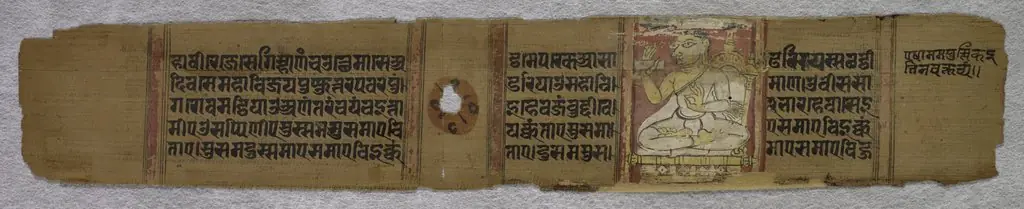 A Monk Preaching: Folio 2 (recto), from a Kalpa-sutra
 Leaf from a Jain Manuscript: Kalpa-sutra (verso)
 Folio (recto) from a Kalpa-sutra and Story of Kalakacharya of Devachandra: Text
 A Monk Preaching: Folio 2 (recto), from a Kalpa-sutra
 Leaf from a Jain Manuscript: Kalpa-sutra: The Monk Gautama, Enthroned (recto)