Artwork
Minerva as Bellone
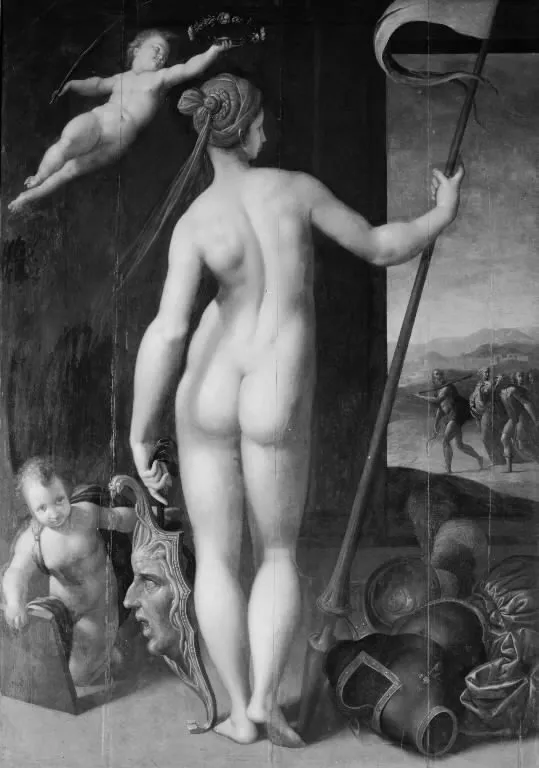
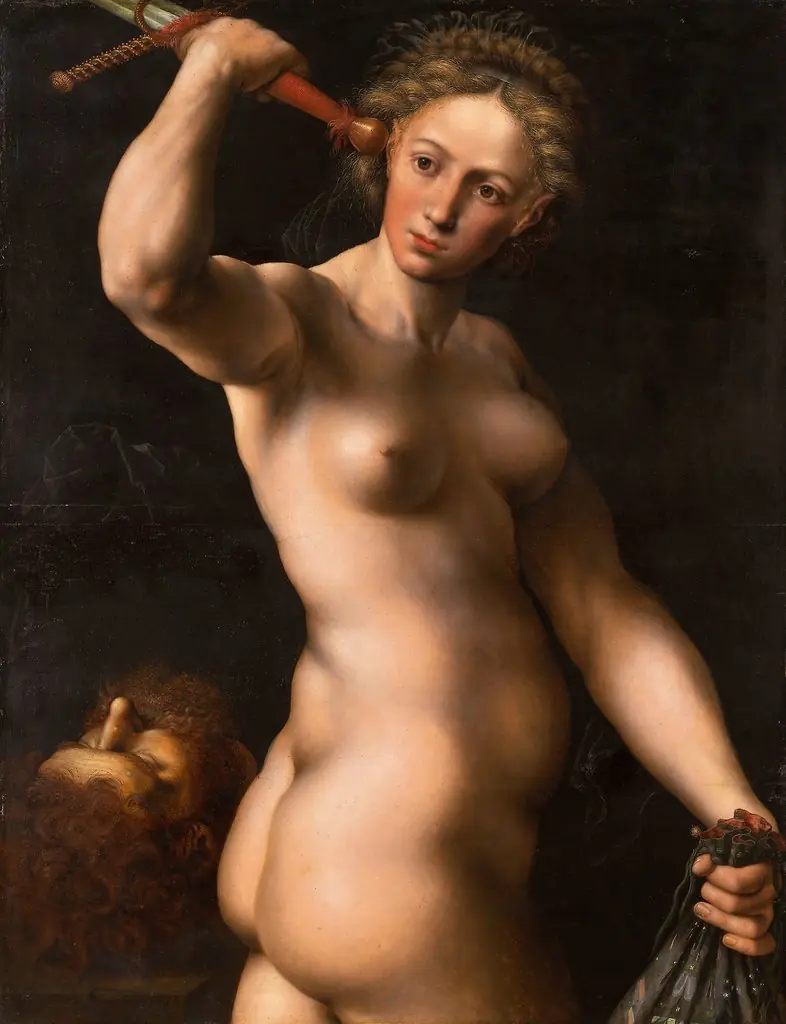
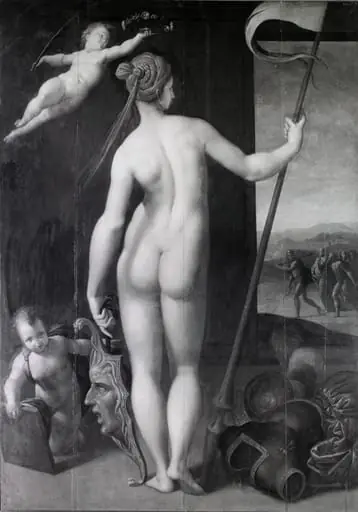
Minerva as Bellone is an unspecified painting by the Mannerist artist Unknown. It dates from 1597 and is held in the collection of the Statens Museum for Kunst. This oil painting portrays a nude female figure in a dynamic, frontal stance, turned away from the viewer.
About this work
Overview
The composition employs strong chiaroscuro to model form and suggest spatial depth, anchoring the figure in a dramatic, ambiguous setting.
This oil painting portrays a nude female figure in a dynamic, frontal stance, turned away from the viewer. She grips a spear and shield, standing atop a mask, while a small, winged form hovers above her. Behind her, two ancillary scenes unfold: one featuring a cherub with a bow, another showing distant male figures. The composition employs strong chiaroscuro to model form and suggest spatial depth, anchoring the figure in a dramatic, ambiguous setting.
Subject & Meaning
The figure is identified as Minerva, the Roman goddess of wisdom and war, rendered in the Bellone type—a martial variant emphasizing her warrior aspect. The floating infant may symbolize the birth of strategic thought or the vulnerability of reason amid conflict. The mask beneath her feet alludes to deception or the subjugation of falsehood, while the background scenes suggest the dual nature of war: divine intervention and human consequence.
Technique & Style
The artist uses chiaroscuro to sculpt the figure’s form with sharp contrasts between light and shadow, enhancing volume and tactile presence. The smooth modeling of skin contrasts with the textured surfaces of the shield and spear. Background elements are rendered with looser brushwork, creating spatial recession. The pose is classical yet tense, combining idealized anatomy with psychological gravity, typical of late Mannerist or early Baroque sensibilities.
History & Provenance
The painting’s origins trace to the late 16th or early 17th century, likely within an Italian or Flemish workshop influenced by classical revivalism. It was likely commissioned for a private collector interested in allegorical themes. Early records place it in a northern European collection by the mid-17th century, though its exact provenance before that remains undocumented. No definitive attribution to a known master has been established.
Context
During this period, mythological allegories were favored in elite collections as vehicles for moral and intellectual reflection. Minerva’s dual role as goddess of wisdom and warfare made her a popular symbol for rulers and scholars. The inclusion of a floating infant and distant warriors reflects contemporary interest in the tension between intellect and violence, a theme explored in humanist writings and courtly iconography of the time.
Legacy
Though not widely reproduced, the painting exemplifies a niche tradition of allegorical female warriors in early modern art. Its synthesis of classical form, psychological nuance, and symbolic complexity influenced later depictions of Minerva in academic painting. The work remains a case study in how mythological subjects were adapted to explore abstract ideals of reason, power, and conflict in a pre-Enlightenment visual culture.
Artist & collection

 Domestic Scene
 Giacomo and Cardinal Marco, investing Andrea, Abbot of San Zeno, with his Benefice
 The Nymph of Fontainebleau
 Portrait of a Woman
 Madonna and Child with Saints in the Enclosed Garden
 Venus and Minerva
 Family Group of Four on Sofa
 Wall painting from Room H of the Villa of P. Fannius Synistor at Boscoreale