Artwork
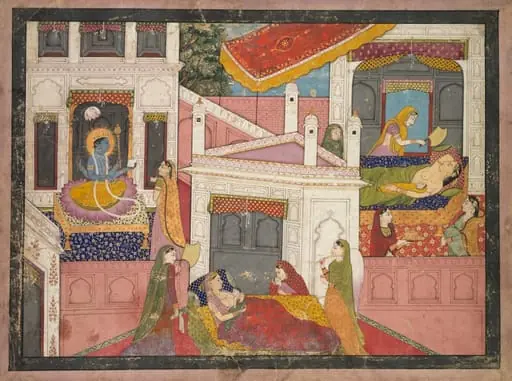
The birth of Rama and his brothers, from Chapter 17 of the Bala Kanda (Book of Childhood) of the Adhyatma Ramayana (Rama's Journey of the Supreme Spirit) from the Brahmanda Purana (Ancient Scripture of the Cosmic Egg)
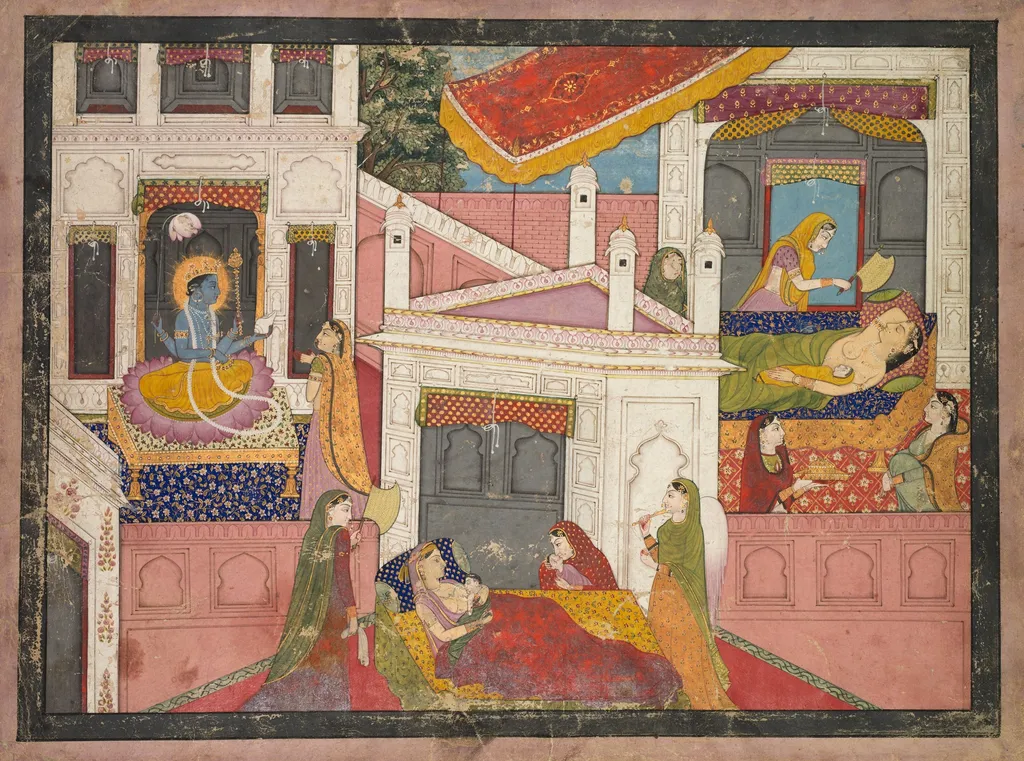
The birth of Rama and his brothers, from Chapter 17 of the Bala Kanda (Book of Childhood) of the Adhyatma Ramayana (Rama's Journey of the Supreme Spirit) from the Brahmanda Purana (Ancient Scripture of the Cosmic Egg) is an unspecified painting by Unknown. It dates from 1840 and is held in the collection of the Cleveland Museum of Art.
About this work
Overview
The work is a painted illustration of a narrative from the Adhyatma Ramayana, specifically the episode describing the birth of Rama and his brothers as recounted in Chapter 17 of the Bala Kanda. Executed as a single panel, the composition presents an interior setting filled with figures and decorative elements, capturing a moment from the ancient Brahmanda Purana tradition.
Subject & Meaning
The scene portrays the divine birth of Rama, Lakshmana, Bharata, and Shatrughna, central heroes of the Ramayana epic. The central blue‑skinned deity occupies a pink and yellow throne, signifying his royal and celestial status, while surrounding attendants and reclining figures emphasize the celebratory and ritual aspects of the birth ceremony.
Technique & Style
Rendered in vivid pigments, the painting employs a rich palette of blues, pinks, yellows, and assorted bright hues to delineate clothing, architecture, and ornamental patterns. The spatial arrangement includes a staircase and balcony, creating depth, while the intricate textile designs reflect traditional Indian miniature conventions.
History & Provenance
The piece belongs to a series of visual interpretations of the Adhyatma Ramayana, a devotional text derived from the Brahmanda Purana. Its precise date and origin are not recorded, but the stylistic traits align with later Indian courtly painting traditions that illustrated religious narratives for elite patrons.
Context
Within the broader corpus of Ramayana art, this painting highlights the theological emphasis on Rama’s divine nature, indicated by his blue skin, and the ritual significance of his birth. The inclusion of architectural elements such as the balcony and staircase situates the event within a sacred domestic space, a common motif in devotional visual culture.
Legacy
Illustrations like this have contributed to the visual canon of Hindu epic storytelling, informing later manuscript illuminations and temple murals. By translating scriptural episodes into pictorial form, they have helped preserve and disseminate the narrative across generations and regions.
Artist & collection

 Domestic Scene
 Giacomo and Cardinal Marco, investing Andrea, Abbot of San Zeno, with his Benefice
 The Nymph of Fontainebleau
 Portrait of a Woman
 Madonna and Child with Saints in the Enclosed Garden
 Venus and Minerva
 Family Group of Four on Sofa
 Wall painting from Room H of the Villa of P. Fannius Synistor at Boscoreale
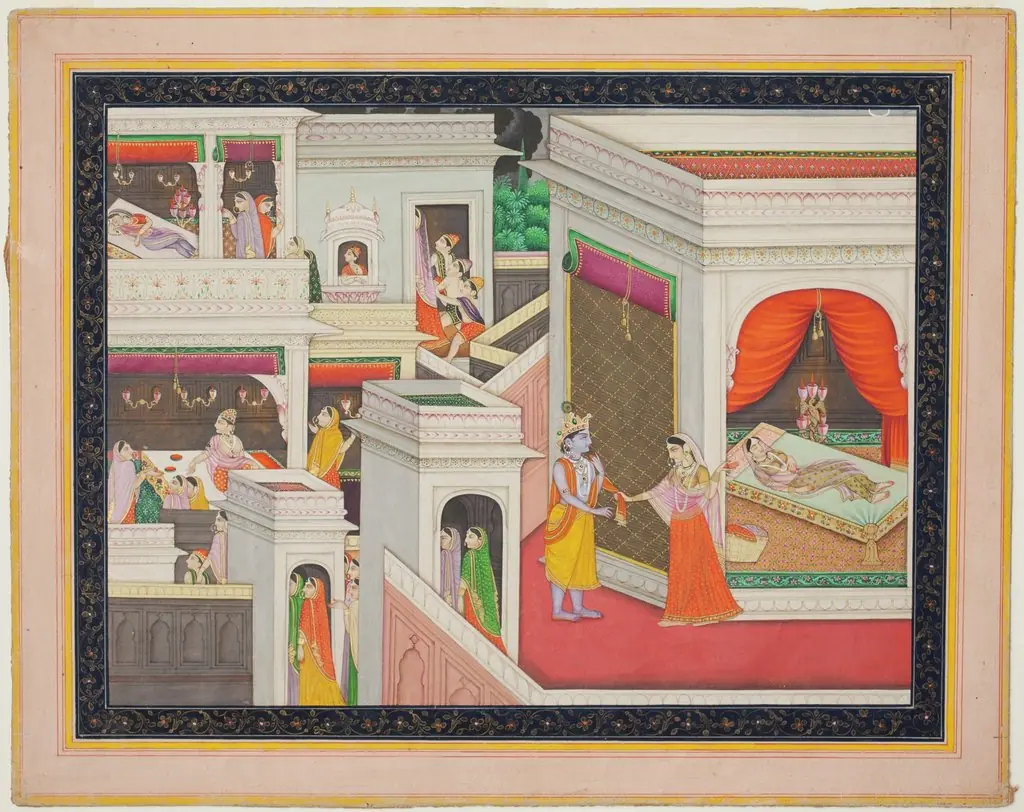 Palace Scene at Night
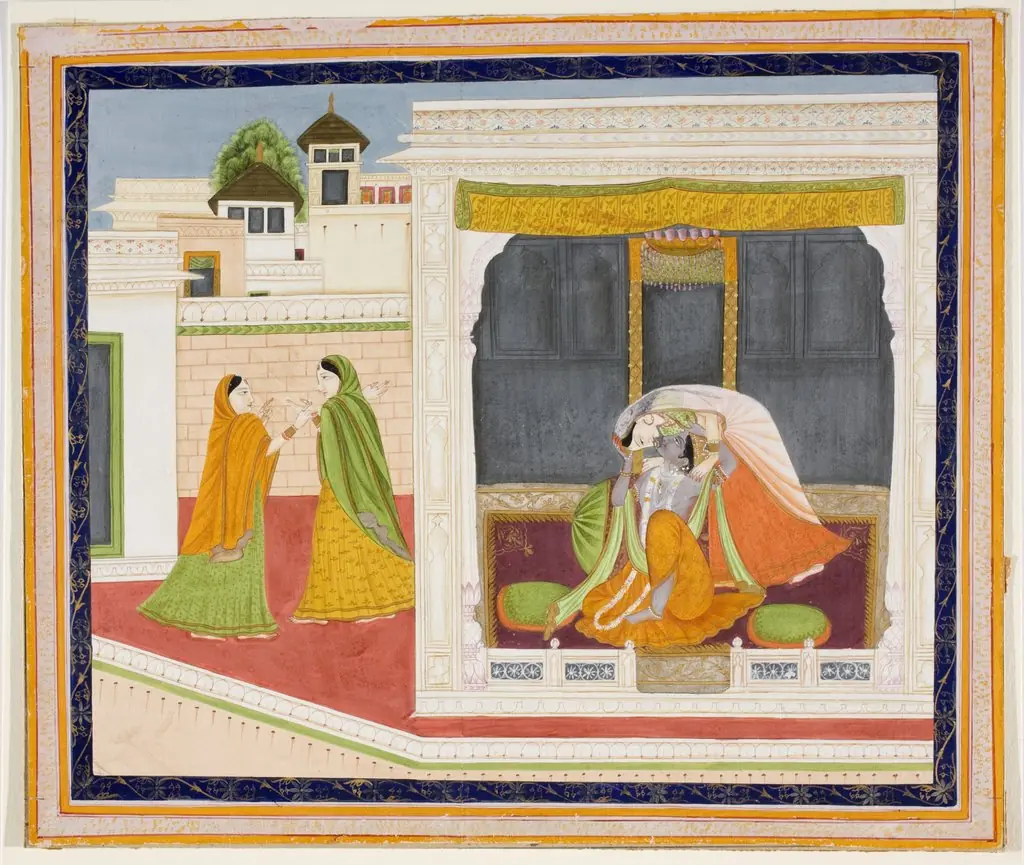 Radha and Krishna in Dalliance
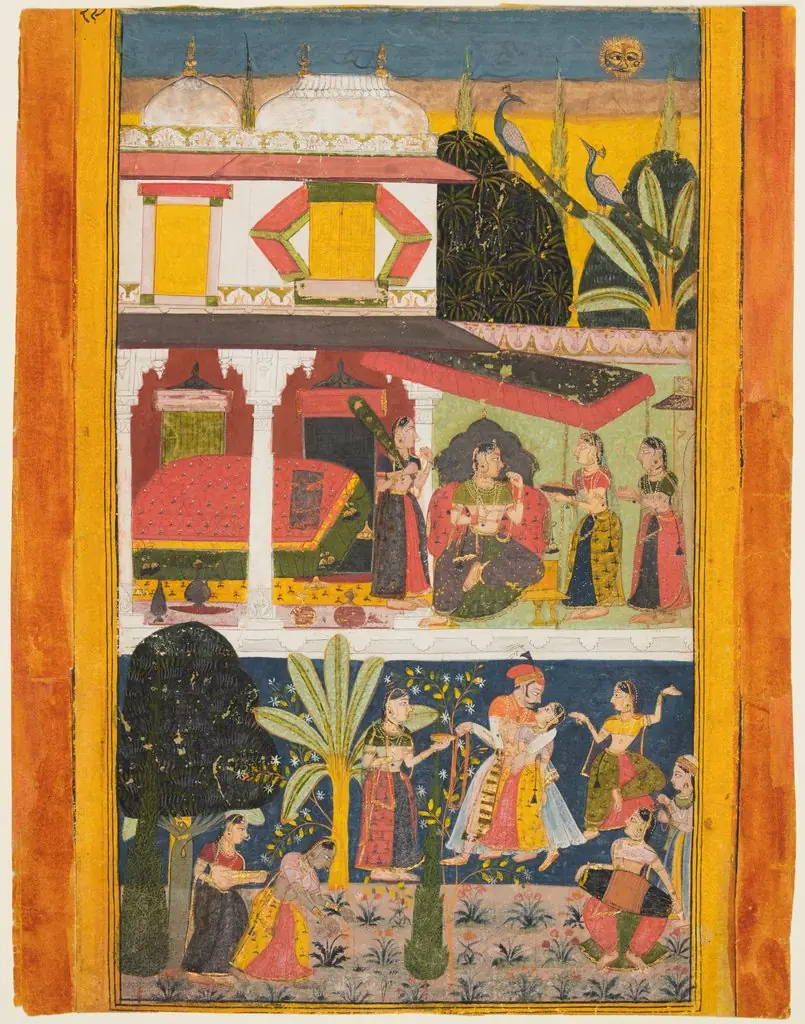 A Heroine and Her Paramour: Malavi Ragini, from a Ragamala
 Story of Krishna and Radha
 Story of Krishna and Radha
 Ala-ud-din
 Story of Krishna and Radha
 Maharaja Ajit Singh of Jodhpur
 Usha viewing the portrait of Aniruddha
 A Royal Woman in a Pavilion: Desavarari Ragini of Dipak, from a Ragamala
 Krishna kills his uncle, the tyrant ruler Kamsa
 The birth of Rama and his brothers, from Chapter 17 of the Bala Kanda (Book of Childhood) of the Adhyatma Ramayana (Rama's Journey of the Supreme Spirit) from the Brahmanda Purana (Ancient Scripture of the Cosmic Egg)