Artwork
Krishna kills his uncle, the tyrant ruler Kamsa
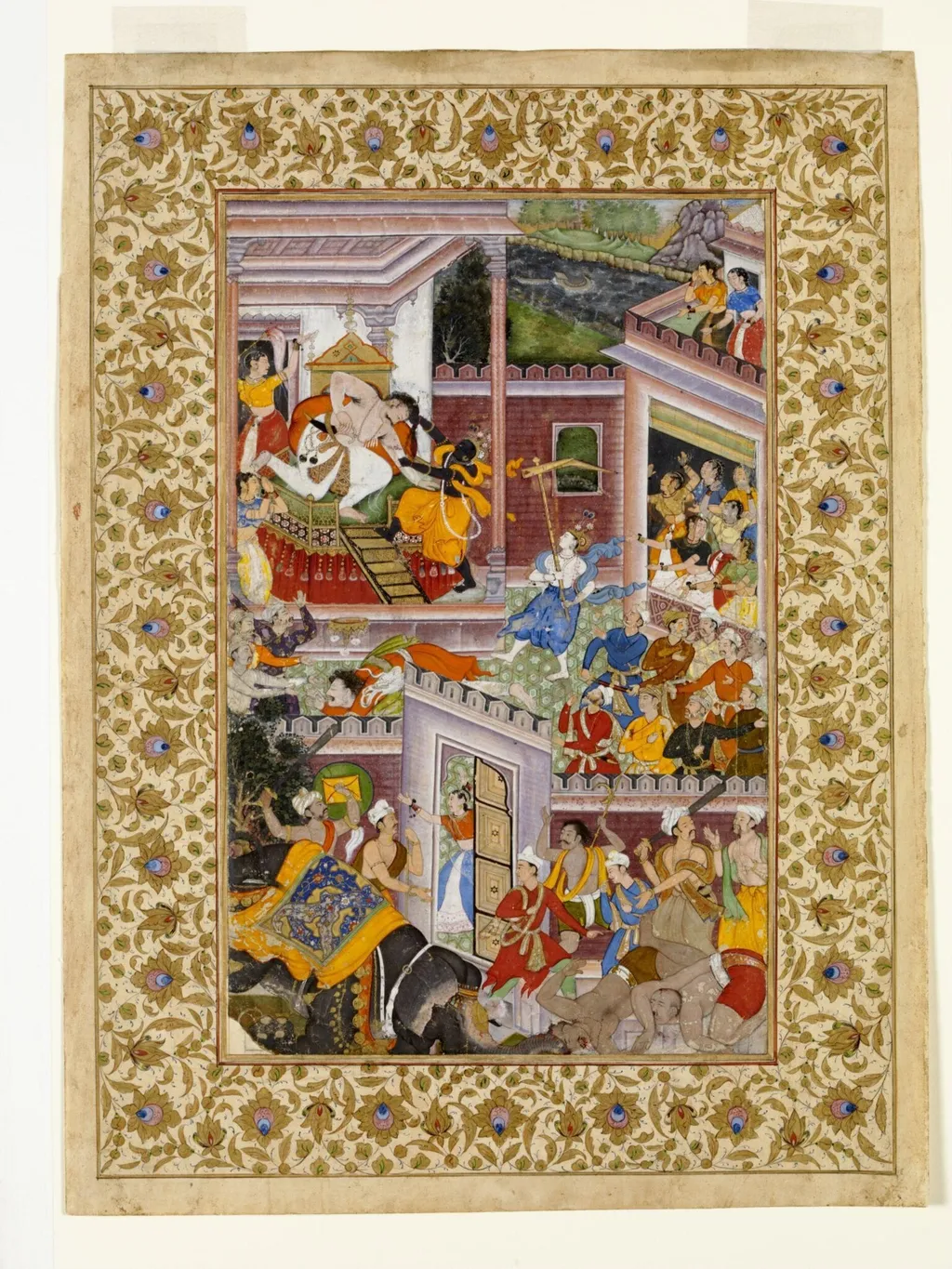
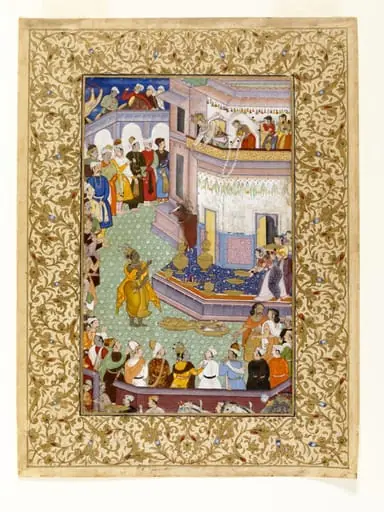
Krishna kills his uncle, the tyrant ruler Kamsa is a paint painting by the Mughal Painting artist Unknown. It dates from 1590 and is held in the collection of the Victoria and Albert Museum. This Mughal-era painting illustrates the climactic moment when the deity Krishna confronts his tyrannical uncle Kamsa.
About this work
You see Krishna, blue-skinned and strong, yanking his uncle Kamsa up by the hair.
You see Krishna, blue-skinned and strong, yanking his uncle Kamsa up by the hair. Kamsa sits on his throne, eyes wide in shock. The throne room is full of warriors—some flee, others watch in amazement.
This comes from a Persian translation of the Harivamsha, an old Hindu text. Akbar, the Mughal emperor, ordered the texts translated in 1590. The scene shows good winning over evil.
Watch for the way the artist uses bold colors to show action. Look for the Victoria and Albert Museum.
Overview
This Mughal-era painting illustrates the climactic moment when the deity Krishna confronts his tyrannical uncle Kamsa. The composition captures Krishna seizing Kamsa by the hair and pulling him from his throne, while surrounding courtiers react with shock or flight. The work reflects a narrative drawn from the Harivamsha, a Sanskrit text that was rendered into Persian for the imperial court in the late sixteenth century.
Subject & Meaning
The scene dramatizes the triumph of divine righteousness over oppressive rule, a core theme in Hindu mythology. Krishna, depicted with his characteristic blue complexion, embodies heroic virtue, while Kamsa’s startled expression underscores his downfall. The surrounding warriors’ varied responses—some fleeing, others watching—emphasize the sudden reversal of power and the moral order restored by the deity’s intervention.
Technique & Style
Executed in vivid pigments, the painting employs bold coloration to heighten the sense of movement and tension. Linear contours define the figures, while the dynamic pose of Krishna—muscular and forward‑leaning—contrasts with Kamsa’s rigid, seated form. The crowded throne room is rendered with a flattened perspective typical of Mughal court art, allowing the narrative action to dominate the visual field.
History & Provenance
The image originates from a Persian translation of the Harivamsha commissioned by Emperor Akbar around 1590, when the Mughal court sought to integrate Hindu literary heritage into its cultural program. The manuscript containing this illustration eventually entered the collection of the Victoria and Albert Museum, where it is catalogued as part of the empire’s illustrated literary corpus.
Context
Akbar’s patronage of Sanskrit-to-Persian translations was part of a broader policy of religious inclusivity and artistic synthesis. By presenting Hindu epics in the language of the court, the emperor fostered a shared cultural vocabulary among his diverse subjects. This painting thus serves both as a devotional image and as evidence of the syncretic artistic environment that flourished under Mughal rule.
Artist & collection

 Domestic Scene
 Giacomo and Cardinal Marco, investing Andrea, Abbot of San Zeno, with his Benefice
 The Nymph of Fontainebleau
 Portrait of a Woman
 Madonna and Child with Saints in the Enclosed Garden
 Venus and Minerva
 Family Group of Four on Sofa
 Wall painting from Room H of the Villa of P. Fannius Synistor at Boscoreale