Artwork
Kalpa Sutra
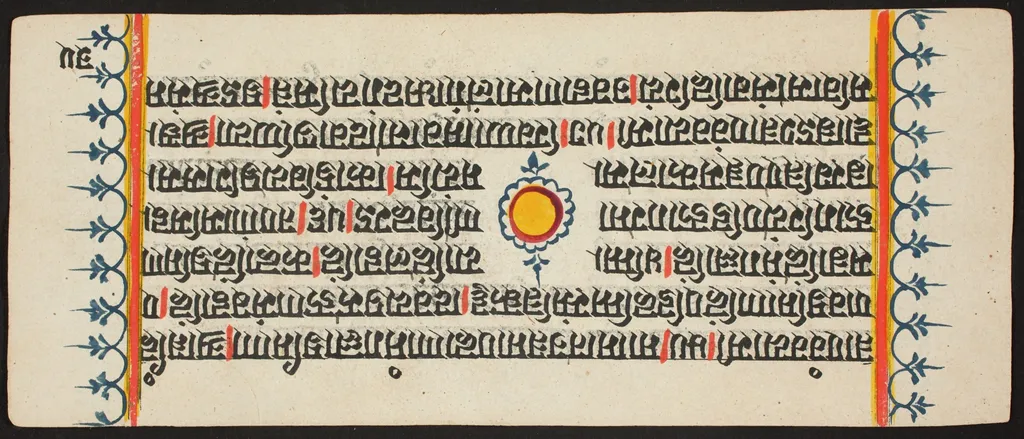
Kalpa Sutra is an unspecified painting by Unknown. It is held in the collection of the Detroit Institute of Arts.
About this work
Overview
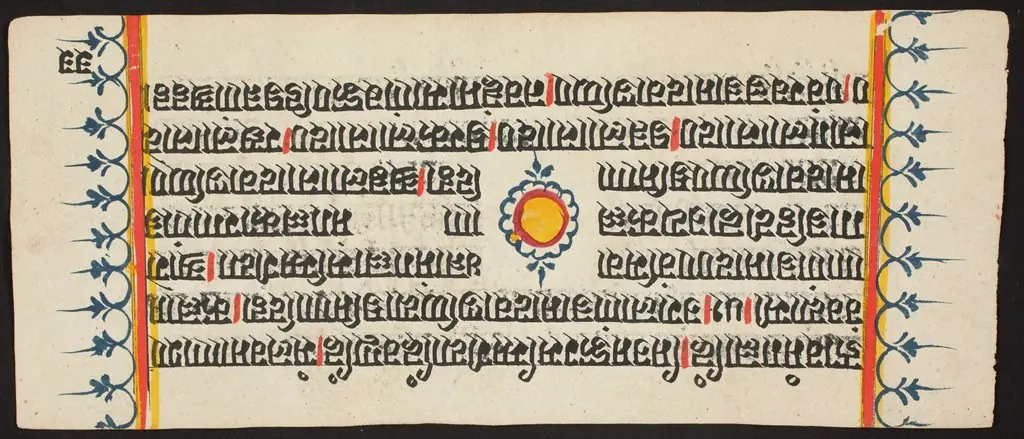
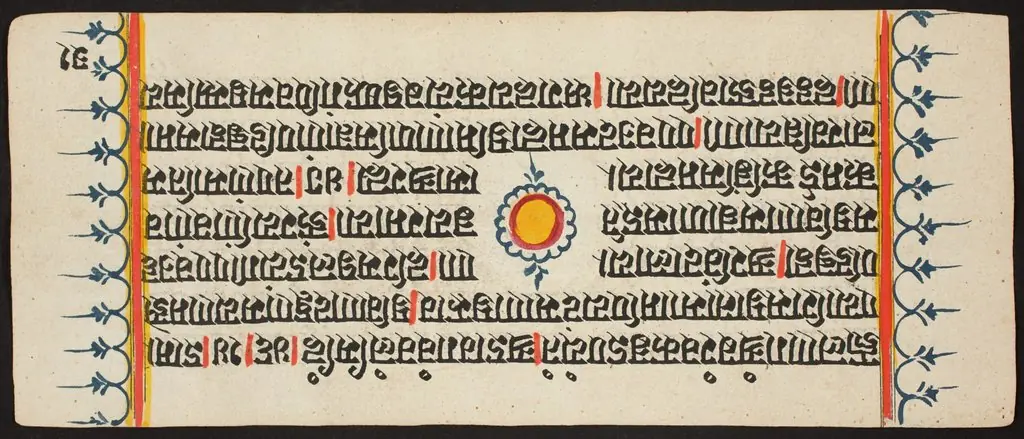
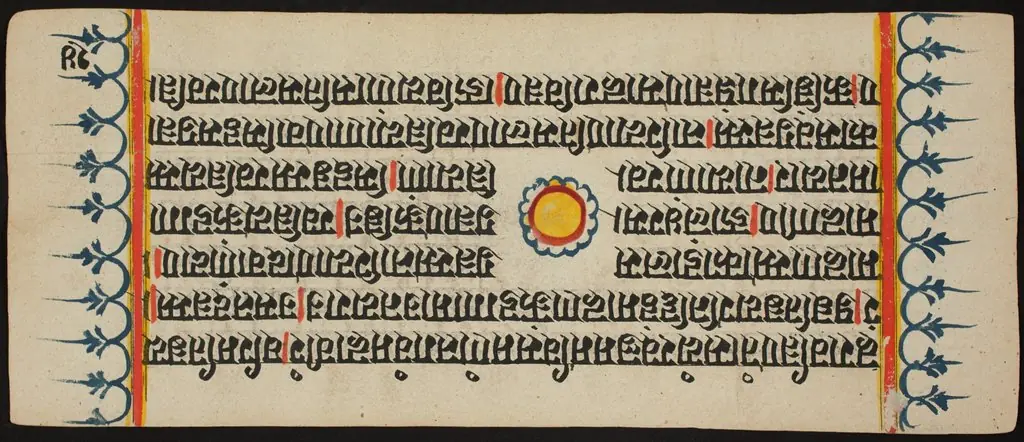
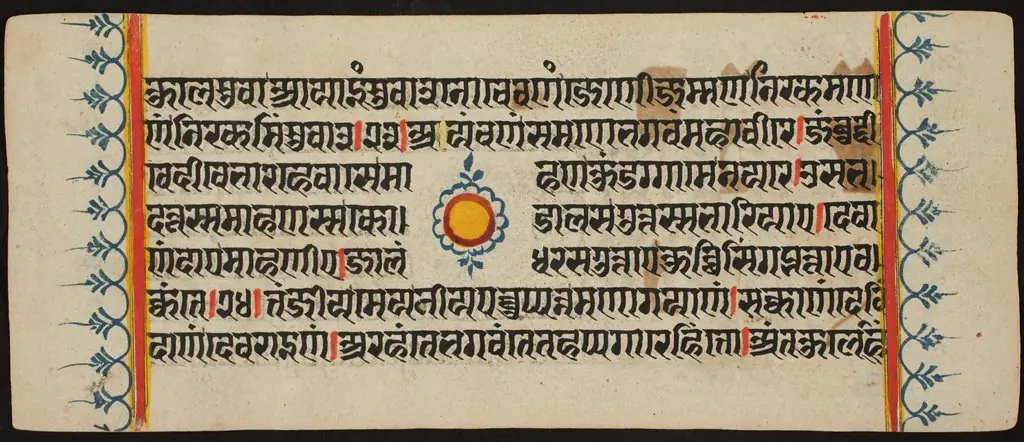
This painted manuscript page features dense black ink script accompanied by subtle red highlights, framed by ornate vegetal patterns on either side. A central yellow circle anchors the composition, suggesting symbolic or ritual significance. The work belongs to a tradition of devotional bookmaking, where textual and decorative elements are carefully integrated to support spiritual practice.
Subject & Meaning
Red accents draw attention to key passages, signaling their liturgical importance.
The script, though undeciphered here, likely contains sacred teachings from an Eastern religious tradition, possibly Jain or Buddhist, given the stylistic parallels. The recurring vines and leaves imply growth, continuity, or cosmic order, while the central yellow disc may represent enlightenment, the divine, or a sacred syllable. Red accents draw attention to key passages, signaling their liturgical importance.
Technique & Style
The text is rendered in fine, precise brushwork using black ink, with red pigment applied sparingly for emphasis. The border designs are meticulously painted, featuring interlaced vines and stylized foliage that echo manuscript traditions of South Asia. The yellow circle, likely made with mineral pigment, stands out against the parchment, creating a focal point without disrupting the text’s legibility.
History & Provenance
This page is part of a larger manuscript tradition dating to the medieval period in western India, likely produced in a monastic scriptorium. Similar Kalpa Sutra folios are held in institutional collections, including the Detroit Institute of Arts, where comparable Jain texts are preserved. Its survival suggests it was carefully stored and handled, indicating ongoing ritual or scholarly use.
Context
Manuscripts like this were created for liturgical recitation and meditation, not mass distribution. Scribes and artists worked under monastic supervision, adhering to strict conventions that balanced textual accuracy with symbolic decoration. The integration of flora and color followed doctrinal guidelines, ensuring each element reinforced the sacred nature of the content.
Legacy
Though the specific text remains untranslated, the aesthetic principles of this work influenced later Indian manuscript painting. Its preservation in museum collections allows ongoing study of scribal practices and devotional aesthetics. The style continues to inform contemporary reconstructions of pre-colonial religious art, serving as a reference for historical craft techniques.
Artist & collection

 Domestic Scene
 Giacomo and Cardinal Marco, investing Andrea, Abbot of San Zeno, with his Benefice
 The Nymph of Fontainebleau
 Portrait of a Woman
 Madonna and Child with Saints in the Enclosed Garden
 Venus and Minerva
 Family Group of Four on Sofa
 Wall painting from Room H of the Villa of P. Fannius Synistor at Boscoreale