Artwork
Prince in Pavilion; Princess with Attendants in Court

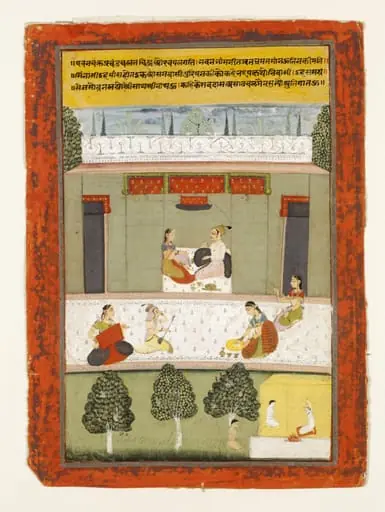
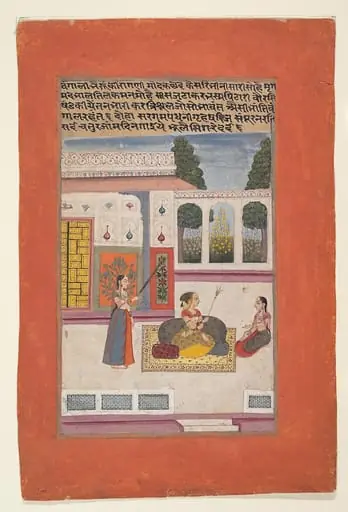
Prince in Pavilion; Princess with Attendants in Court is an unspecified painting by the Rococo painting artist Unknown. It dates from 1750 and is held in the collection of the Detroit Institute of Arts. This painting presents two distinct scenes within a single composition: a male figure in a pavilion and a group of women in a courtyard.
About this work
Overview
The composition reflects a tradition of courtly imagery, where private and public realms are visually juxtaposed to suggest social roles and hierarchy.
This painting presents two distinct scenes within a single composition: a male figure in a pavilion and a group of women in a courtyard. The scenes are separated spatially but unified by shared architectural elements and a decorative red border with inscriptions. The composition reflects a tradition of courtly imagery, where private and public realms are visually juxtaposed to suggest social roles and hierarchy.
Subject & Meaning
The central male figure, seated in a pavilion, likely represents a prince in a moment of quiet reflection or leisure. The three women in the courtyard, one seated and two standing with a fan, suggest attendants engaged in service or ritual. The spatial separation implies gendered spaces within court life, with the prince in a secluded, elevated setting and the women in a more open, functional area of the palace grounds.
Technique & Style
The painting employs flat, decorative planes of color with minimal shading, characteristic of regional courtly styles. Architectural elements are rendered with geometric clarity, and natural features like trees and grass are stylized rather than naturalistic. The use of saturated hues—yellow, red, blue, and pink—creates visual harmony, while the black inscriptions along the red border serve both decorative and textual functions.
History & Provenance
The painting’s origin is tied to a South Asian courtly tradition, likely from the 18th or early 19th century. Its inclusion in the collection of the Detroit Institute of Arts suggests it was acquired through early 20th-century collecting practices focused on Indian and Persianate miniatures. Its preservation with the original border indicates careful handling and recognition of its cultural integrity.
Context
This work aligns with miniature painting traditions from North Indian courts, where scenes of royal life were recorded with symbolic precision. The division between indoor and outdoor spaces, and the emphasis on attire and posture, reflect social norms of the time. Such paintings often served as records of courtly identity, commissioned by nobility to affirm status and ritual order.
Legacy
The painting contributes to the understanding of how gender, space, and hierarchy were visually encoded in South Asian court art. Its survival and display in a Western institution highlight cross-cultural preservation efforts. While not widely known, it remains a quiet example of how everyday courtly moments were elevated into enduring visual records.
Artist & collection

 Domestic Scene
 Giacomo and Cardinal Marco, investing Andrea, Abbot of San Zeno, with his Benefice
 The Nymph of Fontainebleau
 Portrait of a Woman
 Madonna and Child with Saints in the Enclosed Garden
 Venus and Minerva
 Family Group of Four on Sofa
 Wall painting from Room H of the Villa of P. Fannius Synistor at Boscoreale
 Untitled
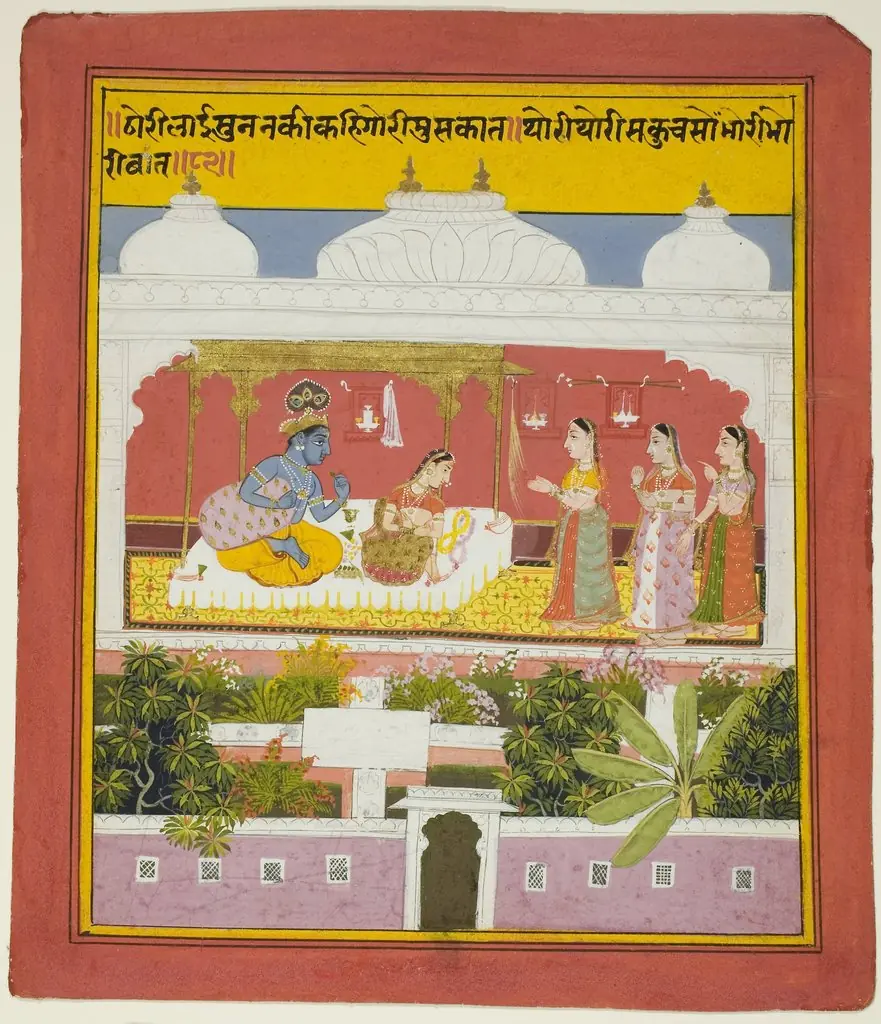 Krishna and Radha in a Pavilion, page from a copy of the Sat Sai Seven Hundred Verses)
 Untitled
 Shiva, Parvati and Nandi
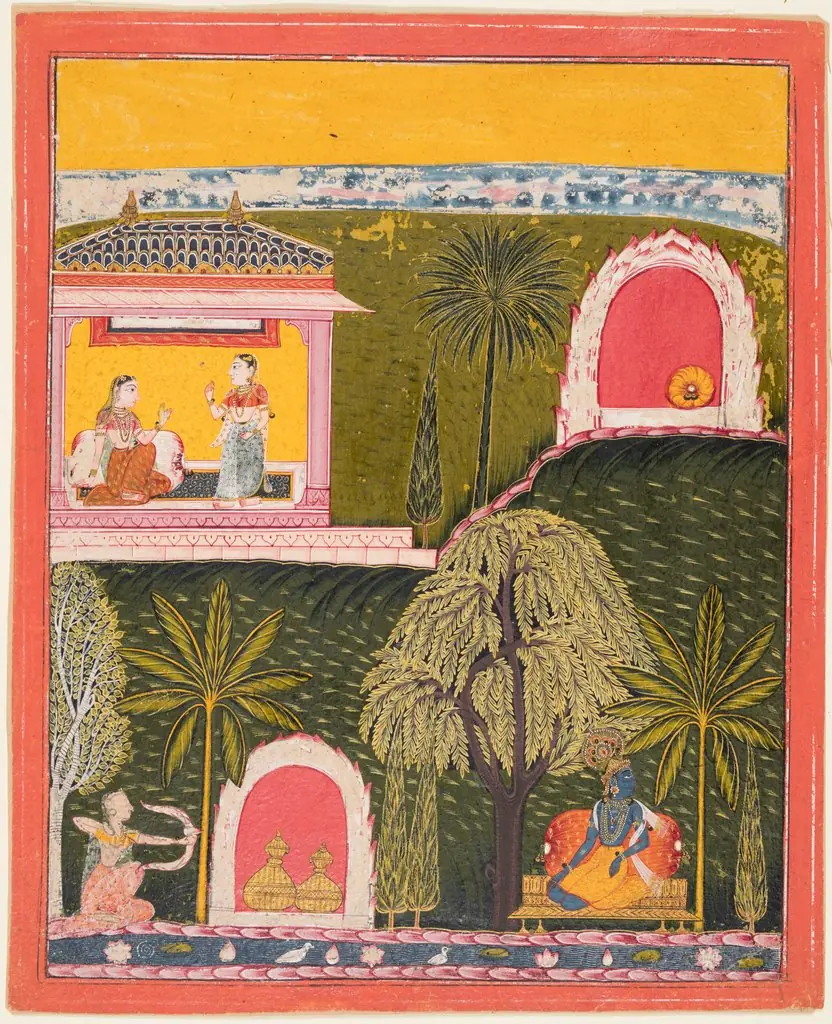 Rati, the Goddess of Erotic Love, Takes Aim at Krishna, from a Rasikapriya
 Krishna and Radha in a Pavilion, from a copy of the Seven Hundred Verses (Sat Sai) of Bihari
 Untitled
 Dhanasri Ragini
 Pancham Ragini
 Illustration to the Musical Mode Malasari Ragini