Artwork
Mila 23
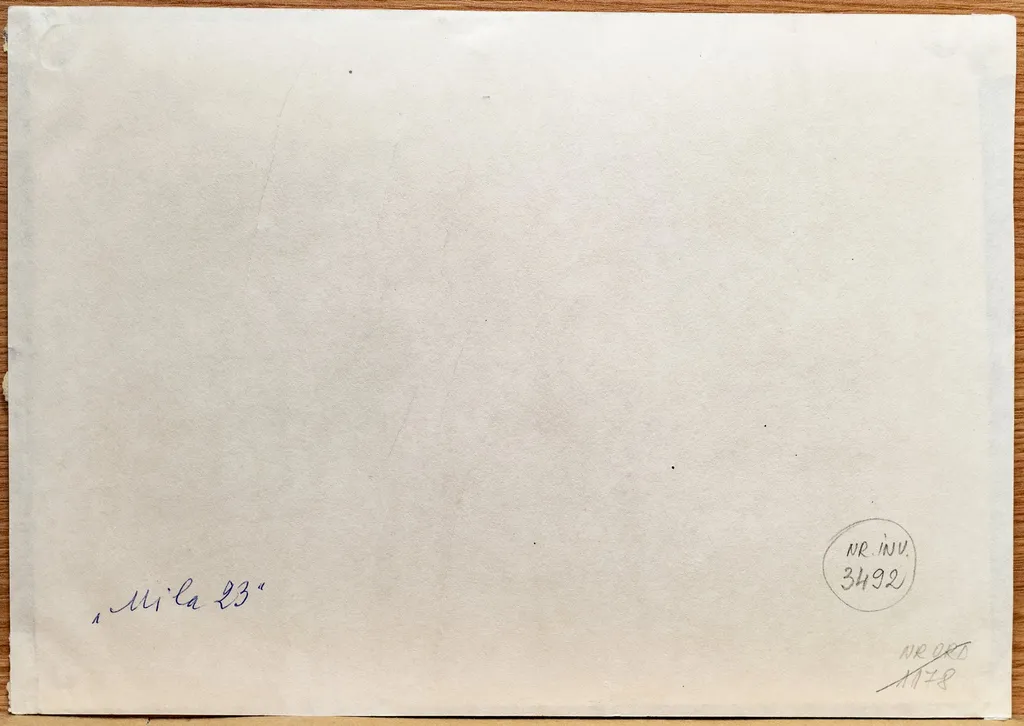
Mila 23 is a print by Eugenia Iftodi. It is held in the collection of the Gavrila Simion Eco-Museum Research Institute Tulcea. This artifact is a fragment of plain, aged paper, its surface unadorned except for minimal markings.
About this work
Overview
This artifact is a fragment of plain, aged paper, its surface unadorned except for minimal markings.
This artifact is a fragment of plain, aged paper, its surface unadorned except for minimal markings. The faint beige tone suggests natural fiber, possibly recycled or reused. Its irregular edges imply it was torn from a larger document. A small stamp bearing the number 3492 appears near the lower right, accompanied by handwritten annotations including 'Mila 23' and '178' in an informal, hurried hand.
Subject & Meaning
The notation 'Mila 23' likely references a specific location or code, possibly tied to a wartime context, while '178' may denote a date, sequence, or identifier. The handwritten script lacks formal structure, suggesting personal or administrative use rather than artistic intent. The absence of imagery or color reinforces its function as a utilitarian scrap, possibly from a record-keeping system under constrained conditions.
Technique & Style
The paper bears no applied pigments, brushwork, or design. Its visual character derives entirely from material age and incidental marks: the stamp’s ink is faded, the handwriting uneven, and the surface slightly worn. The lack of composition or deliberate arrangement reflects a non-artistic context, where form followed function, and preservation was secondary to immediate utility.
History & Provenance
The object’s origin is linked to Eugenia Iftodi, whose name appears in connection with wartime documentation in Eastern Europe. The annotations may relate to records from the Warsaw Ghetto or similar contexts, where paper was scarce and reused. Its survival as a fragment suggests it was discarded, saved accidentally, or later collected as evidence of daily life under duress.
Context
During the Holocaust, paper was often repurposed for clandestine record-keeping, personal notes, or bureaucratic logs. The presence of coded references like 'Mila 23' aligns with practices in ghettos and camps, where numbers and abbreviations conveyed hidden meanings. This scrap, though unremarkable in appearance, may have served as a quiet testament to endurance amid systemic erasure.
Legacy
As a surviving fragment of ephemeral documentation, it holds value not for aesthetic qualities but as material evidence of lived experience under extreme conditions. Its preservation underscores the importance of ordinary objects in reconstructing histories that official records sought to erase. It stands as a silent witness to the persistence of human record-keeping in the face of destruction.
Artist & collection
Artist
Eugenia Iftodi made prints and drawings of everyday life in mid-20th-century Romania.
Museum
Gavrila Simion Eco-Museum Research Institute Tulcea
Continue through works from the same source collection.
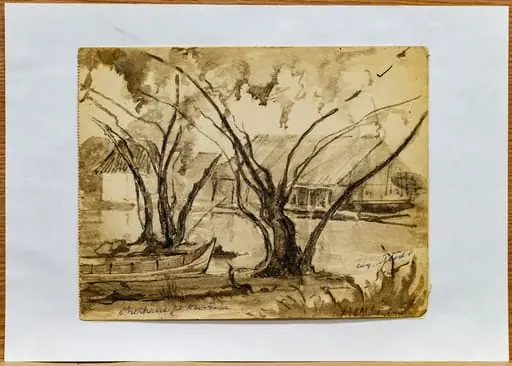
 S 35 - Peisaj la Sulina (Maluri de Dunăre la răsărit)
 Ma 1 - Peisaj la Măcin (Case, garduri și pomi)
 S 25 - Pe Dunăre la Sulina (Ponton și vapor pierdut în ceață pe Dunăre)
 Cabana Calica
 Măcin 1957
 S 18 - Peisaj la Sulina (Răsărit de soare pe Dunăre)
 Conversație - schiță
 S 37 - Natură statică - Vas cu flori la Sulina
 Bună dimineața
 S 33 - Peisaj la Sulina (Dunăre și faleză cu tufe de flori grena)
 S5 - Peisaj la Sulina (Stradă cu pomi și casă)
 Femeie cu umbrelă