Artwork
S 25 - Pe Dunăre la Sulina (Ponton și vapor pierdut în ceață pe Dunăre)
S 25 - Pe Dunăre la Sulina (Ponton și vapor pierdut în ceață pe Dunăre) is an unspecified painting by Medi Wechsler Dinu. It dates from 1958 and is held in the collection of the Gavrila Simion Eco-Museum Research Institute Tulcea. S 25 - Pe Dunăre la Sulina is a landscape painting by Romanian artist Dinu Medi Wechsler, created around 1958.
About this work
Overview
The work is part of the Museum of Ethnography’s collection and reflects Wechsler’s interest in atmospheric conditions and subtle natural forms.
S 25 - Pe Dunăre la Sulina is a landscape painting by Romanian artist Dinu Medi Wechsler, created around 1958. It captures a quiet, obscured view of the Danube River near Sulina, where mist blurs the boundaries between water, sky, and vessel. The work is part of the Museum of Ethnography’s collection and reflects Wechsler’s interest in atmospheric conditions and subtle natural forms. Her approach avoids dramatic detail, favoring mood over narrative.
Subject & Meaning
The painting presents a pontoon and a steamboat partially dissolved in fog, their forms barely discernible. Rather than depicting action or destination, Wechsler emphasizes absence and obscurity. The vessels, rendered as faint silhouettes, suggest isolation and impermanence. The scene conveys a sense of stillness, as if time has paused within the damp air, inviting contemplation rather than storytelling.
Technique & Style
Wechsler employed a restrained palette of soft grays and pale whites, blending tones to mimic the diffusion of light through mist. Brushwork is subdued, with edges softened to dissolve form rather than define it. The surface shows signs of aging—brown discolorations and worn margins—adding to the painting’s sense of temporal decay. Her technique prioritizes atmosphere over precision, aligning with a lyrical realism rooted in observation.
History & Provenance
Dinu Medi Wechsler, born in 1909 and active until her death in 2016, produced this work during a period of relative artistic restraint in Romania. The painting entered the Museum of Ethnography’s holdings after its completion, likely through institutional acquisition. Its preservation reflects its status as a quiet but significant example of mid-20th-century Romanian landscape painting, though it has received limited public attention.
Context
Created during the late 1950s, the painting emerged under a cultural climate that favored socialist realism, yet Wechsler’s focus on ambiguity and subtlety diverged from official norms. Her work, often centered on rivers and rural scenes, offered a personal counterpoint to state-sanctioned themes. Sulina, a remote port at the Danube Delta, provided a fitting subject—remote, overlooked, and resistant to grand narratives.
Legacy
Wechsler’s S 25 remains a quiet testament to her distinctive vision, one that valued introspection over spectacle. Though not widely exhibited, the painting contributes to a broader understanding of Romanian modernism that embraced silence and restraint. Her ability to convey emotional depth through minimal means continues to inform later generations of artists interested in the poetic potential of the everyday landscape.
Artist & collection
Artist
Margareta "Medi" Dinu, née Wechsler (January 4, 1909 – July 18, 2016) was a Romanian classical painter of Jewish origin.
Museum
Gavrila Simion Eco-Museum Research Institute Tulcea
Continue through works from the same source collection.
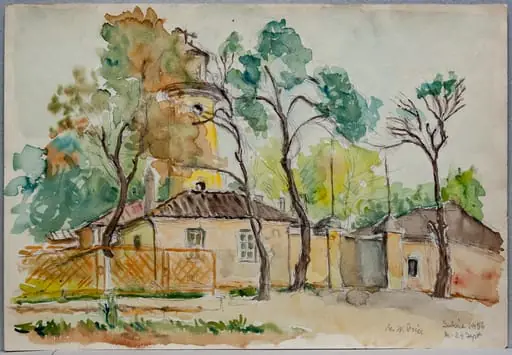 S 38 - Peisaj la Sulina (Stradă cu case și pomi)
 S6 - Peisaj la Sulina (Malul Dunării și case)
 S 28 - Peisaj la Sulina (Intrare de casă cu flori)
 S 9 - Peisaj la Sulina
 S 12 - Peisaj la Sulina (Stradă și 2 case)
 S4 - Peisaj la Sulina (Ochi de apă cu bărci și case)
 S 19 - Peisaj la Sulina (Casă și copaci)
 S 27 - Peisaj la Sulina (Dunăre, vapor în prim plan, case în planul doi)
 S 29 - Peisaj la Sulina (Vas pe Dunăre)
 S 35 - Peisaj la Sulina (Maluri de Dunăre la răsărit)
 S 37 - Natură statică - Vas cu flori la Sulina
 S 32 - Peisaj la Sulina (Dunăre și maluri pierdute în pete de culoare)
 S 18 - Peisaj la Sulina (Răsărit de soare pe Dunăre)
 S 33 - Peisaj la Sulina (Dunăre și faleză cu tufe de flori grena)
 S 21 - Pervaz cu flori la Sulina
 S5 - Peisaj la Sulina (Stradă cu pomi și casă)
 S 20 - Natură statică la Sulina (Fructe pe un platou și dovleac)
 S8 - Peisaj la Sulina (Casă, gard și copac)