Artwork
The Sacrifice of Abraham
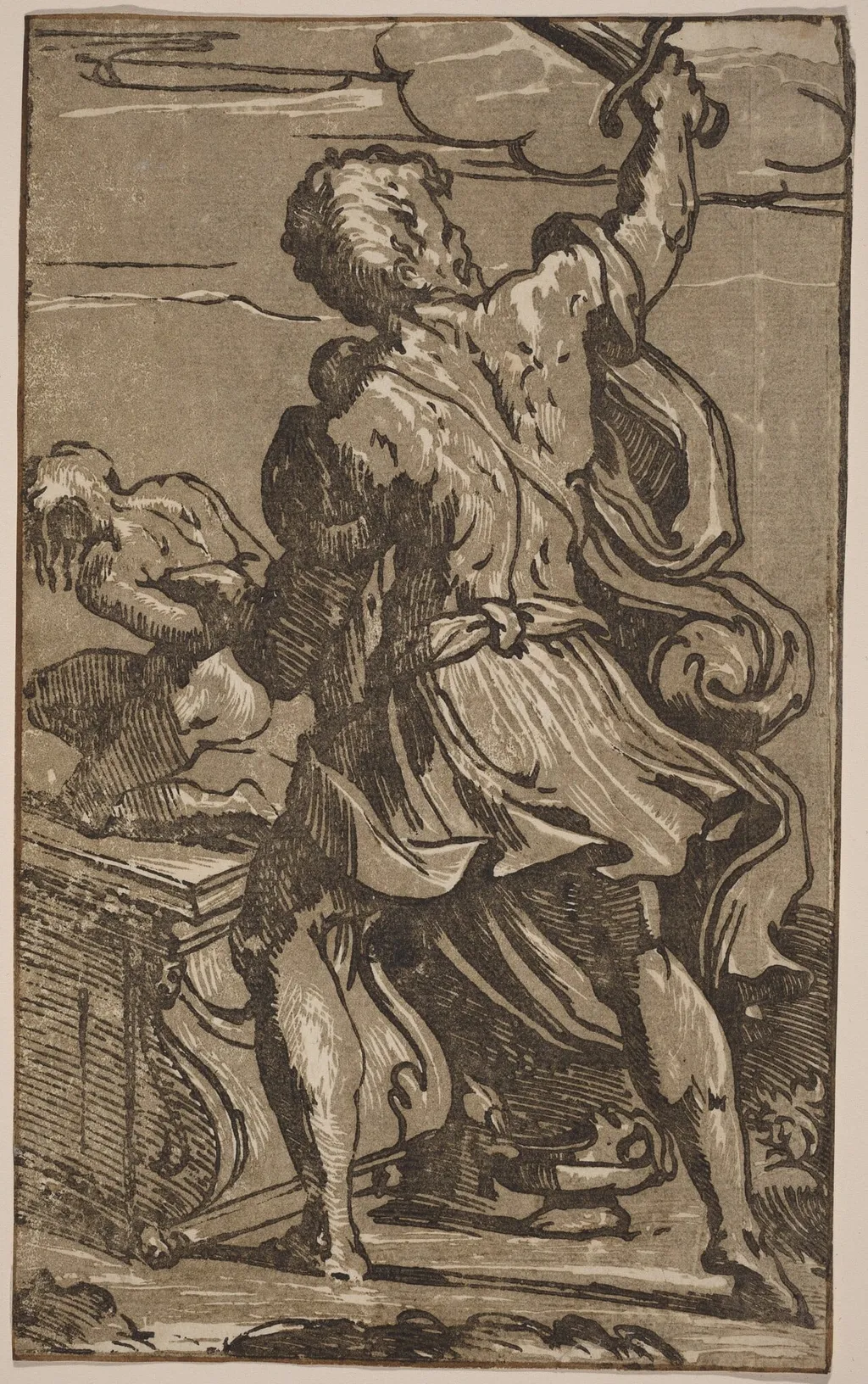
The Sacrifice of Abraham is an ink print by the Renaissance artist Italian 16th Century. It dates from 1550 and is held in the collection of the National Gallery of Art.
About this work
Overview
The work titled *The Sacrifice of Abraham* is a chiaroscuro woodcut executed in black and gray on laid paper. It presents a high‑drama biblical episode, rendered with stark contrasts that emphasize the tension between the figures. The composition centers on a robed man poised to strike a bound youth on an altar, while a ram watches nearby under a turbulent sky.
Subject & Meaning
The image illustrates the moment from Genesis when Abraham prepares to offer his son Isaac as a test of faith, a narrative often interpreted as a study of obedience and divine intervention. The presence of the ram, traditionally the substitute sacrifice, underscores the theme of mercy replacing intended violence, while the dramatic gestures convey the emotional intensity of the trial.
Technique & Style
Created as a chiaroscuro woodcut, the print employs multiple blocks—one for the line work and another for tonal areas—to achieve deep shadows and luminous highlights. The use of laid paper enhances the texture, and the stark black‑gray palette heightens the three‑dimensional effect, a method popular among Renaissance printmakers seeking painterly depth without pigment.
History & Provenance
The piece is catalogued as a print rather than a unique painting, indicating it was likely produced for broader distribution. While specific details of its origin, date, or ownership are not provided, the chiaroscuro technique situates it within the early modern period when such woodcuts were disseminated across European artistic circles.
Artist & collection

Artist
A 16th-century Italian sculptor left us small bronze works in dark brown and gold.