Artwork
Campagna di Roma (Roman Countryside) (recto)
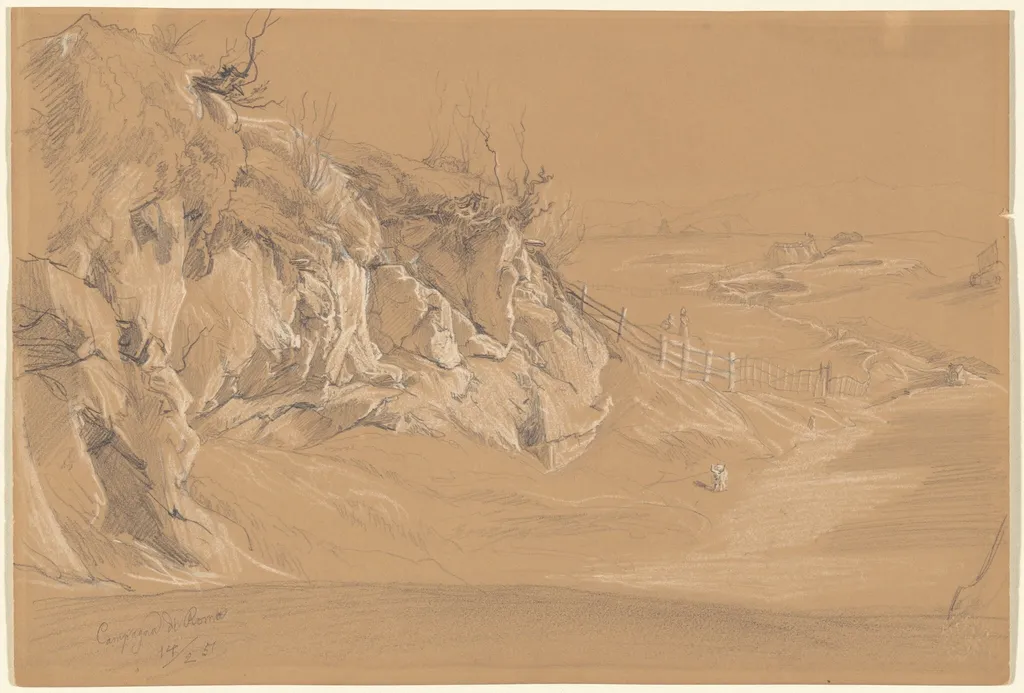
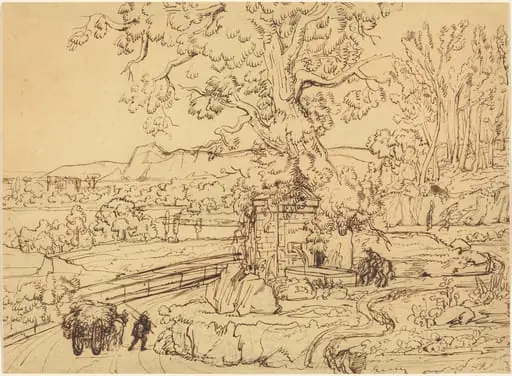
Campagna di Roma (Roman Countryside) (recto) is a graphite drawing by the Impressionist artist Julius Jacob the Elder. It dates from 1851 and is held in the collection of the National Gallery of Art. Created in 1851, this graphite drawing on brown paper captures a stretch of rural terrain near Rome.
About this work
Overview
The artist’s hand is evident in the unpolished, energetic lines that suggest movement and immediacy rather than polished finish.
Created in 1851, this graphite drawing on brown paper captures a stretch of rural terrain near Rome. Executed with minimal refinement, the work bears the marks of rapid, on-site observation. White chalk highlights accentuate sunlit rock surfaces, contrasting against the warm tone of the paper. The artist’s hand is evident in the unpolished, energetic lines that suggest movement and immediacy rather than polished finish.
Subject & Meaning
The scene depicts the rugged, undeveloped landscape of the Roman countryside—bare hills, scattered vegetation, and exposed stone. There is no human presence or architectural element, emphasizing the land’s natural state. The title, inscribed at the bottom, anchors the work as a direct record of place, reflecting an interest in the unadorned topography of Italy’s rural periphery.
Technique & Style
The artist employed rough, directional strokes to model form, avoiding smooth gradients or blending. White heightening was applied selectively to suggest bright sunlight striking rocky outcrops, enhancing contrast without softening edges. The use of brown paper as a mid-tone ground reduced the need for extensive shading, allowing the drawing to retain a sense of spontaneity and directness.
History & Provenance
Attributed to Jacob the Elder, Julius, the drawing dates from a period when artists increasingly turned to outdoor sketching as a means of studying nature. Its survival suggests it was retained as a study rather than a finished piece. No documented exhibition or ownership history is known prior to its current acquisition, indicating a private or academic origin.
Context
This work aligns with mid-19th century shifts in European art toward direct observation and the rejection of idealized landscapes. While not part of a formal movement, its approach resonates with emerging Realist tendencies—valuing the ordinary and unembellished over romanticized scenery. Similar sketches by contemporaries reflect a broader trend of artists engaging with terrain as a subject in its own right.
Legacy
Though not widely exhibited, the drawing contributes to a body of work that documents how 19th-century artists approached landscape as a subject of empirical study. Its raw execution offers insight into the preparatory practices of artists who sought to ground their later compositions in firsthand experience of the natural world.
Artist & collection


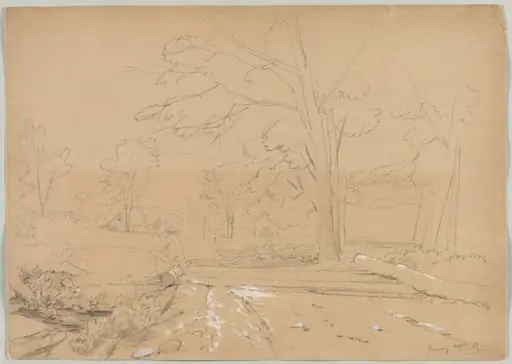 Landscape with Man Fishing, Conway, New Hampshire
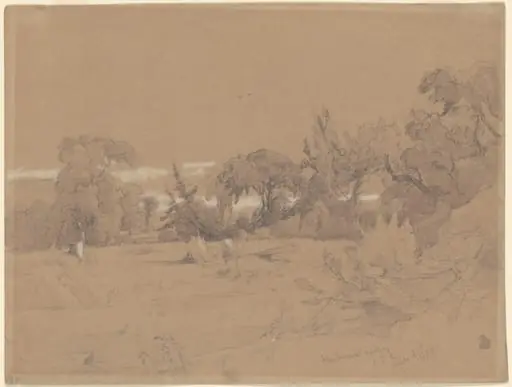 Sherberne Valley
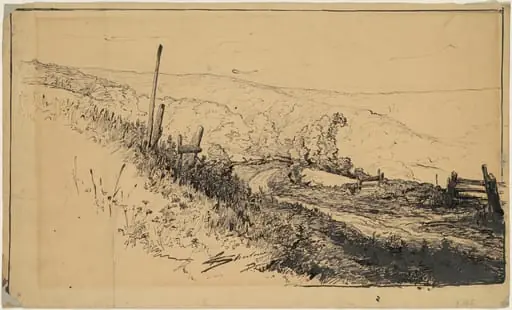 A Road in the Hills Near Dordrecht
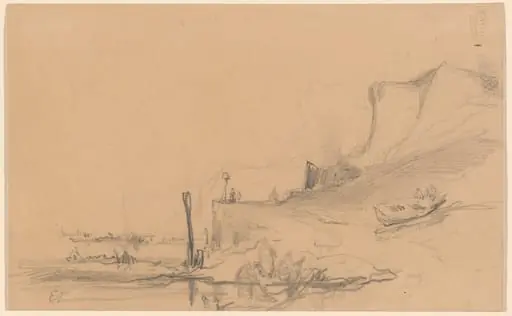 A Coast Road with Cliffs in the North of France
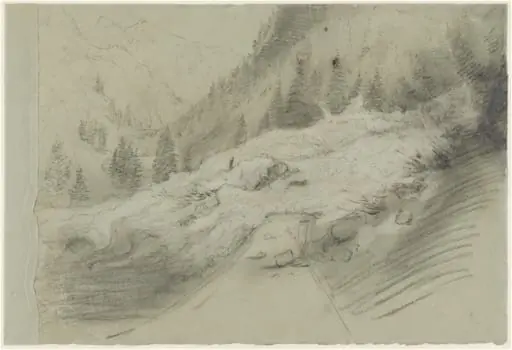 Avalanche in an Alpine Landscape
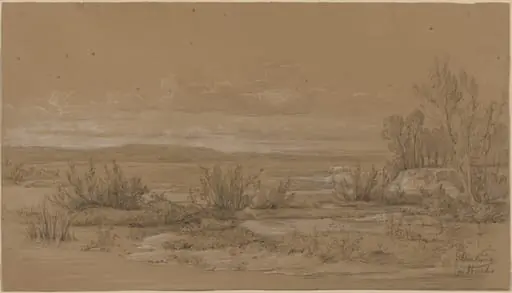 Landscape near Vourlis
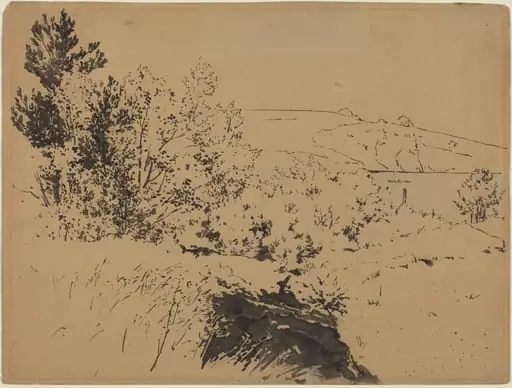 Coastal Landscape
 Encombe Woods (No.1)
 Stream through an Ancient Forest
 Panorama on a Mountain Lake
 A Path through Fields near Leipzig
 The Roman Campagna with an Ancient Fountain