Artwork
L'air (Air)
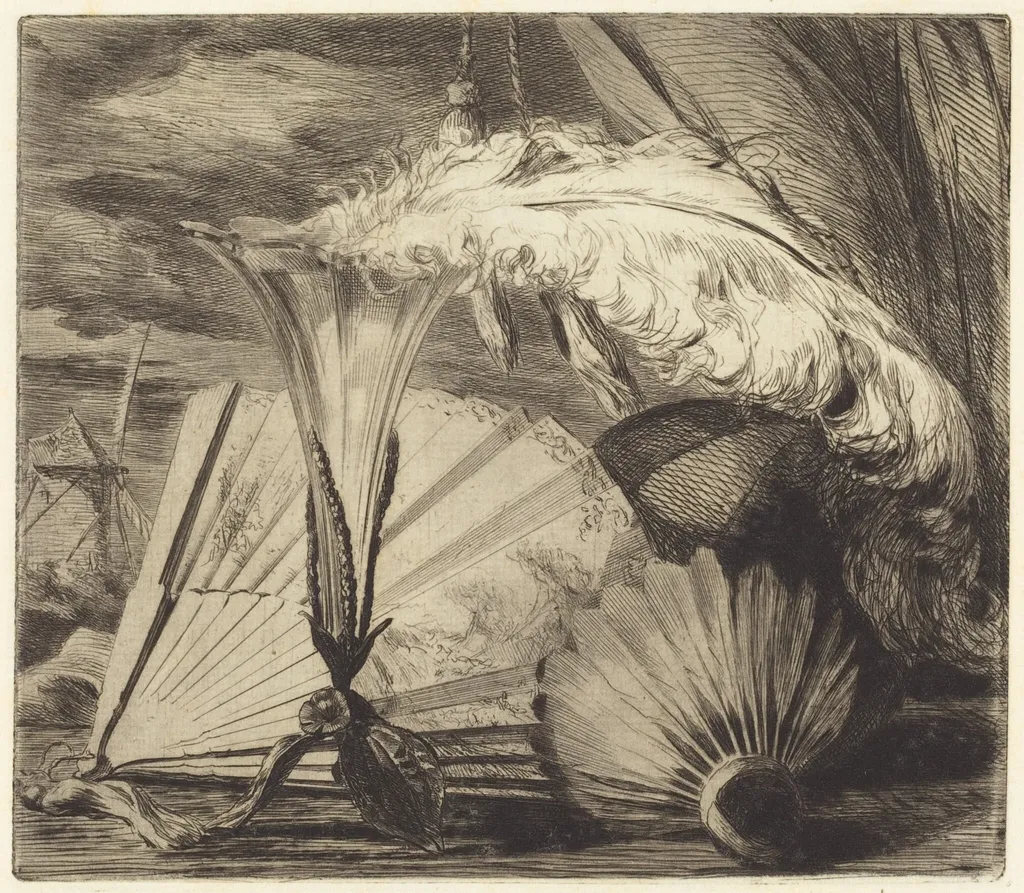
L'air (Air) is an ink print by the Impressionist artist Jules-Ferdinand Jacquemart. It dates from 1863 and is held in the collection of the National Gallery of Art.
About this work
Overview
The composition centers on a feather, a fan, and a slender plant, arranged against a muted, shadowed background that hints at atmospheric movement.
L'air (Air), created in 1863 by Jules-Ferdinand Jacquemart, is an etching and drypoint on cream laid paper. It belongs to a series exploring elemental forces through symbolic objects. The composition centers on a feather, a fan, and a slender plant, arranged against a muted, shadowed background that hints at atmospheric movement. The work exemplifies Jacquemart’s interest in translating natural forms into refined graphic language.
Subject & Meaning
The image functions as an allegory for the element of air. The feather suggests lightness and motion, the fan implies human interaction with breeze, and the pliant plant stem evokes wind’s subtle influence. Together, these objects convey air’s invisible presence through tangible, delicate forms. No figures appear; the abstraction is rendered entirely through still-life elements, inviting contemplation of nature’s unseen forces.
Technique & Style
Jacquemart employed etching and drypoint to achieve varied textures: fine lines define the feather’s softness, while drypoint’s burr adds richness to the plant’s rough foliage. The fan’s smooth surface contrasts with the granular background, created through controlled ink retention. The dark ground enhances the luminosity of the objects, drawing focus to their tactile qualities and reinforcing the ethereal theme through tonal subtlety.
History & Provenance
Created in 1863, the print entered the collection of the National Gallery of Art in Washington, D.C., where it remains today. Jacquemart, known for his detailed naturalist prints, produced this work during a period of renewed interest in printmaking as an independent art form. While not widely exhibited in his lifetime, the piece reflects his technical precision and alignment with contemporary European print traditions.
Context
In mid-19th-century France, artists increasingly turned to printmaking to explore poetic and symbolic themes beyond commercial illustration. Jacquemart’s L'air aligns with this trend, echoing the Symbolist impulse to represent intangible concepts through natural motifs. His work shares affinities with contemporaries who used etching to evoke mood rather than narrative, emphasizing atmosphere over storytelling.
Legacy
L'air stands as a quiet example of Jacquemart’s contribution to the revival of etching as a medium for introspective art. Though not widely reproduced or celebrated in his era, the print continues to be studied for its nuanced handling of texture and its restrained allegorical language. It remains a reference point for understanding how 19th-century printmakers translated natural philosophy into visual form.
Own this work as a print
Artist & collection


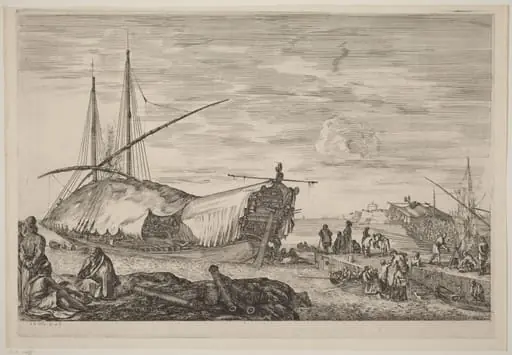 Galley with Deck Covered with Sails
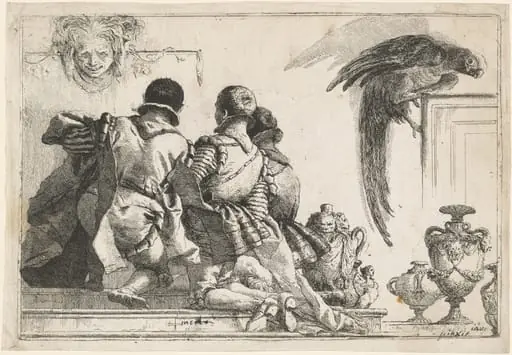 Kneeling Pages, a Mask, and a Parrot
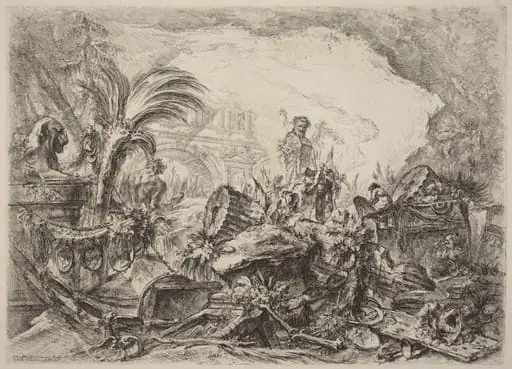 The Triumphal Arch
 Disparate claro (Clear Folly)
 A Bonfire and Moonlight
 The Holy Family Being Ferried Across the River
 The Madonna, Child, and Angels Entering the Boat
 Soldier in Armor and a Cannon
 The Phantom Ship, or On the Waves
 Flight into Egypt: Dedication with Winged Figure of Fame bearing the Arms of the Prince-Bishop of Wurzburg
 Swift Sailing Proa, Mulgrave Archipelago, Oceania
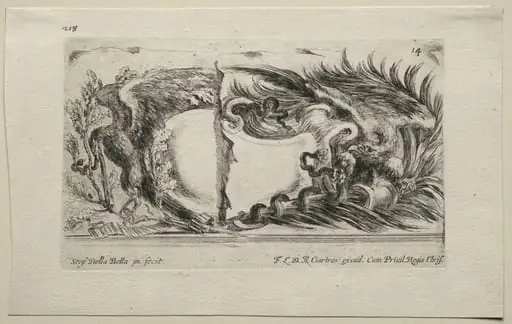 Collection of Various Caprices and New Designs of Cartouches and Ornaments: No 14