Artwork
Arch of Constantine, Rome
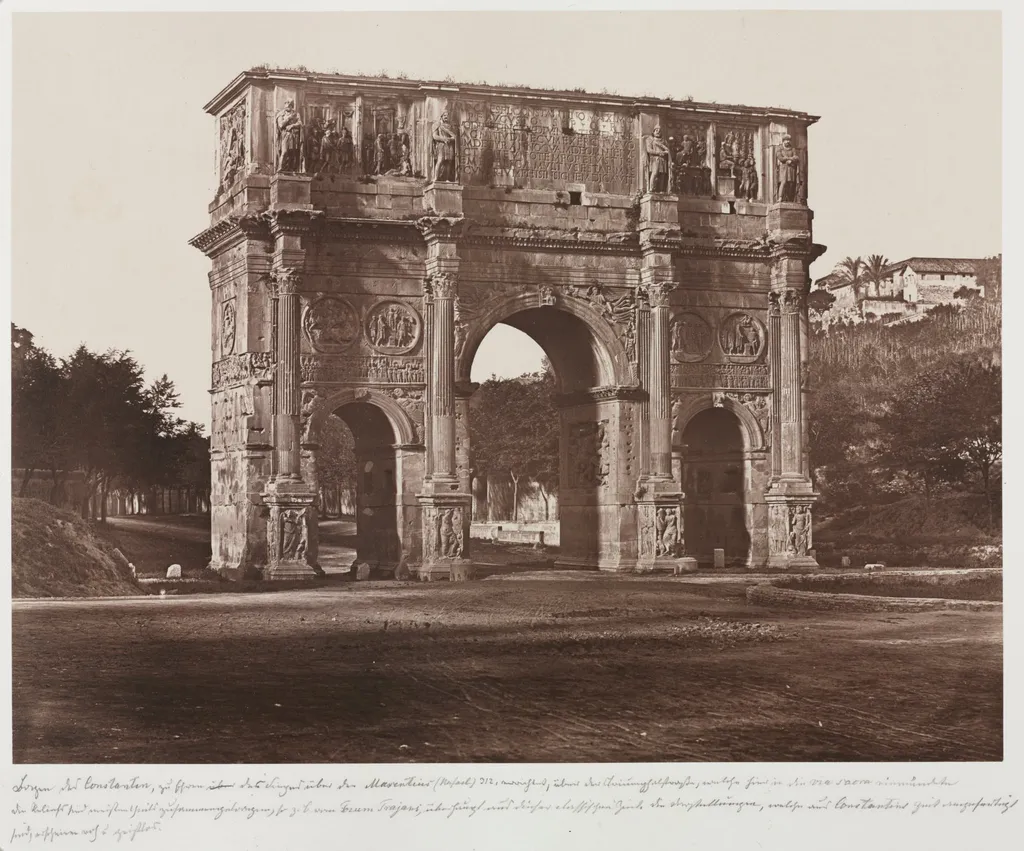
Arch of Constantine, Rome is a photography by the Impressionist artist James Anderson. It dates from 1858 and is held in the collection of the Cleveland Museum of Art.
About this work
Overview
The image presents the monument in its weathered state, framed by trees and a winding path, with distant structures hinting at the urban landscape.
A black-and-white photograph taken around 1858 by James Anderson captures the Arch of Constantine in Rome. The image presents the monument in its weathered state, framed by trees and a winding path, with distant structures hinting at the urban landscape. The photograph emphasizes the arch’s scale and age, rendering its stone surface and intricate carvings in tonal contrast, preserving its presence as a relic of antiquity.
Subject & Meaning
The arch commemorates Emperor Constantine’s victory at the Battle of Milvian Bridge in 312 CE. Its sculpted panels depict military processions, imperial ceremonies, and mythological figures, many repurposed from earlier monuments. The inscriptions in Latin honor Constantine’s rule and frame his triumph as divinely sanctioned, blending propaganda with the visual language of earlier Roman emperors to legitimize his authority.
Technique & Style
Anderson’s photograph employs the wet-plate collodion process, typical of mid-19th-century photography. The monochrome tones accentuate the texture of weathered stone and the depth of carved reliefs. Compositionally, the arch is centered, with natural elements framing the structure to suggest both its endurance and its integration into the surrounding environment, reflecting a documentary approach to ancient ruins.
History & Provenance
The photograph was made during a period of increased European interest in Roman antiquities. James Anderson, a British photographer active in Italy, documented architectural sites for scholarly and aesthetic audiences. The image entered the collection of The Cleveland Museum of Art, where it serves as a historical record of the arch’s condition in the mid-1800s, prior to modern restoration efforts.
Context
In the 1850s, photography emerged as a tool for preserving and studying ancient monuments. Anderson’s work aligned with broader efforts by travelers and scholars to catalog Rome’s ruins, often driven by archaeological curiosity and Romantic ideals of decay. The Arch of Constantine, standing near the Colosseum, was a frequent subject, symbolizing the layered history of imperial Rome and its enduring physical presence.
Legacy
Anderson’s photograph contributes to the visual archive of Roman architecture, offering a pre-industrial snapshot of the arch before widespread tourism and conservation altered its surroundings. It remains a reference for historians studying 19th-century photographic practices and the evolving perception of ancient monuments as cultural artifacts rather than mere ruins.
Artist & collection