Artwork
Arch of Constantine, Rome
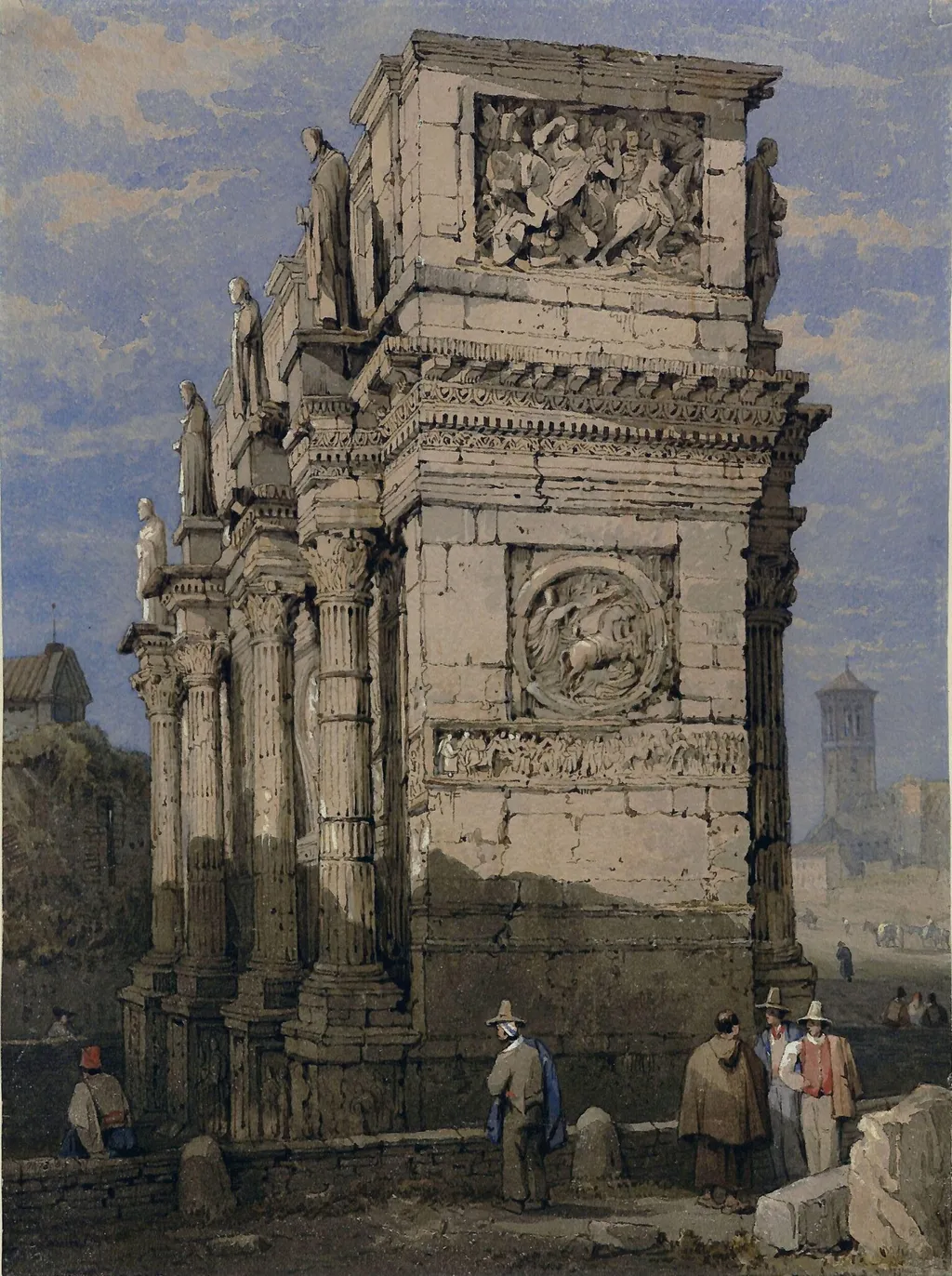
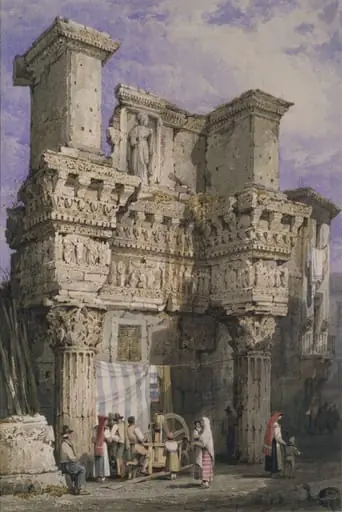
Arch of Constantine, Rome is a watercolor work on paper by the Romanticist artist Samuel Prout. It dates from 1800 and is held in the collection of the Victoria and Albert Museum. The work is a watercolour rendering of Rome’s Arch of Constantine, executed in the early nineteenth century.
About this work
Overview
The composition emphasizes the contrast between the ancient structure and the surrounding landscape, inviting contemplation of the passage of time.
The work is a watercolour rendering of Rome’s Arch of Constantine, executed in the early nineteenth century. It presents the monument in a state of partial ruin, with weathered stone, fragmented reliefs and a few contemporary figures gathered at its base. The composition emphasizes the contrast between the ancient structure and the surrounding landscape, inviting contemplation of the passage of time.
Subject & Meaning
The image focuses on the arch’s broken masonry, highlighting its decorative program: a battle scene in the upper register, a circular portrait with a laurel wreath in the middle, and statues perched on the corners. The presence of pedestrians in period costume suggests a dialogue between past and present, underscoring the Romantic fascination with historic decay as a symbol of cultural memory.
Technique & Style
Rendered in transparent watercolour, the artist captures the stone’s texture through delicate washes and precise line work. Light is employed to delineate the reliefs, making the carvings appear to emerge from the weathered surface. The handling reflects the approach of Samuel Prout, noted for his atmospheric treatment of architectural subjects and his ability to convey materiality through subtle tonal variation.
History & Provenance
Created in the early 1800s, the piece belongs to a period when European artists frequently depicted classical ruins as subjects for study and aesthetic exploration. While the specific creator is not recorded, the work aligns with the output of artists influenced by Prout’s architectural watercolours, and it has circulated among collections that emphasize Romantic-era depictions of antiquity.
Context
During the Romantic movement, ruins served as visual metaphors for the sublime and the transience of human achievement. This watercolour participates in that tradition, using the Arch of Constantine—a monument celebrating a 4th‑century triumph—to explore themes of impermanence and the layered history of Rome’s urban fabric.
Artist & collection

Artist
Samuel Prout (; 17 September 1783 – 10 February 1852) was a British watercolourist, and one of the masters of watercolour architectural painting, who largely invented the genre of the grand steet scene in British…