Artwork
My Boyhood's Home
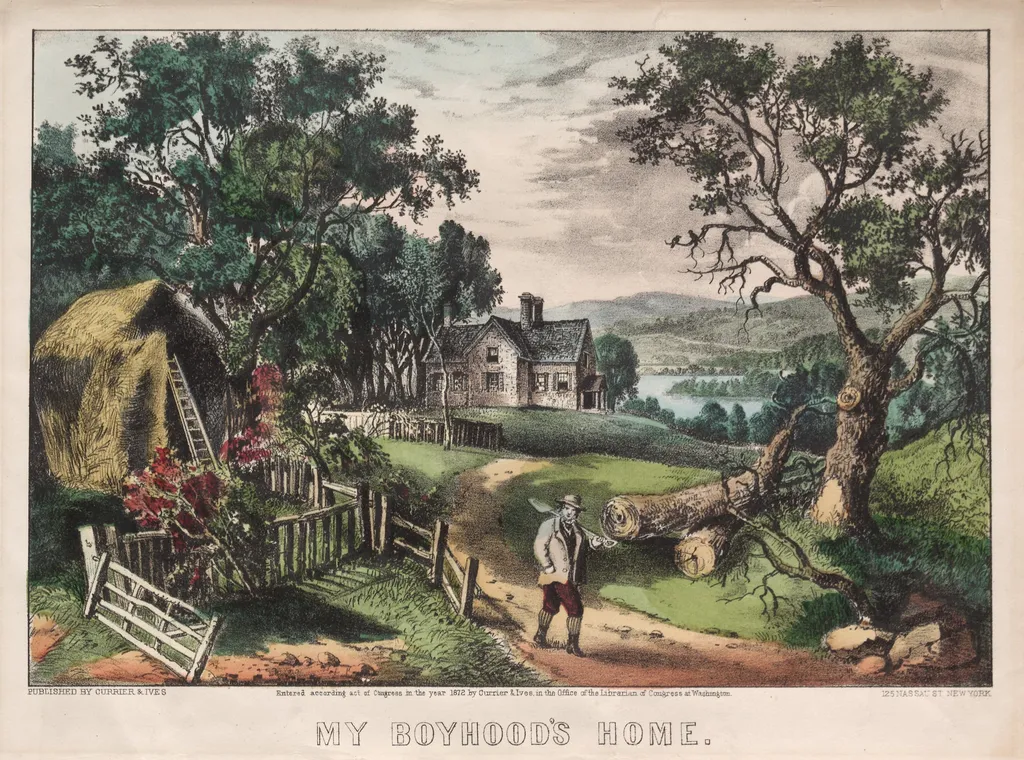
My Boyhood's Home is a print by the Impressionist artist James Merritt Ives. It dates from 1872 and is held in the collection of the Cleveland Museum of Art.
About this work
Overview
Created in 1872 by James Merritt Ives, My Boyhood's Home is a lithographic print that captures a quiet rural scene. It was produced during a period when commercial printmaking allowed widespread access to landscape imagery. The work is part of the collection at The Cleveland Museum of Art, where it is preserved as an example of 19th-century American print culture.
Subject & Meaning
The scene portrays a solitary figure carrying wood along a path toward a distant homestead, framed by trees and water. The composition evokes nostalgia, suggesting a personal connection to a childhood residence. The absence of figures at the house and the quiet solitude of the walker imply reflection rather than narrative action, inviting contemplation of memory and place.
Technique & Style
Ives employed fine-line lithography to render detailed textures in foliage, clothing, and terrain. Subtle gradations of tone and layered ink work create atmospheric depth, with soft contrasts between light and shadow guiding the viewer’s gaze toward the house. The rendering emphasizes naturalism over drama, favoring quiet observation over theatrical effect.
History & Provenance
The print was produced during Ives’s collaboration with the firm Currier & Ives, known for mass-distributed scenes of American life. Though widely circulated, surviving impressions are now rare. The Cleveland Museum of Art acquired its copy through documented donations in the early 20th century, preserving it as a representative work of the era’s popular printmaking.
Context
In the post-Civil War United States, images of rural life gained popularity as symbols of stability and moral virtue. My Boyhood's Home reflects this trend, offering an idealized vision of domesticity amid rapid industrialization. Such prints were often displayed in middle-class homes, serving as visual anchors to an imagined pastoral past.
Legacy
While Ives is better known for his urban and historical scenes, this print stands as a quieter, more introspective work within his oeuvre. It contributes to the broader understanding of how 19th-century Americans used imagery to process change and preserve personal memory. Today, it remains a touchstone for studies of domestic nostalgia in American visual culture.
Artist & collection

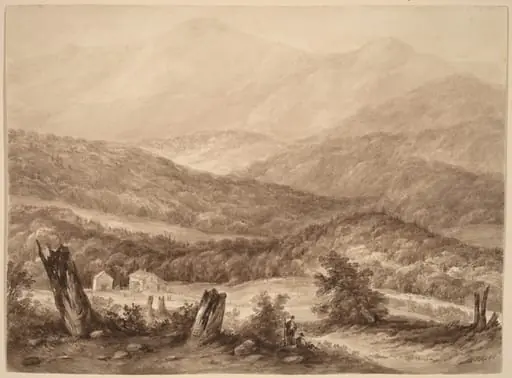 White Mountains (?)
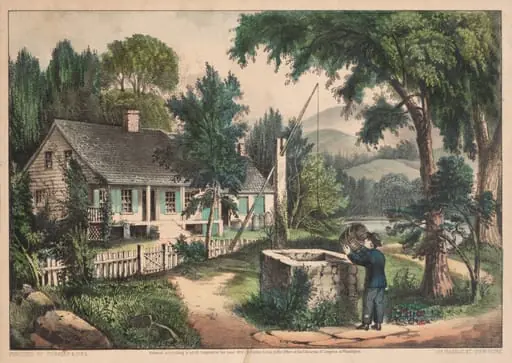 The Old Oaken Bucket
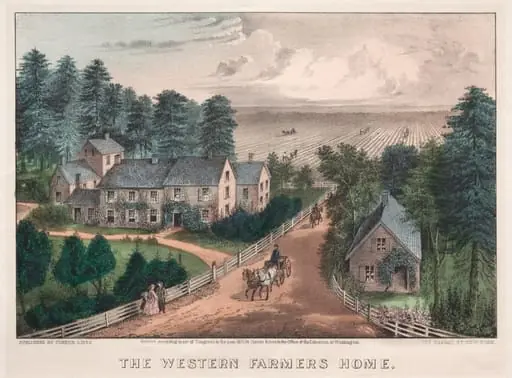 The Western Farmer's Home
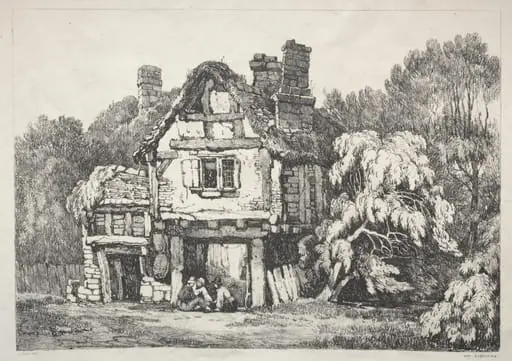 A Series of Ancient Buildings and Rural Cottages in the North of England: Near Ashbourn
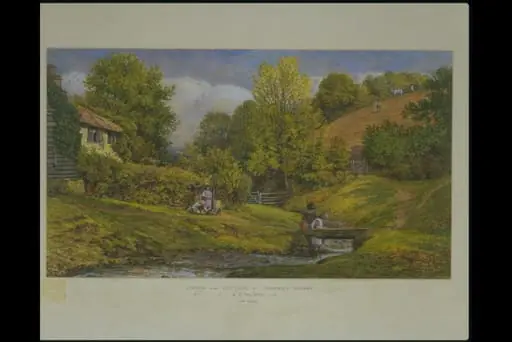 Stream and Cottage at Thursley, Surrey
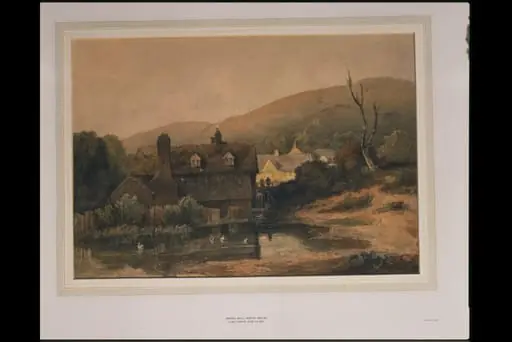 Water Mill, North Wales
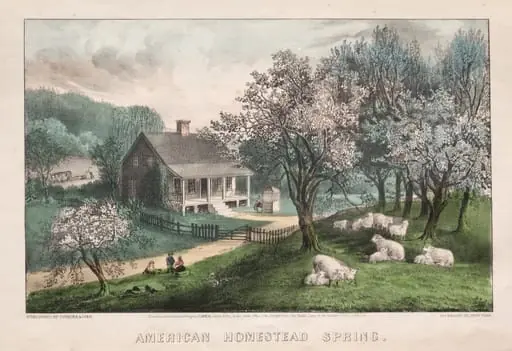 American Homestead, Spring
 A Series of Ancient Buildings and Rural Cottages in the North of England: Near Byland
 Cottage near Norwood
 Untitled
 Landscape with cottage and figures