Artwork
Fourteen Celebrated Horses: Adonis
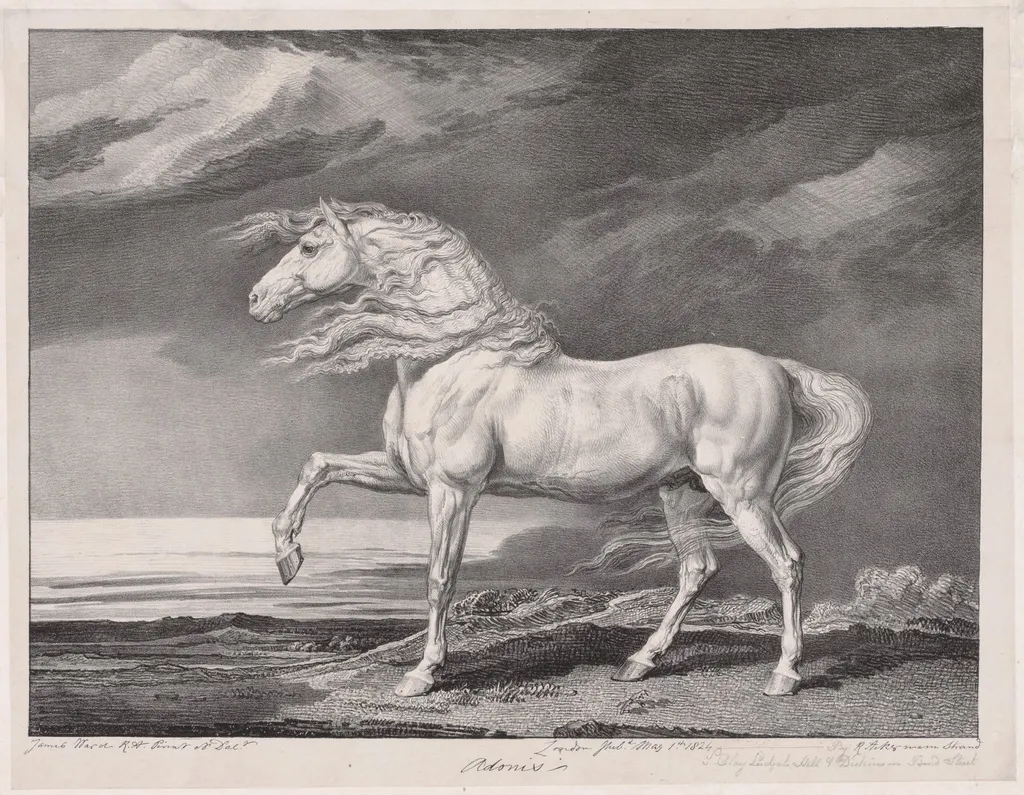
Fourteen Celebrated Horses: Adonis is a print by the Romanticist artist James Ward. It dates from 1824 and is held in the collection of the Cleveland Museum of Art.
About this work
The artist focused on the horse’s powerful muscles and flowing hair, making it look almost alive.
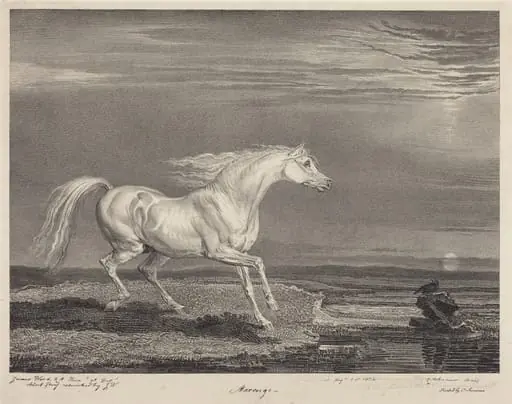
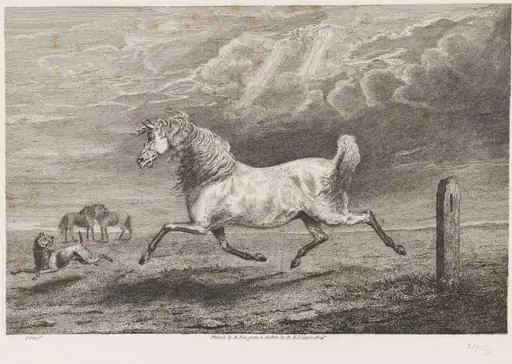
This is a black-and-white print of a single white horse standing on a rocky shore. The horse faces left, its mane and tail flowing as if caught in wind. The sky above is dramatic, with thick clouds and a dark horizon line.
The artist focused on the horse’s powerful muscles and flowing hair, making it look almost alive. This print was made in 1824 as part of a series called *Fourteen Celebrated Horses*.
Next, look up James Ward to see more of his animal paintings.
Overview
Created in 1824 by James Ward, this black-and-white print is one of fourteen in a series depicting renowned horses of the era. The work, held at The Cleveland Museum of Art, isolates a single stallion on a windswept shore, rendered with precise tonal contrasts. The composition emphasizes the animal’s physical presence against a moody, cloud-choked sky, reflecting Ward’s interest in equine anatomy and natural drama.
Subject & Meaning
The horse depicted is Adonis, a celebrated racehorse known for his speed and lineage. Ward presents him not as a trophy or symbol of wealth, but as a force of nature—standing alone on a barren shore, mane and tail stirred by unseen wind. The isolation and intensity suggest reverence for the animal’s vitality, aligning with early 19th-century ideals of noble, untamed strength.
Technique & Style
Ward employed etching and engraving to achieve fine, controlled lines that model the horse’s musculature and flowing hair. The dramatic sky is rendered with dense, layered hatching, creating depth and tension. The stark contrast between the white horse and the darkened horizon enhances the figure’s sculptural quality, emphasizing form over narrative context.
History & Provenance
The print was produced as part of a limited series commissioned to document prominent horses of the time. Ward, known for his detailed animal studies, collaborated with engravers to translate his drawings into prints. The Cleveland Museum of Art acquired the work as part of its broader collection of 19th-century British prints, preserving its place in the history of animal portraiture.
Context
In early 19th-century Britain, thoroughbred horses were objects of intense cultural fascination, tied to racing, breeding, and national identity. Ward’s series emerged amid growing public interest in animal physiology and natural history. Unlike decorative equestrian portraits, these prints focused on individual character and physical realism, reflecting scientific and aesthetic shifts of the period.
Legacy
Ward’s 'Fourteen Celebrated Horses' influenced later artists interested in animal anatomy and expressive realism. While not widely exhibited today, the series remains a significant example of how printmaking could elevate natural subjects beyond mere documentation. The Adonis print, in particular, endures as a quiet testament to the dignity attributed to individual animals in an era of industrial change.
Artist & collection