Artwork
Untitled
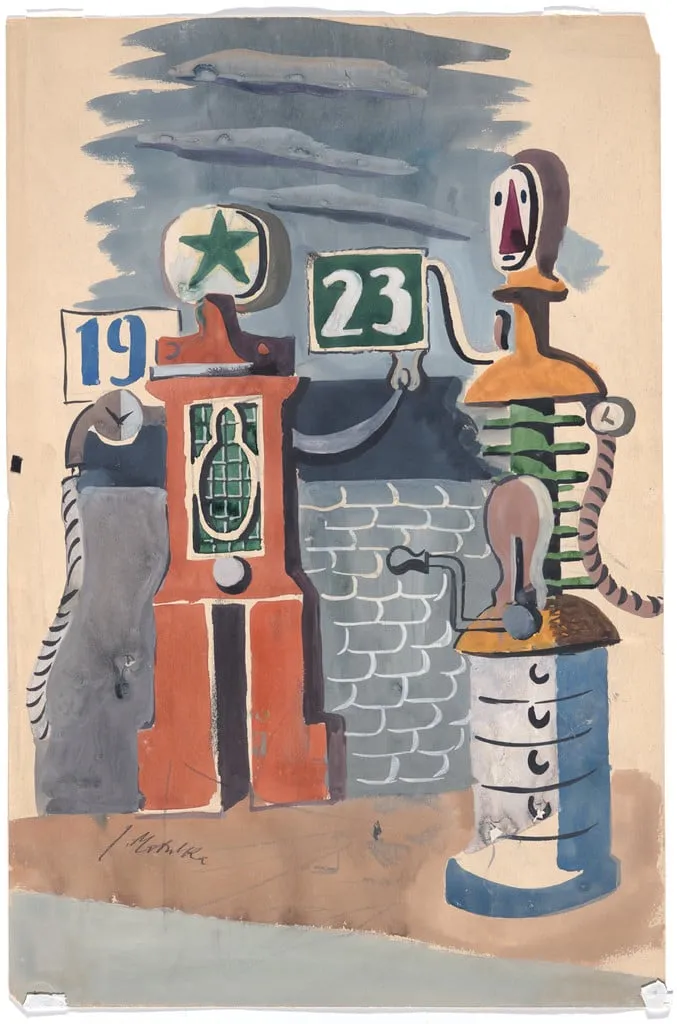
Untitled is a gouache drawing by Jan Matulka. It dates from 1934 and is held in the collection of the Museum of Modern Art.
About this work
Overview
It presents three stylized human forms against a muted background, combining geometric simplicity with symbolic elements.
Created around 1934, this gouache and pencil drawing by Jan Matulka is part of The Museum of Modern Art’s collection. It presents three stylized human forms against a muted background, combining geometric simplicity with symbolic elements. The use of gouache lends a matte, opaque quality, while pencil lines define structure and detail. The composition avoids naturalism, favoring abstracted forms that suggest narrative without literal representation.
Subject & Meaning
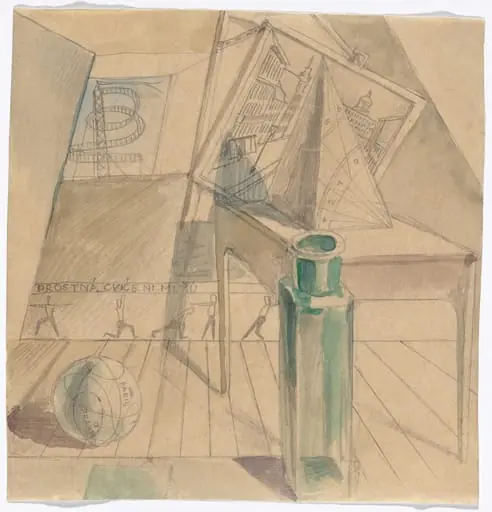
Three figures, rendered as blocky silhouettes, stand before a brick wall. Two wear striped trousers and hold clocks marked with the numbers 19 and 23, possibly referencing time, age, or ritual. The third figure has a ladder-like torso and a small animal on a stool, introducing an element of quiet mystery. A green star and sign in the pale sky add an enigmatic, almost surreal layer. The scene evokes routine or existential markers without prescribing a single interpretation.
Technique & Style
Matulka employs gouache for its dense, flat color and lack of transparency, enhancing the figures’ sculptural presence. Pencil outlines reinforce form and add subtle texture. The figures are constructed from simplified planes and sharp angles, recalling early modernist abstraction and children’s drawings. The background’s minimal detail—pale sky, green star, and sign—creates a dreamlike void, focusing attention on the symbolic objects and postures of the figures.
History & Provenance
The work was produced during Matulka’s time in New York, when he was engaged with avant-garde circles and exploring non-representational forms. It entered The Museum of Modern Art’s collection in the mid-20th century, likely through acquisition or donation. While not widely exhibited, it reflects Matulka’s broader interest in merging European modernism with American urban themes during the 1930s.
Context
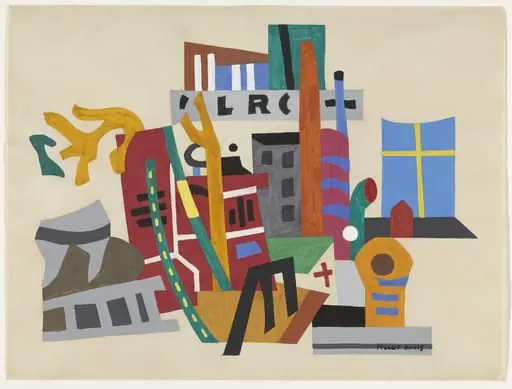
Made during the Great Depression, the drawing aligns with a period when artists sought new visual languages to express social and psychological states. Matulka’s abstraction echoes contemporaries like Stuart Davis and Charles Sheeler, though his tone is more poetic than industrial. The clocks and symbolic signs suggest a preoccupation with time and structure, themes resonant in a society grappling with economic instability and shifting identities.
Legacy
Though not among Matulka’s most widely known works, this drawing exemplifies his unique synthesis of European modernism and American subject matter. Its quiet symbolism and restrained palette influenced later artists interested in narrative abstraction. The piece remains a quiet testament to the capacity of simplified forms to convey complex, unspoken human experiences.
Artist & collection

Artist
Jan Matulka was a Czech-American modern artist originally from Bohemia. Matulka's style ranged from Abstract expressionism to landscapes, sometimes in the same day. He has directly influenced artists like Dorothy…