Artwork
Filial Piety (The Paralytic)
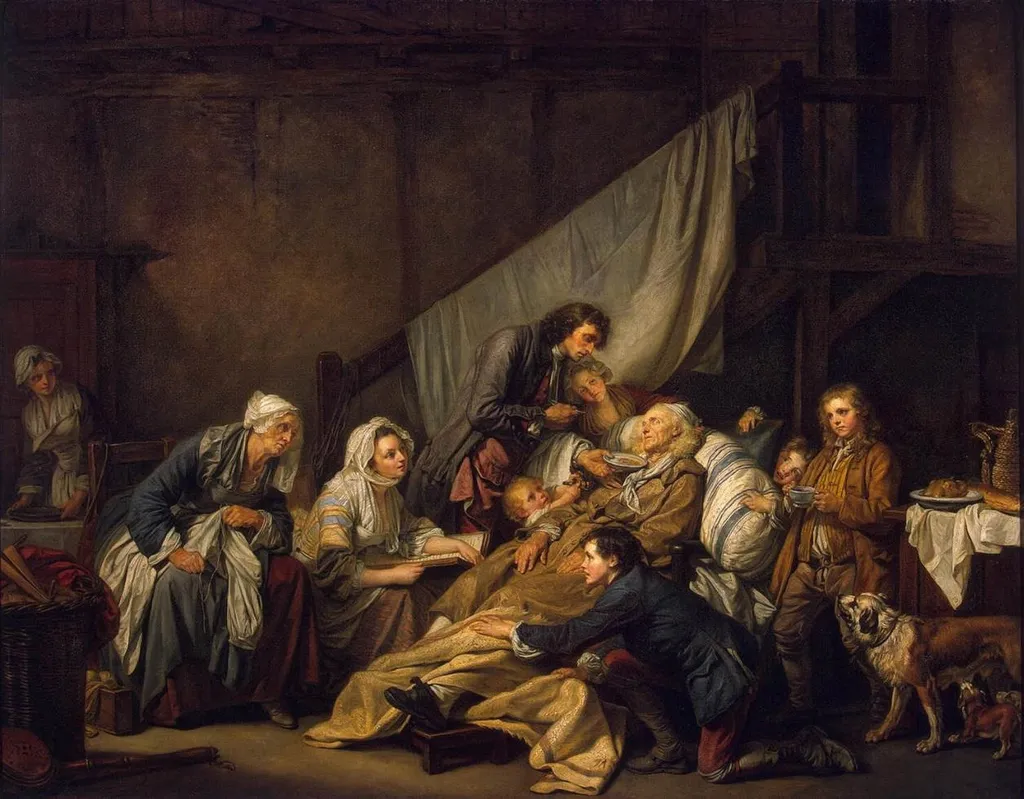
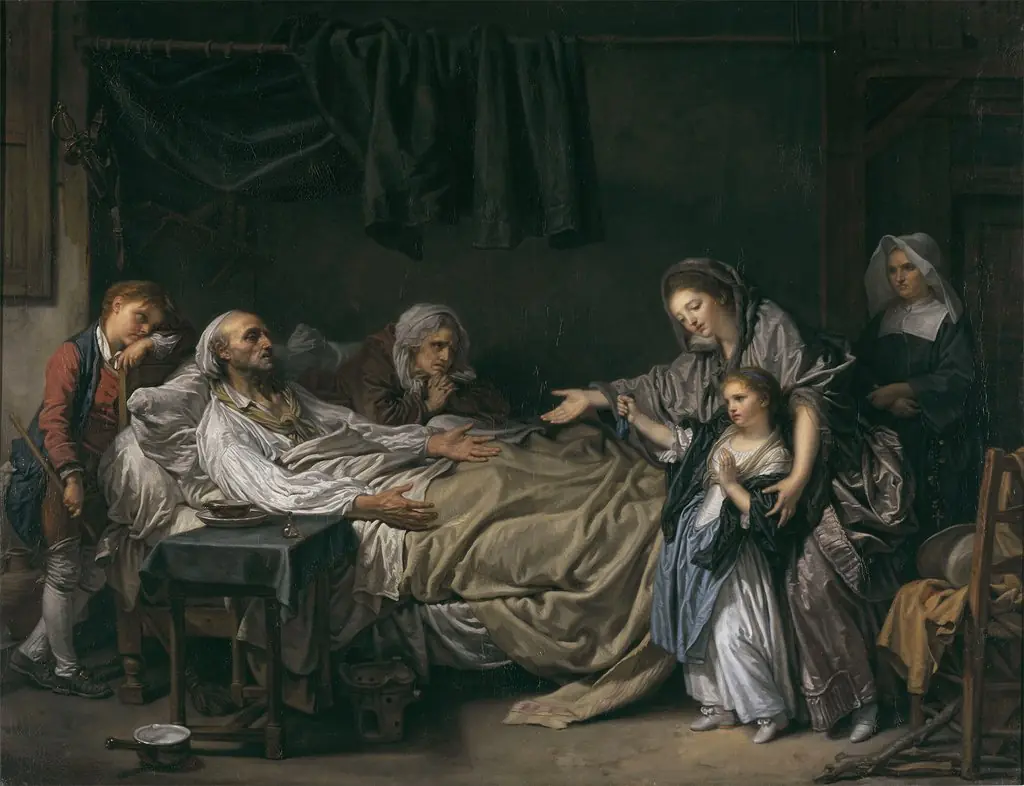
Filial Piety (The Paralytic) is an oil painting by the Rococo painting artist Jean-Baptiste Greuze. It dates from 1763 and is held in the collection of the Hermitage Museum.
About this work
Overview
Though trained in academic traditions, Greuze often turned to scenes of everyday life infused with emotional gravity.
Jean-Baptiste Greuze completed this oil painting in 1763, capturing a quiet domestic moment rooted in moral themes. Though trained in academic traditions, Greuze often turned to scenes of everyday life infused with emotional gravity. The work is now part of the State Hermitage Museum’s collection, where it stands as an example of 18th-century French narrative painting that blends genre realism with ethical undertones.
Subject & Meaning
The scene portrays a paralyzed man being fed by a woman, likely his daughter, while other family members observe in silence. The act of care is rendered without theatricality, emphasizing duty over sentiment. Children and elders in the room lend weight to the moment, suggesting generational continuity and the quiet endurance of familial responsibility. The title, 'Filial Piety,' frames the act as a moral virtue, aligned with Enlightenment ideals of domestic virtue.
Technique & Style
Greuze employed subtle chiaroscuro to model forms in dim interior light, drawing focus to the central figures without dramatic contrast. Brushwork is precise yet restrained, particularly in the textures of fabric and skin. The composition is tightly grouped, with figures arranged to guide the viewer’s gaze toward the act of feeding. The palette is muted, dominated by earth tones and soft grays, reinforcing the scene’s solemnity and intimacy.
History & Provenance
Painted in 1763, the work was likely exhibited in Parisian salons, where Greuze’s moralizing genre scenes gained attention. It entered the Russian imperial collection in the late 18th or early 19th century, possibly through diplomatic acquisition. Its presence in the Hermitage reflects the taste of Catherine the Great’s circle for French art that combined technical skill with ethical narrative, distinguishing it from purely decorative Rococo works.
Context
In mid-18th-century France, artists increasingly turned to domestic scenes to explore moral and social values amid shifting class structures. Greuze’s work responded to this trend, offering visual sermons on virtue. While Rococo aesthetics favored elegance and playfulness, this painting diverges by prioritizing emotional restraint and ethical gravity, aligning more closely with emerging Neoclassical ideals of duty and sincerity.
Legacy
Though less celebrated than Greuze’s portraits, this painting exemplifies his commitment to elevating ordinary life through moral narrative. It influenced later 19th-century realists who sought to depict social responsibility with dignity. Its preservation in the Hermitage underscores its recognition as a thoughtful contribution to the evolution of French narrative painting beyond courtly ornamentation.
Artist & collection
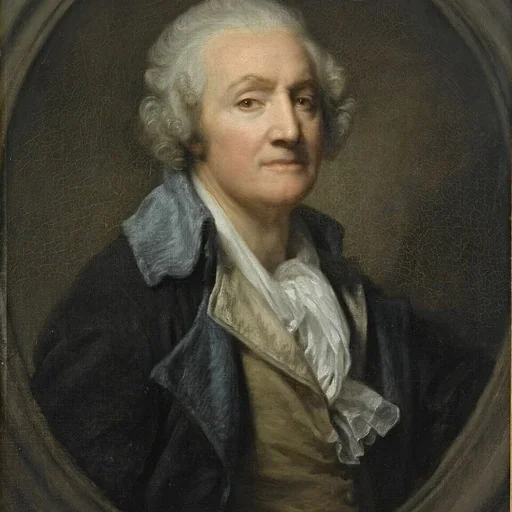
Artist
Jean-Baptiste Greuze (French pronunciation: , 21 August 1725 – 4 March 1805) was a French painter of portraits, genre scenes, and history painting.