Artwork
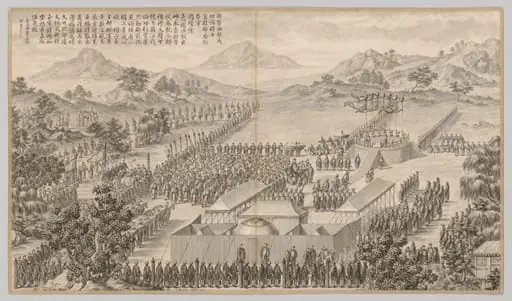
Victory at Heluo Heshi: from Battle Scenes of the Quelling of Rebellions in the Western Regions, with Imperial Poems
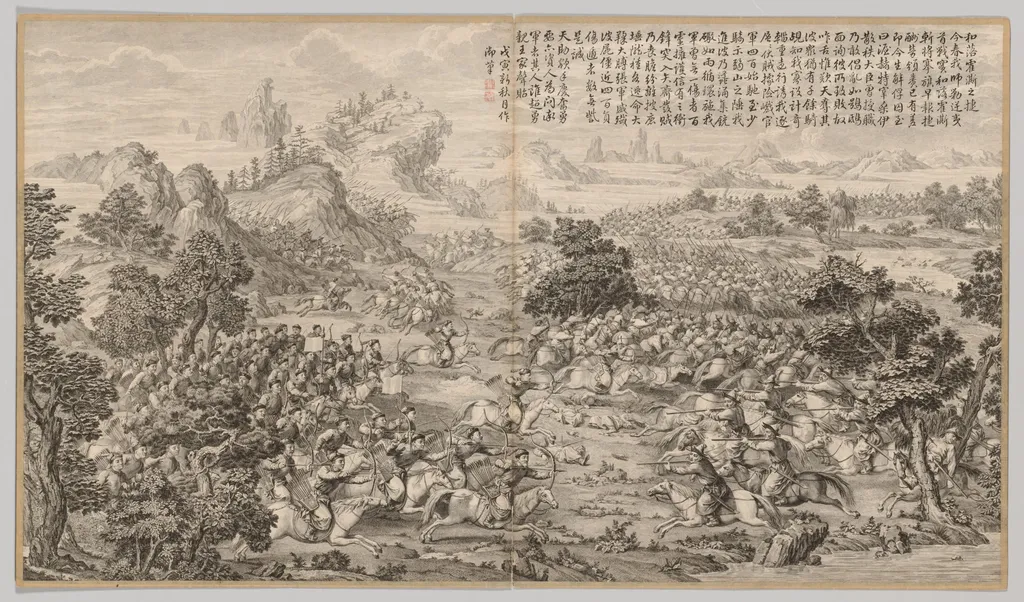
Victory at Heluo Heshi: from Battle Scenes of the Quelling of Rebellions in the Western Regions, with Imperial Poems is a print by the Romanticist artist Jean Denis Attiret. It is held in the collection of the Cleveland Museum of Art. This print is part of a series commissioned by Emperor Qianlong to document military campaigns in the Western Regions, now part of Xinjiang.
About this work
It was made for Emperor Qianlong, who wrote poems praising his army after wars in Central Asia.
This French etching shows a Qing battle scene with soldiers and a drumming rider. The horse’s wild eyes and flying mane suggest chaos, but the soldiers look calm.
It was made for Emperor Qianlong, who wrote poems praising his army after wars in Central Asia. The artist never saw these battles—he worked from sketches and descriptions.
Look up Jean Denis Attiret (French, 1702–1768) to see more of his Qing-inspired art.
Overview
This print is part of a series commissioned by Emperor Qianlong to document military campaigns in the Western Regions, now part of Xinjiang. Created by French Jesuit artist Jean Denis Attiret, the etchings blend European engraving techniques with Chinese imperial narratives. Each image was paired with the emperor’s own poetry, reinforcing state ideology through visual and literary means. The series was produced in China, not Europe, despite the artist’s Western origins.
Subject & Meaning
The scene depicts a Qing military engagement during the suppression of regional uprisings. Soldiers maintain disciplined formations amid chaotic horseback motion, symbolizing imperial control over disorder. The drumming rider, central to the composition, signals coordination rather than frenzy. Qianlong’s accompanying poems frame the conflict as a righteous consolidation of authority, transforming battlefield violence into a narrative of civilizing order under the Mandate of Heaven.
Technique & Style
Attiret employed fine-line etching, a European method, to render detail with precision. The contrast between the agitated horse—wild eyes, flaring mane—and the composed soldiers reflects a deliberate stylistic tension. Shading and perspective follow Western conventions, yet the composition adheres to Chinese pictorial traditions of hierarchical scale and symbolic arrangement. The work was executed in Beijing, adapting European techniques to serve Qing visual propaganda.
History & Provenance
Commissioned in the mid-18th century, the series was produced under imperial supervision at the Qing court. Attiret, who had been in China since 1738, relied on sketches and reports from officers who witnessed the campaigns, never visiting the battlefields himself. The prints were distributed among court officials and stored in palace archives. Their production coincided with Qianlong’s broader effort to immortalize his military achievements through art and literature.
Context
The Western Regions campaigns were part of Qianlong’s expansionist policy to secure trade routes and stabilize frontier territories. The Qing state invested heavily in documenting these wars, not only for military record but to legitimize rule over diverse ethnic groups. The fusion of European artistic methods with Chinese imperial poetry illustrates the court’s cosmopolitan approach to representation, blending foreign skill with native ideology to project power across cultural boundaries.
Legacy
The series remains a key example of cross-cultural artistic collaboration in 18th-century China. It influenced later imperial documentation projects and reflects the Qing court’s strategic use of visual media for political messaging. While Attiret’s role was significant, the works were ultimately expressions of Qing authority, shaped by imperial will rather than individual creativity. Today, they serve as historical records of both military campaigns and the aesthetics of imperial self-representation.
Artist & collection

Artist
Jean Denis Attiret was a French Jesuit painter and missionary to Qing China.

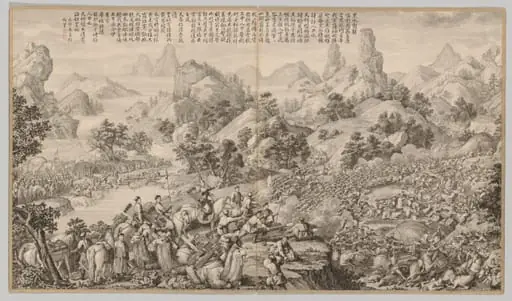 Breaking Through the Siege at Hesui: from Battle Scenes of the Quelling of Rebellions in the Western Regions, with imperial Poems
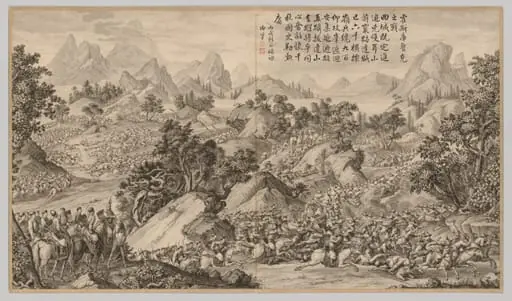 Battle at Heshi Kuluke: from Battle Scenes of the Quelling of Rebellions in the Western Regions, with Imperial Poems
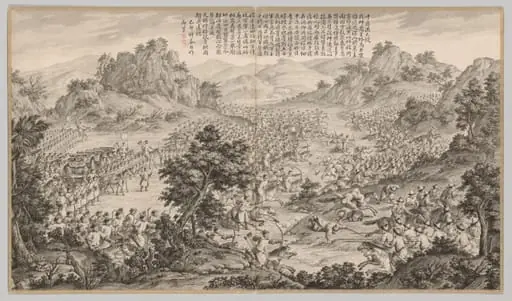 Great Victory at Hu'erman: from Battle Scenes of the Quelling of Rebellions in the Western Regions, with Imperial Poems
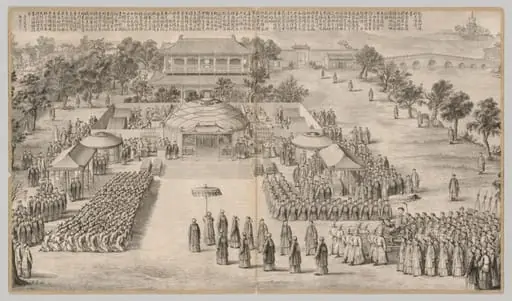 The Victory Banquet: from Battle Scenes of the Quelling of Rebellions in the Western Regions, with Imperial Poems
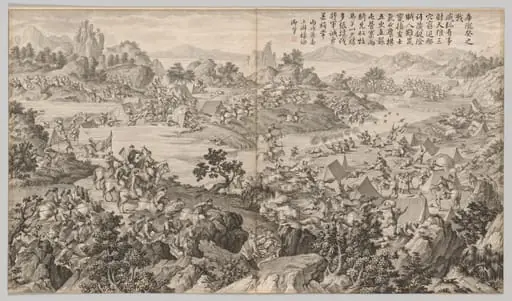 Battle of Kulongkui: from Battle Scenes of the Quelling of Rebellions in the Western Regions, with Imperial Poems
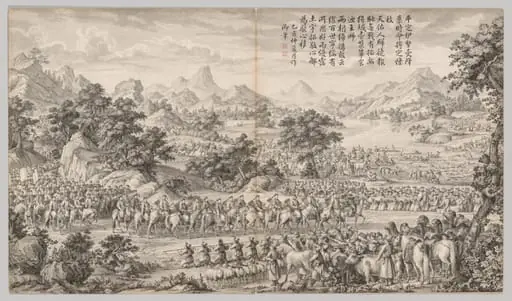 Receiving Surrender from the Eli: from Battle Scenes of the Quelling of Rebellions in the Western Regions, with Imperial Poems
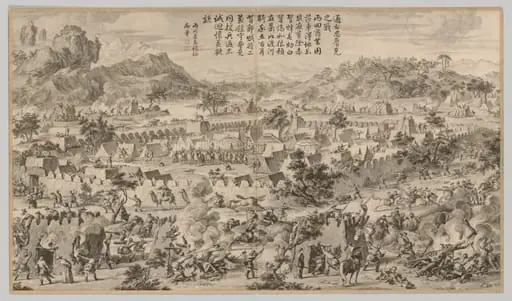 Battle at Tunggushi Luke: from Battle Scenes of the Quelling of the Rebellions in the Western Regions, with Imperial Poems
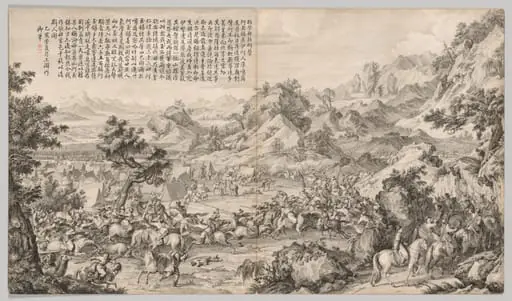 Attacking the Camp at Gatan Ola: from Battle Scenes of the Quelling of Rebellions in the Western Region, with Imperial Poems
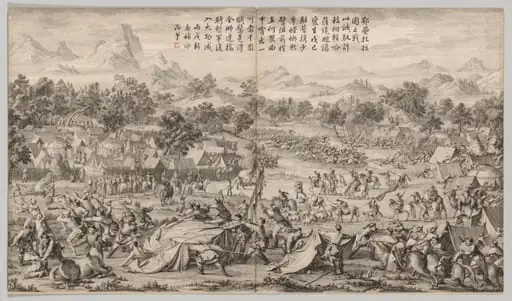 The Battle at Elei Zhalatu: from Battle Scenes of the Quelling of Rebellions in the Western Regions, with Imperial Poems
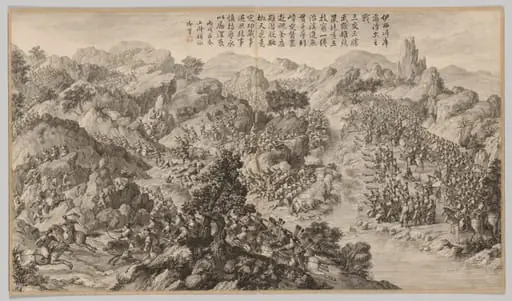 Battle at Yixi'er Ku'ernao'er: from Battle Scenes of the Quelling of Rebellions in the Western Regions, with Imperial Poems
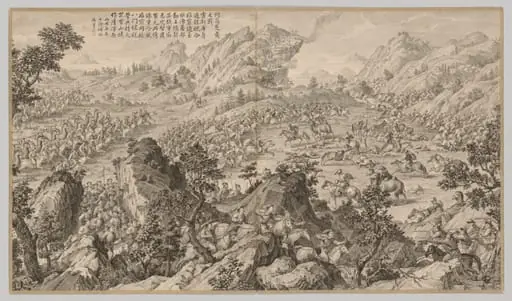 Battle at A'erchu'er: from Battle Scenes of the Quelling of Rebellions in the Western Regions, with Imperial Poems
 Rewards to Generals and Officers in Quelling the Uigurs: from Battle Scenes of the Quelling of Rebellions in the Western Regions, with Imperial Poems