Artwork
Breaking Through the Siege at Hesui: from Battle Scenes of the Quelling of Rebellions in the Western Regions, with imperial Poems
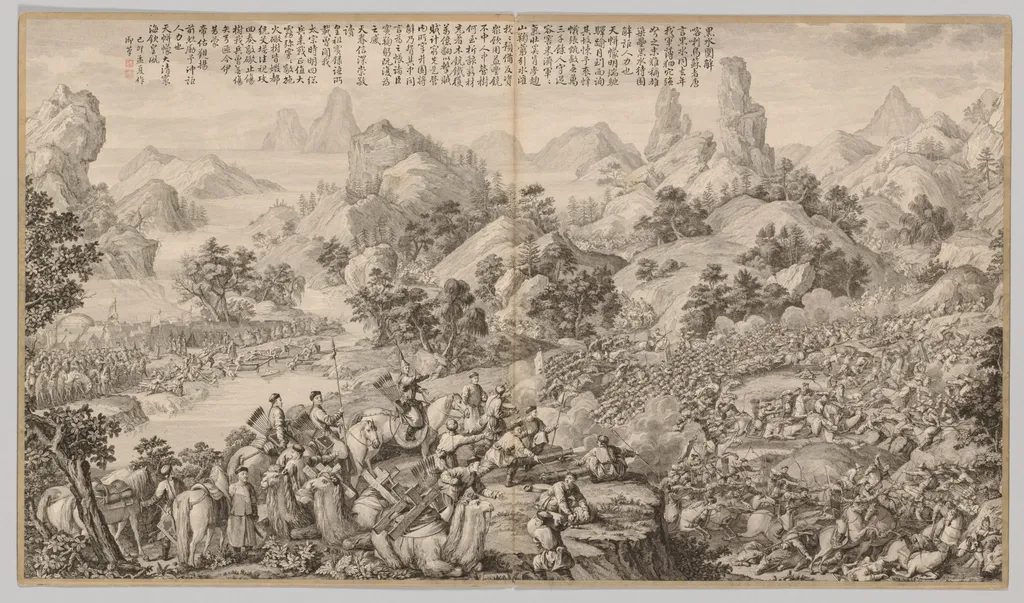
Breaking Through the Siege at Hesui: from Battle Scenes of the Quelling of Rebellions in the Western Regions, with imperial Poems is a print by the Romanticist artist Giuseppe Castiglione. It is held in the collection of the Cleveland Museum of Art. This print is part of a series commissioned by Emperor Qianlong to document military campaigns in the Western Regions, now part of Xinjiang.
About this work
Overview
This print is part of a series commissioned by Emperor Qianlong to document military campaigns in the Western Regions, now part of Xinjiang.
This print is part of a series commissioned by Emperor Qianlong to document military campaigns in the Western Regions, now part of Xinjiang. Created as a set of etchings, each image was paired with a poem composed by the emperor himself. The series served as both historical record and imperial propaganda, blending Chinese artistic traditions with European printmaking techniques to convey the Qing dynasty’s military authority.
Subject & Meaning
The scene depicts Qing troops scaling the walls of a fortified city during a campaign against regional uprisings. Soldiers in armor, ladders in hand, advance amid rising smoke, suggesting intense combat. The imagery emphasizes discipline and valor, reinforcing the emperor’s narrative of legitimate suppression of rebellion. The accompanying poem, inscribed in the corner, personalizes the victory as an act of moral and dynastic duty.
Technique & Style
The print fuses Chinese ink-wash aesthetics with European copperplate etching, a method introduced by Jesuit artists at the Qing court. Figures are rendered with precise linework and tonal gradation, while the composition retains traditional Chinese spatial conventions. This hybrid style reflects the emperor’s interest in adopting foreign techniques to enhance the visual authority of imperial narratives without abandoning native artistic values.
History & Provenance
Commissioned in the late 18th century, the series was produced under imperial supervision, likely by court artists working with European engravers. The prints were distributed among officials and stored in palace collections. Their creation coincided with the consolidation of Qing control over Xinjiang, making them part of a broader effort to legitimize territorial expansion through visual culture.
Context
The Western Regions had long been a contested frontier, and Qianlong’s campaigns there were among the most significant military efforts of his reign. The prints were part of a larger project to memorialize these victories, aligning them with Confucian ideals of order and loyalty. The inclusion of the emperor’s poetry elevated the works beyond mere documentation, framing them as cultural achievements tied to his personal virtue.
Legacy
The series remains a key example of Qing imperial art that merged political messaging with technical innovation. It influenced later state-sponsored visual histories and demonstrated how the court used art to project power across diverse audiences. Today, the prints are studied for their hybrid aesthetics and their role in shaping narratives of empire, territorial control, and cultural synthesis in 18th-century China.
Artist & collection



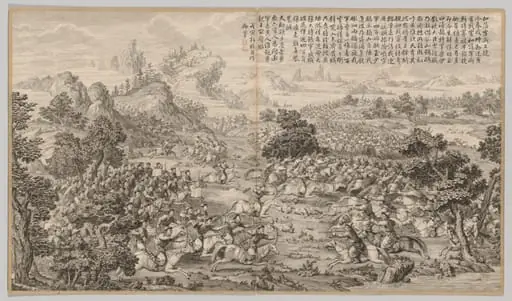 Victory at Heluo Heshi: from Battle Scenes of the Quelling of Rebellions in the Western Regions, with Imperial Poems
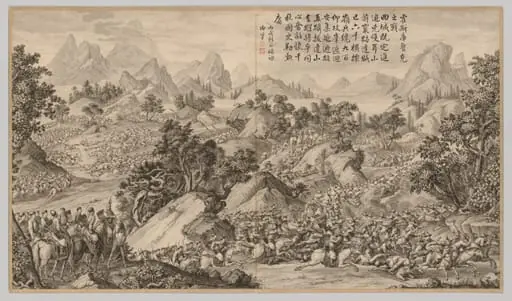 Battle at Heshi Kuluke: from Battle Scenes of the Quelling of Rebellions in the Western Regions, with Imperial Poems
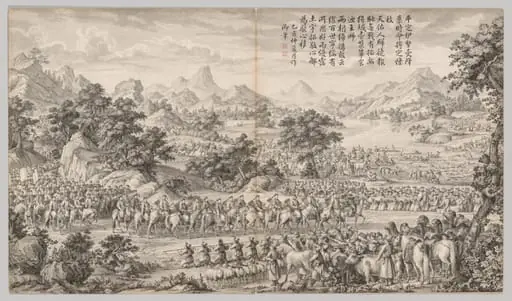 Receiving Surrender from the Eli: from Battle Scenes of the Quelling of Rebellions in the Western Regions, with Imperial Poems
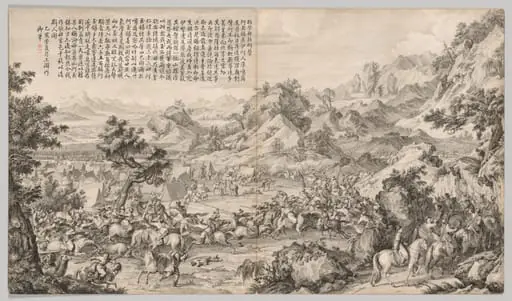 Attacking the Camp at Gatan Ola: from Battle Scenes of the Quelling of Rebellions in the Western Region, with Imperial Poems
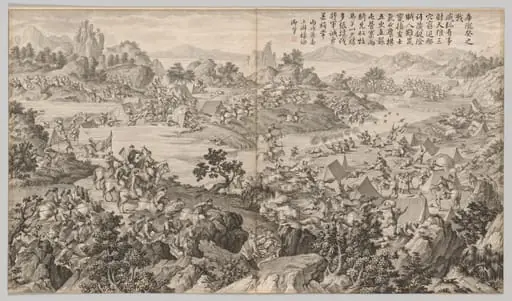 Battle of Kulongkui: from Battle Scenes of the Quelling of Rebellions in the Western Regions, with Imperial Poems
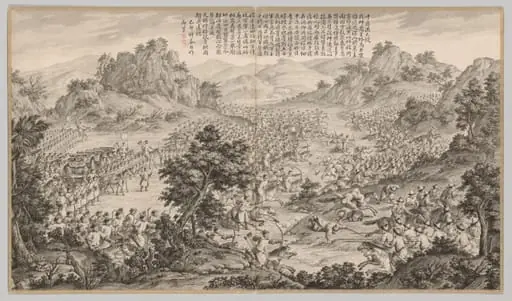 Great Victory at Hu'erman: from Battle Scenes of the Quelling of Rebellions in the Western Regions, with Imperial Poems
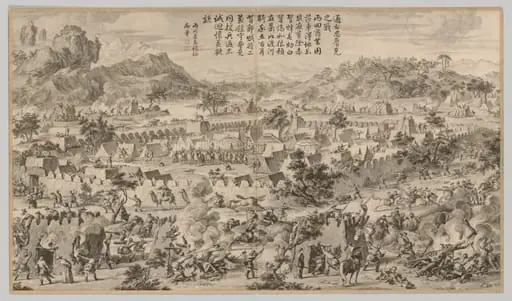 Battle at Tunggushi Luke: from Battle Scenes of the Quelling of the Rebellions in the Western Regions, with Imperial Poems
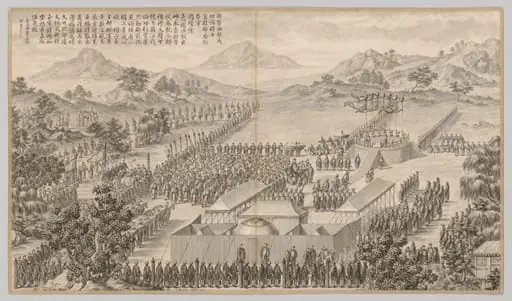 Rewards to Generals and Officers in Quelling the Uigurs: from Battle Scenes of the Quelling of Rebellions in the Western Regions, with Imperial Poems
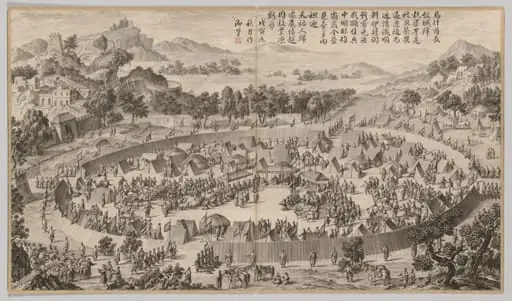 Chieftain Wushe Surrendering the City: from Battle Scenes of the Quelling of the Rebellions in the Western Regions, with imperial Poems
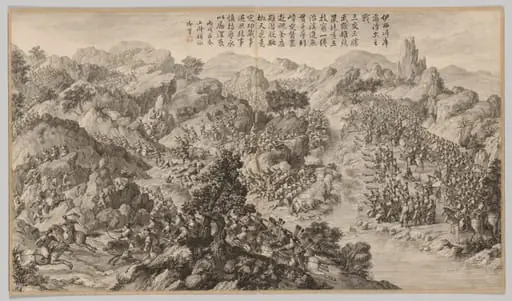 Battle at Yixi'er Ku'ernao'er: from Battle Scenes of the Quelling of Rebellions in the Western Regions, with Imperial Poems
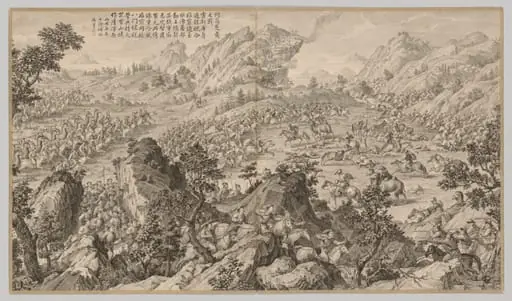 Battle at A'erchu'er: from Battle Scenes of the Quelling of Rebellions in the Western Regions, with Imperial Poems
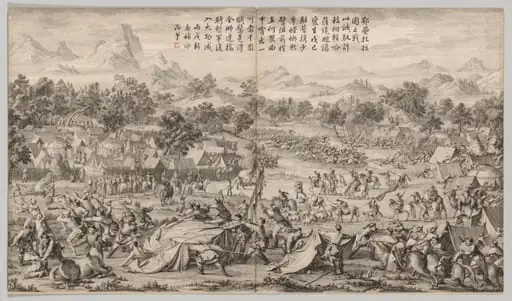 The Battle at Elei Zhalatu: from Battle Scenes of the Quelling of Rebellions in the Western Regions, with Imperial Poems