Artwork
Battle at Tunggushi Luke: from Battle Scenes of the Quelling of the Rebellions in the Western Regions, with Imperial Poems
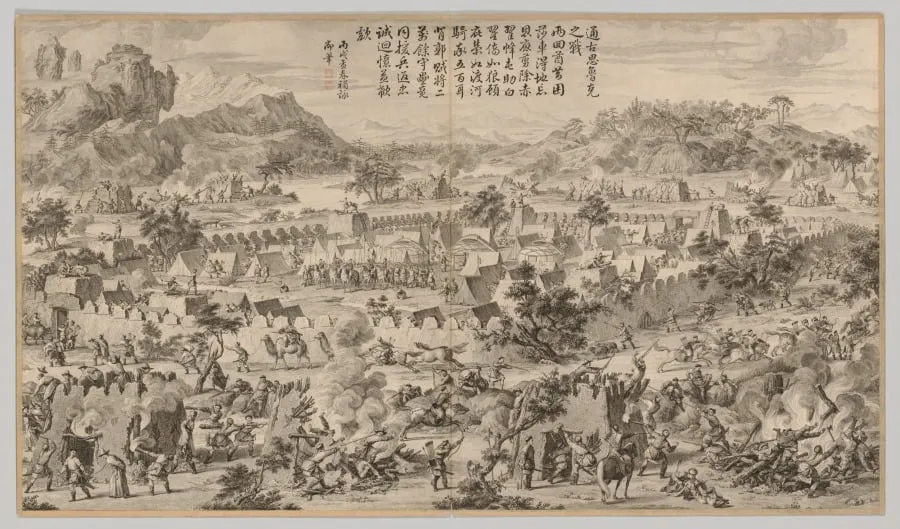
Battle at Tunggushi Luke: from Battle Scenes of the Quelling of the Rebellions in the Western Regions, with Imperial Poems is a print by the Romanticist artist Unknown. It dates from 1770 and is held in the collection of the Cleveland Museum of Art. This print is part of a series commissioned by Emperor Qianlong to document military campaigns in the Western Regions, now part of Xinjiang.
About this work
The artist worked from sketches by European missionaries, so the faces and shadows look different from traditional Chinese art.
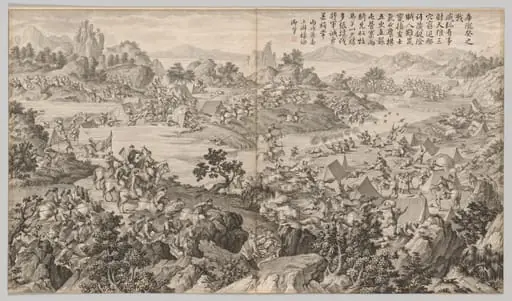
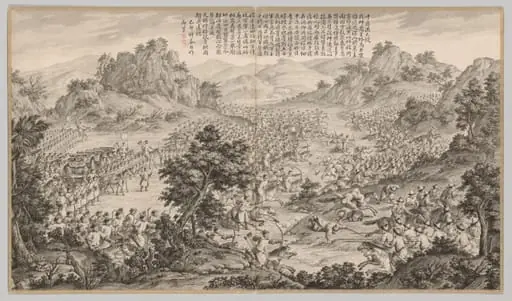
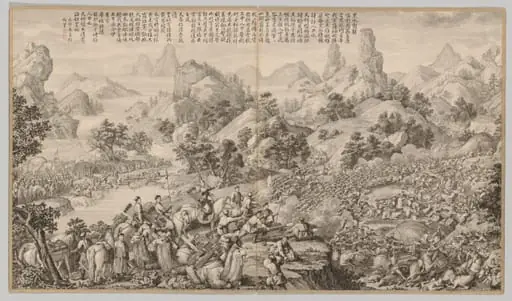
You see soldiers on horseback charging through a rocky pass, arrows flying, banners snapping in the wind.
This print was made for an emperor. Qianlong added his own poem to the scene, turning a battle into a story of loyalty and power. The artist worked from sketches by European missionaries, so the faces and shadows look different from traditional Chinese art.
Look up *qianlong reign (1736–95)* to see how emperors used art to shape history.
Overview
This print is part of a series commissioned by Emperor Qianlong to document military campaigns in the Western Regions, now part of Xinjiang. Created as a set of engraved plates, each image was paired with an imperial poem composed by the emperor himself. The series served as both historical record and political statement, reinforcing the Qing dynasty’s authority over distant territories through visual and literary means.
Subject & Meaning
The scene depicts Qing troops advancing through a mountain pass during a campaign against regional uprisings. Soldiers on horseback, arrows in flight, and fluttering banners convey motion and urgency. The emperor’s accompanying verse frames the conflict not as mere warfare but as an act of loyal service to the state, transforming battlefield chaos into a narrative of imperial virtue and disciplined order.
Technique & Style
The print combines traditional Chinese compositional elements with Western engraving techniques introduced by Jesuit missionaries. Shading, perspective, and anatomical detail in the figures reflect European artistic training, diverging from conventional Chinese brushwork. This fusion was intentional, signaling the empire’s access to global knowledge while maintaining its cultural authority through subject matter and poetic inscription.
History & Provenance
Commissioned between 1760 and 1770, the series was produced under imperial supervision in Beijing. Engravings were made by Chinese artisans working from sketches by European missionaries stationed at court. The prints were distributed to officials and stored in palace archives, serving as official records rather than public art. Their production coincided with the consolidation of Qing control over the Western Regions after decades of conflict.
Context
During Qianlong’s reign, the empire expanded its reach into Central Asia, facing resistance from local groups. The emperor used art, literature, and historiography to legitimize these campaigns as necessary for stability and civilization. This series was one of several projects—alongside compiled histories and painted scrolls—that framed military conquest as moral triumph, reinforcing the emperor’s role as cosmic ruler and protector of order.
Legacy
The series remains a key example of how Qing rulers manipulated visual culture to construct state ideology. While later historians have critiqued its propagandistic intent, the prints are valued for their technical synthesis of East and West and their role in documenting imperial military policy. They offer insight into how power was visually encoded in 18th-century China, beyond the written chronicles of court historians.
Artist & collection

 Domestic Scene
 Giacomo and Cardinal Marco, investing Andrea, Abbot of San Zeno, with his Benefice
 The Nymph of Fontainebleau
 Portrait of a Woman
 Madonna and Child with Saints in the Enclosed Garden
 Venus and Minerva
 Family Group of Four on Sofa
 Wall painting from Room H of the Villa of P. Fannius Synistor at Boscoreale
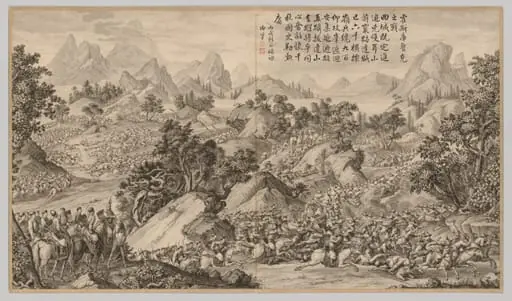 Battle at Heshi Kuluke: from Battle Scenes of the Quelling of Rebellions in the Western Regions, with Imperial Poems
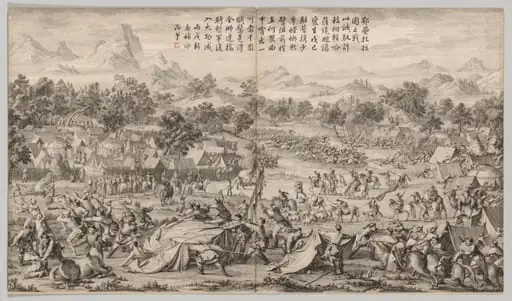 The Battle at Elei Zhalatu: from Battle Scenes of the Quelling of Rebellions in the Western Regions, with Imperial Poems
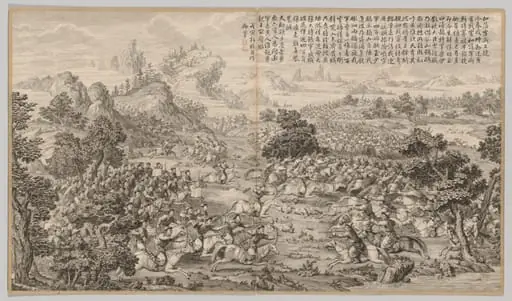 Victory at Heluo Heshi: from Battle Scenes of the Quelling of Rebellions in the Western Regions, with Imperial Poems
 Battle of Kulongkui: from Battle Scenes of the Quelling of Rebellions in the Western Regions, with Imperial Poems
 Great Victory at Hu'erman: from Battle Scenes of the Quelling of Rebellions in the Western Regions, with Imperial Poems
 Chieftain Wushe Surrendering the City: from Battle Scenes of the Quelling of the Rebellions in the Western Regions, with imperial Poems
 Breaking Through the Siege at Hesui: from Battle Scenes of the Quelling of Rebellions in the Western Regions, with imperial Poems
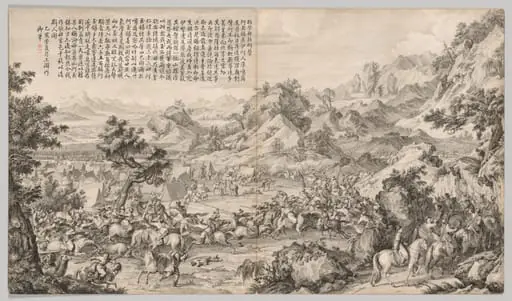 Attacking the Camp at Gatan Ola: from Battle Scenes of the Quelling of Rebellions in the Western Region, with Imperial Poems
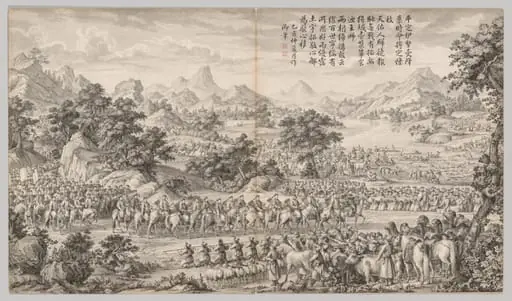 Receiving Surrender from the Eli: from Battle Scenes of the Quelling of Rebellions in the Western Regions, with Imperial Poems
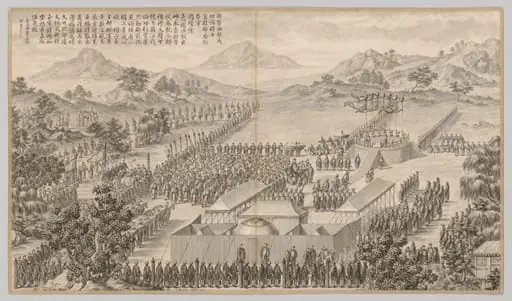 Rewards to Generals and Officers in Quelling the Uigurs: from Battle Scenes of the Quelling of Rebellions in the Western Regions, with Imperial Poems
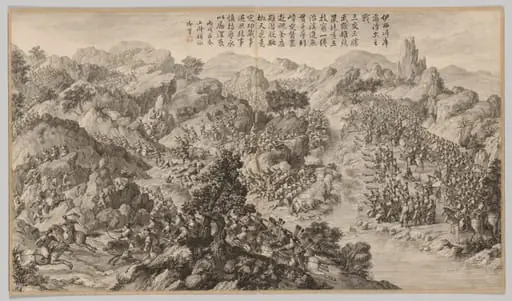 Battle at Yixi'er Ku'ernao'er: from Battle Scenes of the Quelling of Rebellions in the Western Regions, with Imperial Poems