Artwork
The Battle at Elei Zhalatu: from Battle Scenes of the Quelling of Rebellions in the Western Regions, with Imperial Poems
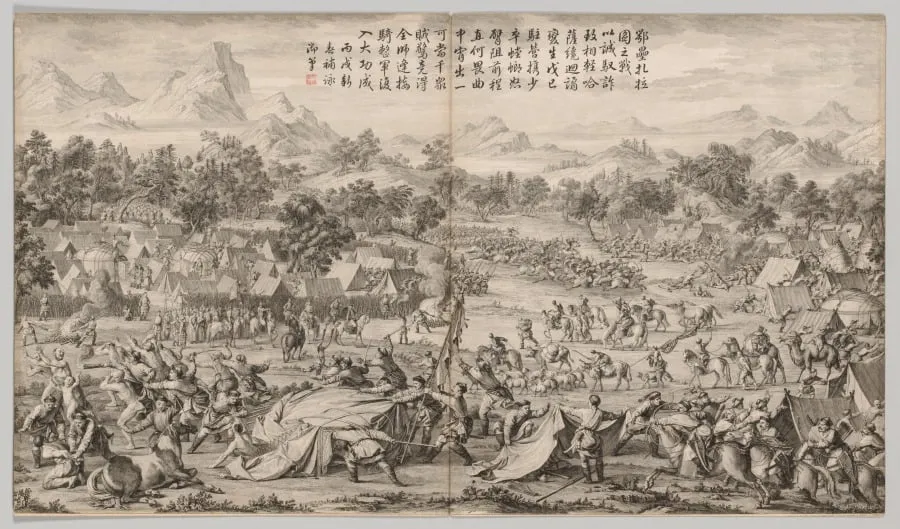
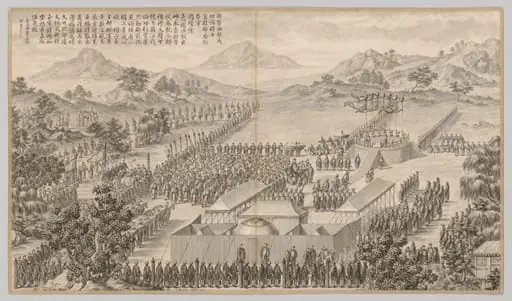
The Battle at Elei Zhalatu: from Battle Scenes of the Quelling of Rebellions in the Western Regions, with Imperial Poems is a print by the Romanticist artist Unknown. It dates from 1770 and is held in the collection of the Cleveland Museum of Art. A series of engraved prints commissioned by Emperor Qianlong documents military campaigns in China’s western frontier.
About this work
You see soldiers on horseback charging across a rocky valley, arrows flying, banners snapping in the wind.
You see soldiers on horseback charging across a rocky valley, arrows flying, banners snapping in the wind.
This print was made for Emperor Qianlong to celebrate a real battle in what’s now Xinjiang. The emperor even wrote a poem at the top—his way of signing off on the victory. The scene mixes careful detail with drama, like a news report in ink.
If you like these battle scenes, look up qing dynasty (1644–1911) for more art from the same era.
Overview
A series of engraved prints commissioned by Emperor Qianlong documents military campaigns in China’s western frontier. Each print pairs a detailed battle scene with an imperial poem composed by the emperor himself, serving as both historical record and political statement. The works were produced under state supervision, blending European engraving techniques with Chinese artistic traditions to glorify Qing military successes.
Subject & Meaning
The scene depicts Qing troops charging through a rugged valley in what is now Xinjiang, amid flying arrows and fluttering banners. It captures a specific engagement during the suppression of regional uprisings, emphasizing discipline, momentum, and imperial authority. The inclusion of Qianlong’s poetry transforms the image from mere documentation into a curated tribute, affirming the emperor’s personal endorsement of the campaign’s legitimacy and valor.
Technique & Style
The print employs fine-line etching, likely influenced by Jesuit artists at the Qing court, to render dynamic movement and textured terrain. Figures are rendered with precise anatomical detail, while the landscape remains stylized, balancing realism with symbolic grandeur. The integration of calligraphic verse at the top anchors the image in imperial authority, merging visual narrative with literary expression in a format unique to Qing state propaganda.
History & Provenance
Created between 1767 and 1770, the series was produced in Beijing under imperial order, with designs sent to Paris for engraving by skilled artisans. The finished prints were returned to China and distributed within court circles. These works were not public decorations but elite objects, intended to reinforce the emperor’s narrative of territorial consolidation and moral superiority over rebellious groups.
Context
The campaigns depicted occurred during Qianlong’s efforts to extend Qing control over the Tarim Basin and suppress Dzungar and Muslim-led revolts. The prints were part of a broader strategy to legitimize expansion into Central Asia, framing it as a civilizing mission. Similar visual records were made for other campaigns, forming a visual archive that linked military action to Confucian ideals of order and imperial virtue.
Legacy
The series remains one of the most systematic visual chronicles of Qing military expansion. While not widely known outside scholarly circles, it influenced later state-sponsored art in China and stands as an early example of propaganda using print technology. Its fusion of European technique and Chinese imperial ideology offers insight into the global dimensions of 18th-century Chinese court culture.
Artist & collection

 Domestic Scene
 Giacomo and Cardinal Marco, investing Andrea, Abbot of San Zeno, with his Benefice
 The Nymph of Fontainebleau
 Portrait of a Woman
 Madonna and Child with Saints in the Enclosed Garden
 Venus and Minerva
 Family Group of Four on Sofa
 Wall painting from Room H of the Villa of P. Fannius Synistor at Boscoreale
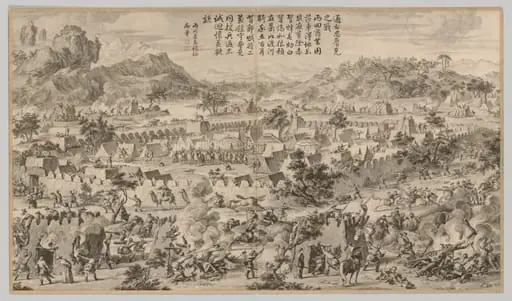 Battle at Tunggushi Luke: from Battle Scenes of the Quelling of the Rebellions in the Western Regions, with Imperial Poems
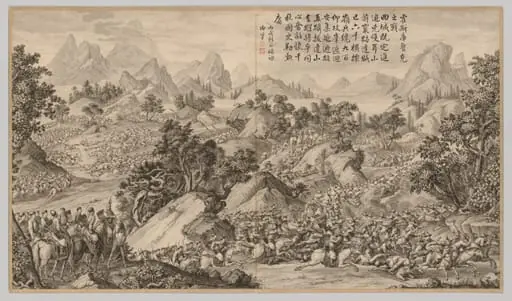 Battle at Heshi Kuluke: from Battle Scenes of the Quelling of Rebellions in the Western Regions, with Imperial Poems
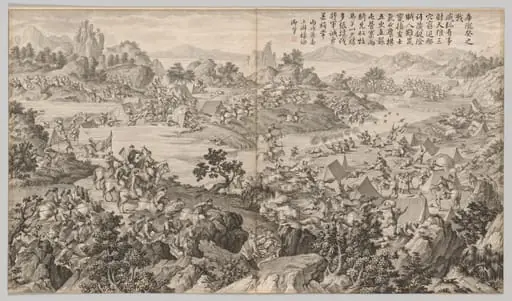 Battle of Kulongkui: from Battle Scenes of the Quelling of Rebellions in the Western Regions, with Imperial Poems
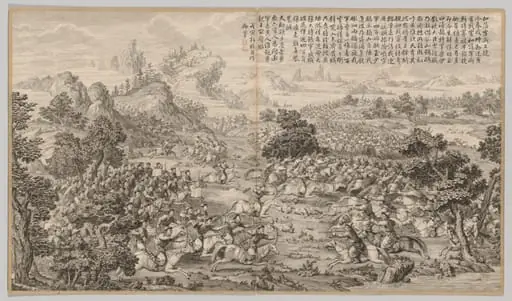 Victory at Heluo Heshi: from Battle Scenes of the Quelling of Rebellions in the Western Regions, with Imperial Poems
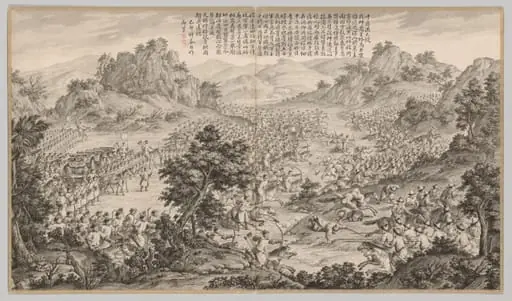 Great Victory at Hu'erman: from Battle Scenes of the Quelling of Rebellions in the Western Regions, with Imperial Poems
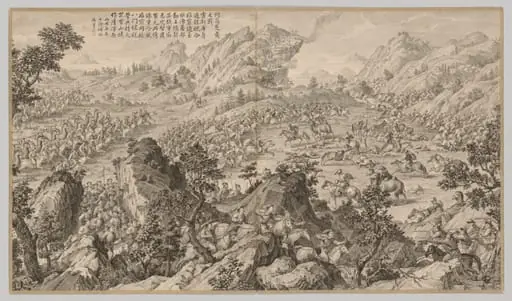 Battle at A'erchu'er: from Battle Scenes of the Quelling of Rebellions in the Western Regions, with Imperial Poems
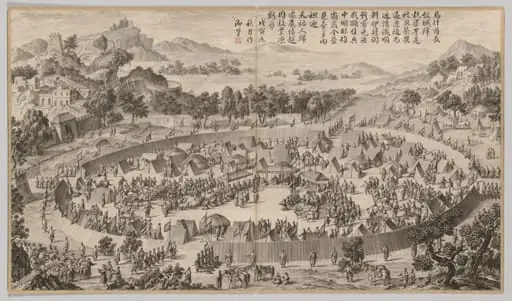 Chieftain Wushe Surrendering the City: from Battle Scenes of the Quelling of the Rebellions in the Western Regions, with imperial Poems
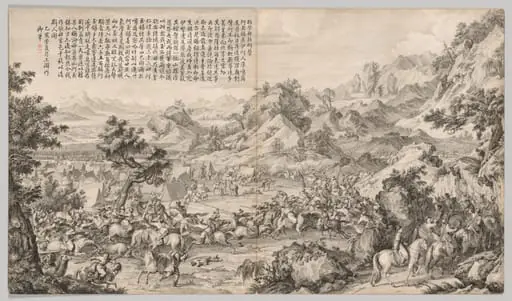 Attacking the Camp at Gatan Ola: from Battle Scenes of the Quelling of Rebellions in the Western Region, with Imperial Poems
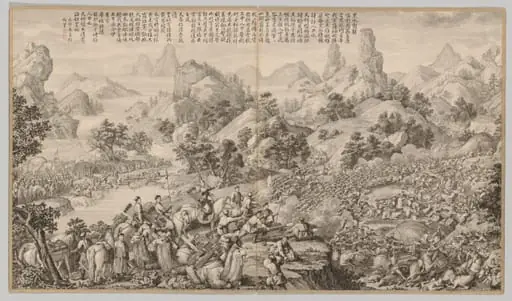 Breaking Through the Siege at Hesui: from Battle Scenes of the Quelling of Rebellions in the Western Regions, with imperial Poems
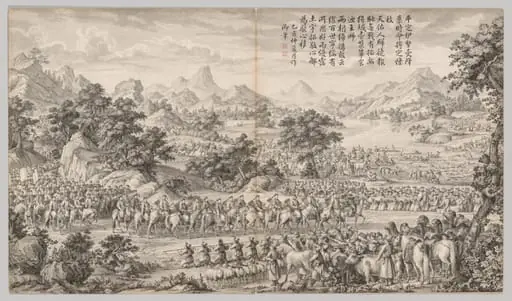 Receiving Surrender from the Eli: from Battle Scenes of the Quelling of Rebellions in the Western Regions, with Imperial Poems
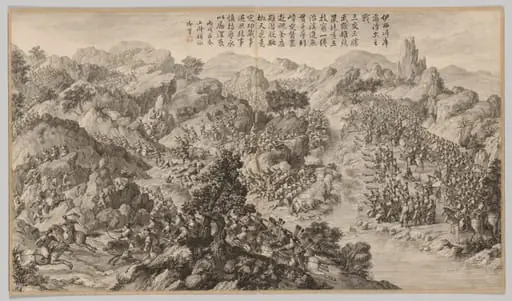 Battle at Yixi'er Ku'ernao'er: from Battle Scenes of the Quelling of Rebellions in the Western Regions, with Imperial Poems
 Rewards to Generals and Officers in Quelling the Uigurs: from Battle Scenes of the Quelling of Rebellions in the Western Regions, with Imperial Poems