Artwork
Nudes in a Landscape
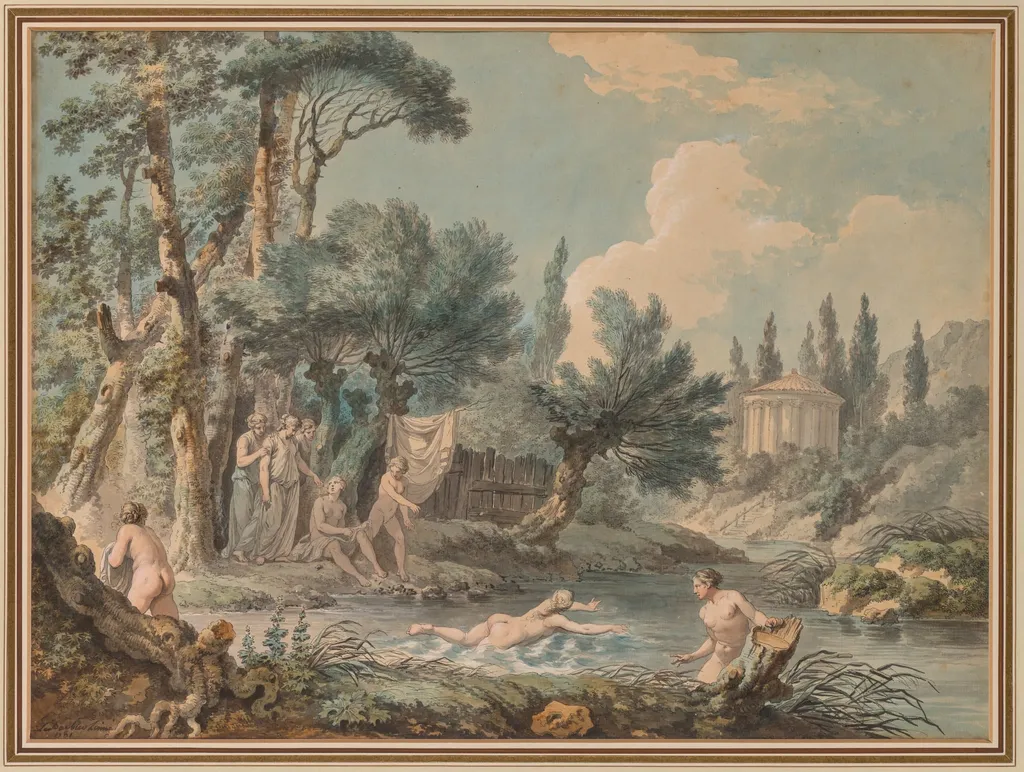
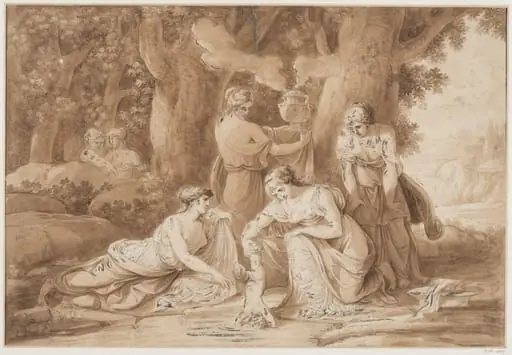
Nudes in a Landscape is a drawing by the Romanticist artist Jean-Jacques-François Lebarbier, called Le Barbier L’Aîné. It dates from 1781 and is held in the collection of the Cleveland Museum of Art.
About this work
Overview
This watercolor drawing by Jean-Jacques-François Le Barbier, known as Le Barbier L’Aîné, presents a pastoral scene populated by nude figures and classical architecture. Executed in the late 18th century, it aligns with the French Neoclassical movement’s revival of ancient forms, blending idealized human bodies with structured, temple-like ruins to evoke a sense of timeless harmony.
Subject & Meaning
A group of robed women stands in the middle ground, their poses reminiscent of ancient statuary, while a circular temple anchors the right side.
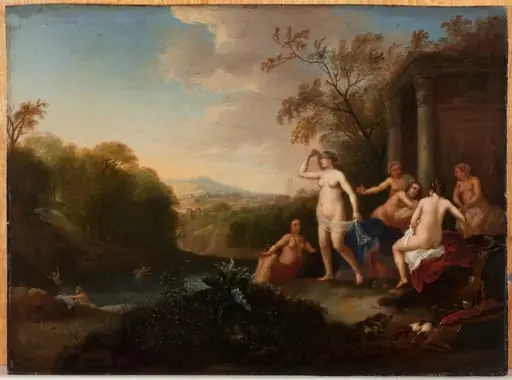
The composition centers on nude figures interacting within a tranquil landscape, their forms echoing classical sculpture. A group of robed women stands in the middle ground, their poses reminiscent of ancient statuary, while a circular temple anchors the right side. These elements suggest an idealized vision of antiquity, where nature and architecture coexist as expressions of moral and aesthetic order.
Technique & Style
Le Barbier employs delicate watercolor washes to render soft transitions of light and form, enhancing the ethereal quality of the scene. The figures are rendered with restrained anatomical precision, avoiding overt naturalism in favor of balanced, sculptural silhouettes. Architectural details are rendered with linear clarity, reinforcing the classical ideals that inform the entire composition.
History & Provenance
Created during the height of Neoclassicism in France, the work reflects the cultural fascination with antiquity following archaeological discoveries at Pompeii and Herculaneum. While specific early ownership records are not widely documented, the drawing aligns with private collections of the period that favored scholarly, mythologically inflected landscapes over overt narrative subjects.
Context
In the decades before the French Revolution, French artists turned to classical models as a counterpoint to Rococo frivolity. Le Barbier’s work participates in this shift, using mythic allusions and architectural references to construct serene, contemplative scenes. His approach was part of a broader trend among illustrators and draftsmen who sought to elevate decorative art through historical reference.
Legacy
Le Barbier’s drawings contributed to the dissemination of Neoclassical aesthetics in France, particularly through illustrated publications and private commissions. Though less celebrated than major painters of the era, his precise, restrained style influenced contemporaries working in graphic arts and helped normalize classical motifs in domestic and literary contexts.
Own this work as a print
Artist & collection
Artist
Jean-Jacques-François Lebarbier, called Le Barbier L’Aîné
Jean-Jacques-François Lebarbier, called Le Barbier L’Aîné (1738–1826) was a French artist.

![The Judgment of Paris [recto], by Guillaume Lethière](https://artifactworldgallery.com/img/guillaume-lethiere--the-judgment-of-paris-recto--1df8771f117e8a0e-w320.webp)