Artwork
Madame Greuze Asleep
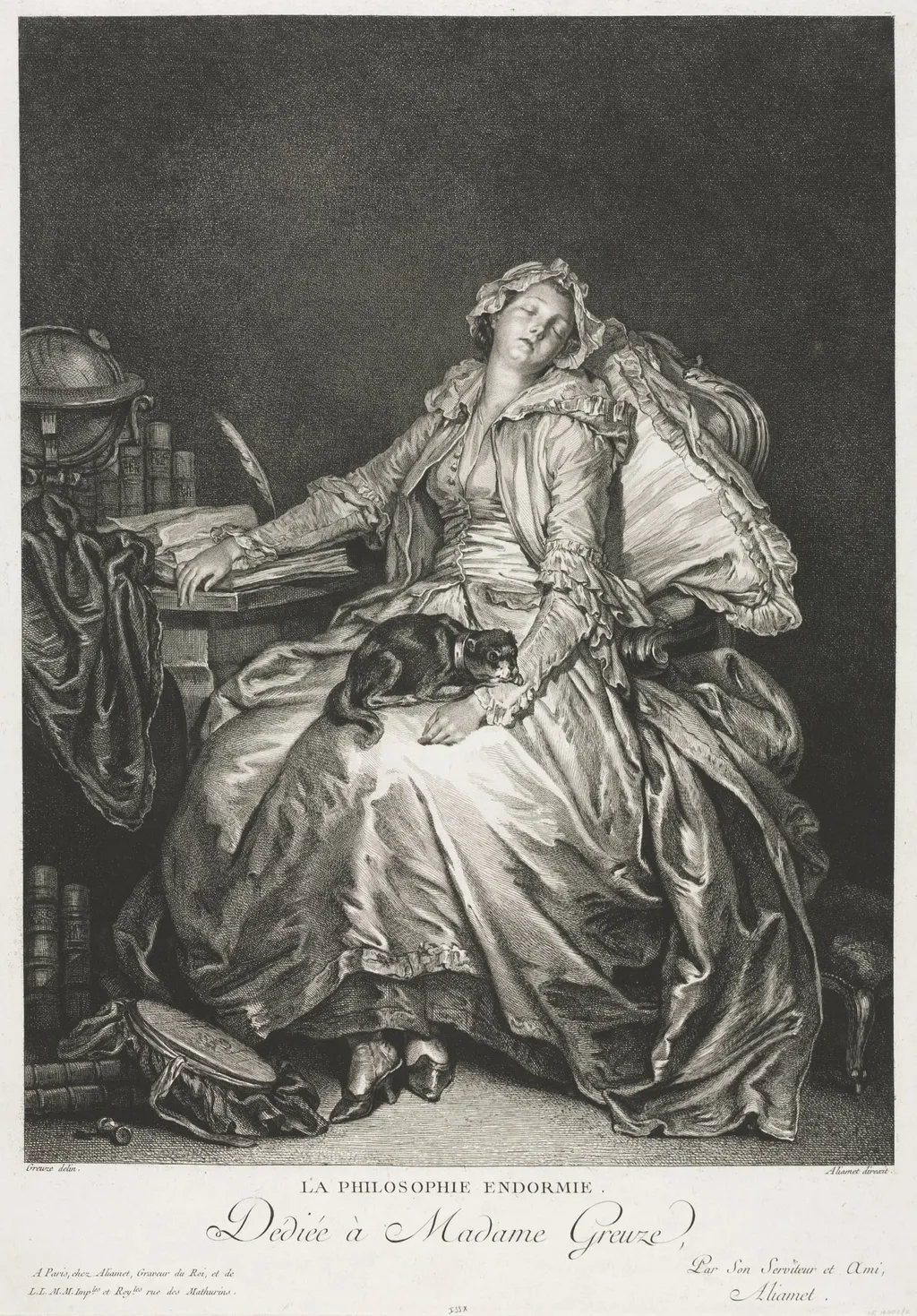
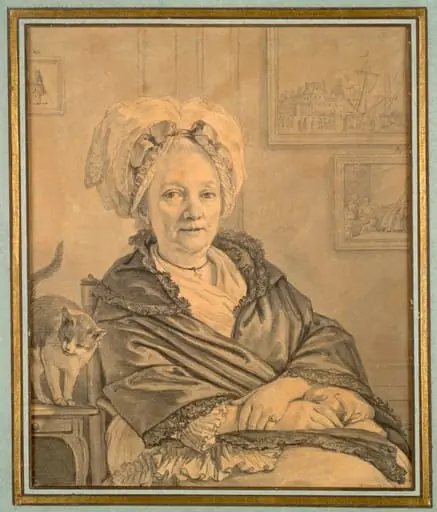
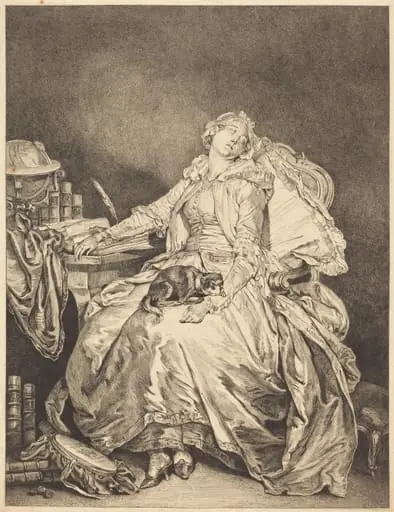
Madame Greuze Asleep is a print by the Romanticist artist Jean-Michel the Younger Moreau. It dates from 1776 and is held in the collection of the Cleveland Museum of Art. This print depicts a woman asleep amid scholarly objects—a desk, books, and a celestial globe—presented as an allegory of philosophy.
About this work
Overview
This print depicts a woman asleep amid scholarly objects—a desk, books, and a celestial globe—presented as an allegory of philosophy.
This print depicts a woman asleep amid scholarly objects—a desk, books, and a celestial globe—presented as an allegory of philosophy. The image was derived from a drawing by Jean-Baptiste Greuze, executed in collaboration with his wife, Anne-Gabrielle Babuti. Though appearing serene, the composition reflects a complex personal and professional dynamic, as Babuti played an active role in the production of Greuze’s prints for the market.
Subject & Meaning
The sleeping woman symbolizes philosophy, traditionally represented in repose among intellectual tools. The arrangement of books, pen, and globe evokes contemplation, yet the choice of a sleeping figure suggests a suspension of reason rather than its active pursuit. This ambiguity may reflect tensions between idealized intellectual virtue and the lived reality of the model, whose personal conduct contrasted sharply with the image’s serene dignity.
Technique & Style
The print employs fine linear detail and subtle tonal contrasts to render texture and form, characteristic of 18th-century reproductive engraving. Soft shadows define the drapery and objects, while the delicate rendering of the globe’s surface and book spines demonstrates technical precision. The composition is carefully balanced, with the reclining figure anchoring a quiet, intimate space filled with symbolic artifacts of learning.
History & Provenance
Anne-Gabrielle Babuti, the model and Greuze’s wife, was involved in the production of his prints, as evidenced by contracts with printmakers. Their marriage, marked by mutual artistic collaboration, deteriorated over time. Greuze sought divorce in 1793, citing adultery and moral misconduct. The print, created during their union, thus exists as both a collaborative work and a quiet monument to a fractured relationship.
Context
In late 18th-century France, allegorical depictions of philosophy often drew on classical imagery, but the use of a real woman—especially one known for personal controversy—introduced a layer of social commentary. The print’s production reflects the growing commercial print market, where artists’ spouses frequently contributed to the labor of reproduction, even as their public roles remained obscured.
Legacy
The print endures as a case study in the intersection of personal life and artistic production. It reveals how women’s contributions to printmaking were often instrumental yet uncredited in historical narratives. The dissonance between the image’s serene allegory and the model’s documented reputation invites ongoing reflection on the gap between representation and reality in art.
Artist & collection
Artist
Jean-Michel the Younger Moreau
Jean-Michel the Younger Moreau (1741–1814) was a French artist.