Artwork
Untitled
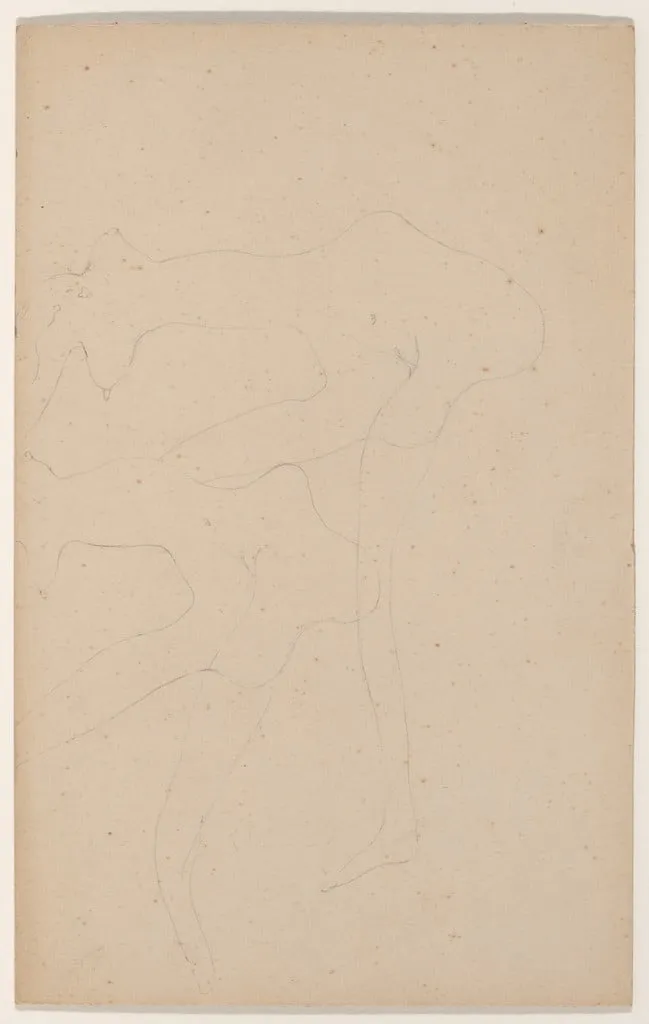
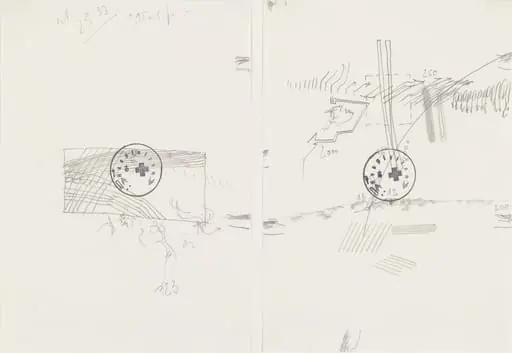
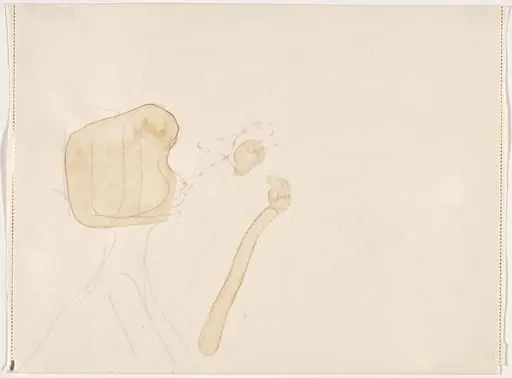
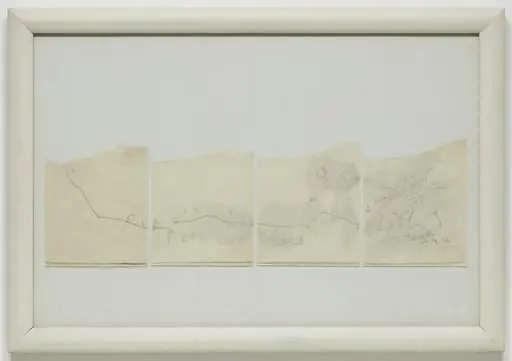
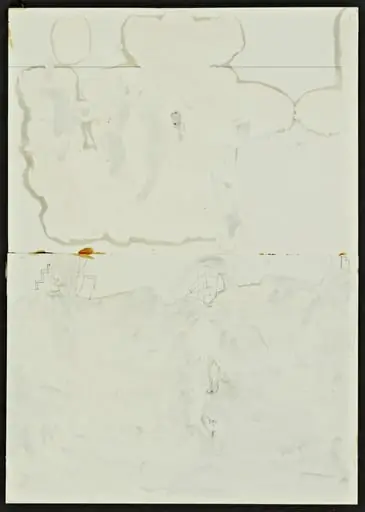
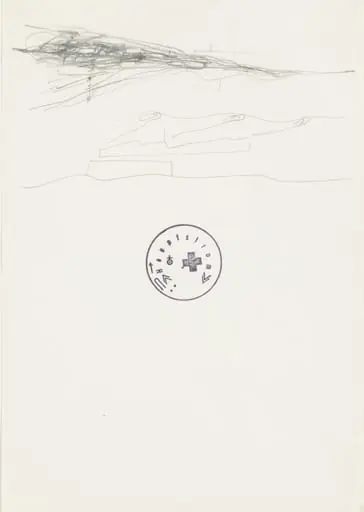
Untitled is a graphite drawing by Joseph Beuys. It dates from 1958 and is held in the collection of the Museum of Modern Art.
About this work
Overview
Created in 1958, this pencil drawing on board is an early work by Joseph Beuys, predating his better-known performance and political projects.
Created in 1958, this pencil drawing on board is an early work by Joseph Beuys, predating his better-known performance and political projects. Executed with minimal means, it reflects his interest in the expressive potential of line and form. The piece belongs to a formative phase in his career, when he was developing a visual language rooted in gesture and bodily presence, distinct from the symbolic materials he would later employ.
Subject & Meaning
The drawing depicts a single nude figure, rendered without context or environment. The absence of facial features or anatomical detail shifts focus to the body’s kinetic energy. Rather than representing a specific person, the figure functions as an abstracted vessel of movement and vitality. Beuys often explored the body as a site of physical and spiritual transformation, and this work anticipates his later conceptual focus on human potential and energy flow.
Technique & Style
Using only pencil on a light wooden board, Beuys employed rapid, overlapping strokes to construct the figure. The lines are unrefined and fluid, avoiding contour clarity in favor of cumulative motion. The lack of shading or background isolates the form, emphasizing the interplay of pressure and direction in each mark. This approach reveals his interest in drawing as a direct, physical act—more about process than representation.
History & Provenance
This work originates from Beuys’s early studio period, before his rise to international prominence in the 1960s and 70s. It was likely made during his time teaching at the Düsseldorf Art Academy, when he was refining his artistic vocabulary through frequent sketching. The drawing has remained in private and institutional collections since its creation, valued for its insight into his pre-performance development.
Context
In postwar Germany, many artists sought new modes of expression beyond traditional representation. Beuys, influenced by his wartime experiences and interest in anthropology, turned to drawing as a way to explore inner states and collective memory. This work aligns with broader European tendencies toward gestural abstraction, yet remains uniquely personal—focused on the body as a fundamental, unmediated form of expression.
Legacy
Though modest in scale, this drawing illustrates the foundational principles of Beuys’s later work: the body as a site of action, line as a record of energy, and simplicity as a vehicle for depth. It reveals how his conceptual concerns—humanism, transformation, and social sculpture—were already present in his earliest visual experiments, long before they took public form in performances or institutional projects.
Artist & collection
Artist
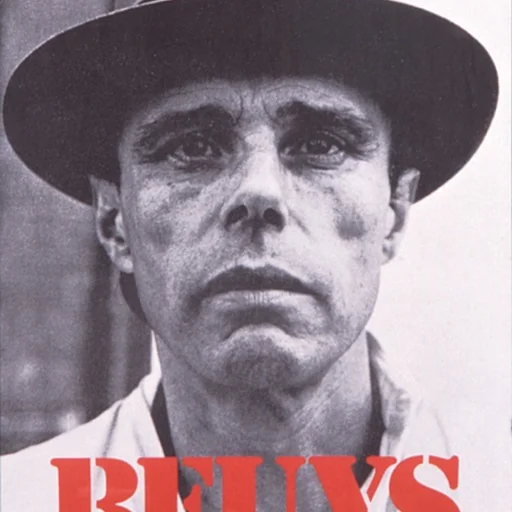
Joseph Heinrich Beuys ( BOYSS; German: ; 12 May 1921 – 23 January 1986) was a German artist, teacher, performance artist, and art theorist whose work reflected concepts of humanism and sociology.

 Study of a Female Nude
![Sketch for the Flight into Egypt [verso], by Giovanni Domenico Tiepolo](https://artifactworldgallery.com/img/giovanni-domenico-tiepolo--sketch-for-the-flight-into-egypt-verso--c1883479f90269fc-w320.webp) Sketch for the Flight into Egypt [verso]
Sketch for the Flight into Egypt [verso] Figure Studies
![Sheet of Studies [recto and verso], by John Flaxman](https://artifactworldgallery.com/img/john-flaxman--sheet-of-studies-recto-and-verso--c82bf77b351cdf13-w320.webp) Sheet of Studies [recto and verso]
Sheet of Studies [recto and verso]![Sheet of Studies [recto and verso], by John Flaxman](https://artifactworldgallery.com/img/john-flaxman--sheet-of-studies-recto-and-verso--a7e6ad641a0703a0-w320.webp) Sheet of Studies [recto and verso]
Sheet of Studies [recto and verso]![Study of a Farmer [verso], by Perry, Enoch Wood, Jr.](https://artifactworldgallery.com/img/perry-enoch-wood-jr--study-of-a-farmer-verso--a0126474be455213-w320.webp) Study of a Farmer [verso]
Study of a Farmer [verso]![Head of a Cow [recto], by Paul Gauguin](https://artifactworldgallery.com/img/paul-gauguin--head-of-a-cow-recto--b91cefb1149f906f-w320.webp) Head of a Cow [recto]
Head of a Cow [recto]![Study of the "Ecorché" [recto], by Paul Cezanne](https://artifactworldgallery.com/img/paul-cezanne--study-of-the-ecorche-recto--1614b86d796e004d-w320.webp) Study of the "Ecorché" [recto]
Study of the "Ecorché" [recto]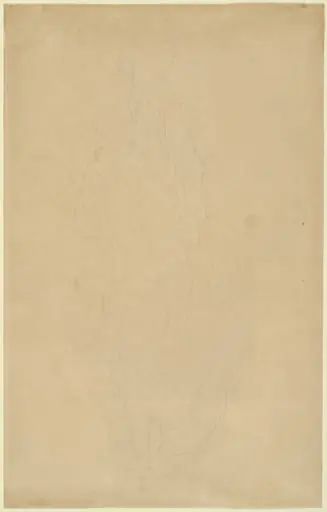 Untitled
 Study of the Allegorical Figure of Health in Rubens' "The Birth of Louis XIII"
![Sketch of a Sphinx [?] (verso), by Luc-Olivier Merson](https://artifactworldgallery.com/img/luc-olivier-merson--sketch-of-a-sphinx-verso--01aae5545d384a57-w320.webp) Sketch of a Sphinx [?] (verso)
Sketch of a Sphinx [?] (verso) Study for a Lunette