Artwork
The Cut from Culebra, Panama
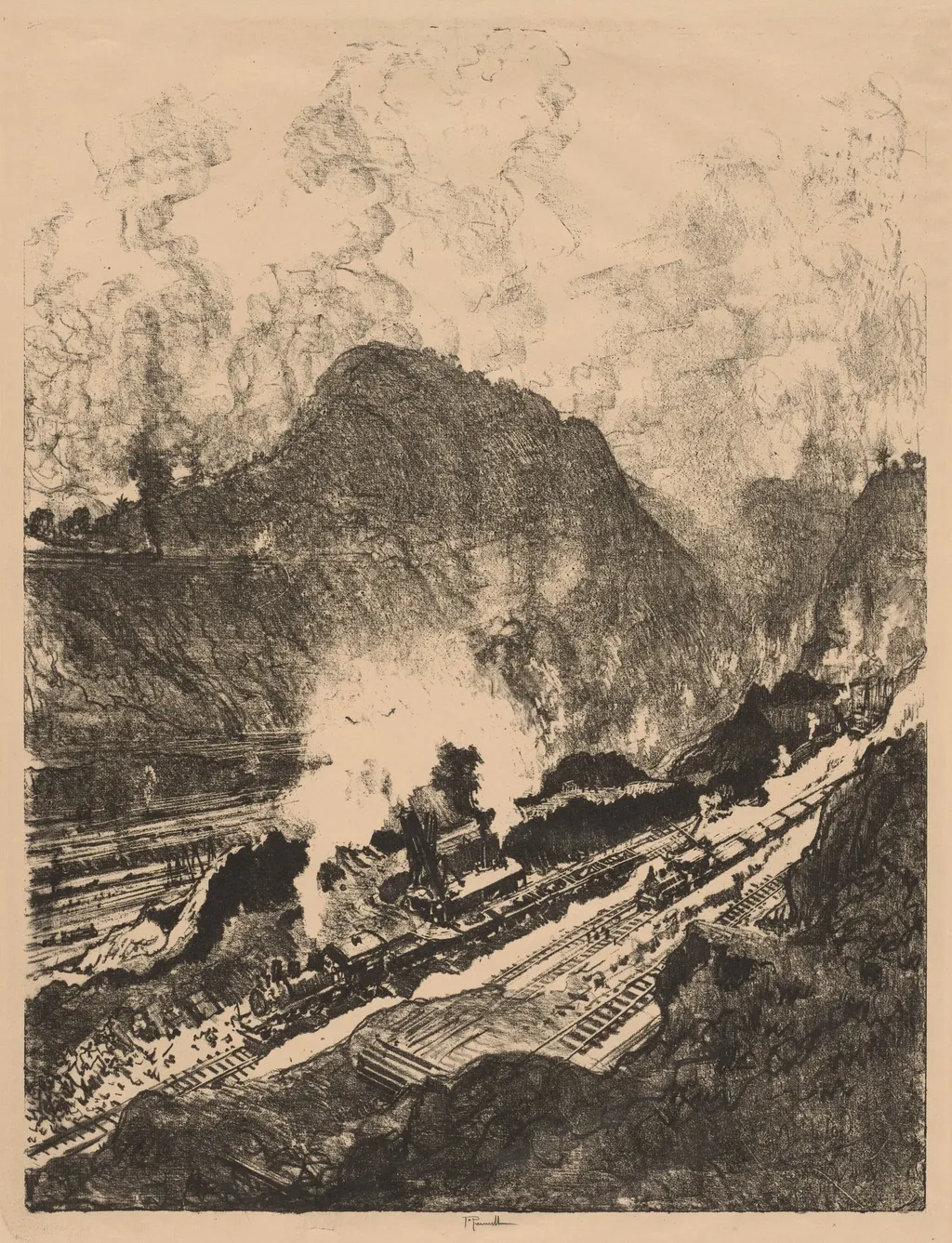
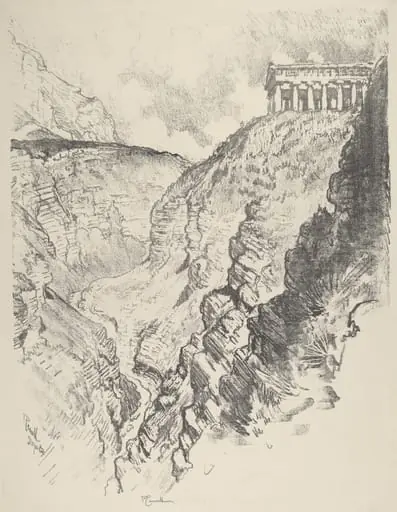
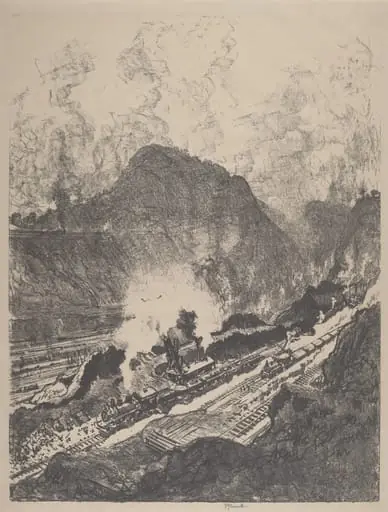
The Cut from Culebra, Panama is a print by Joseph Pennell. It dates from 1912 and is held in the collection of the Cleveland Museum of Art.
About this work
Tiny buildings and trees dot the slopes, and the whole scene feels rough and textured, almost like scratched paper.
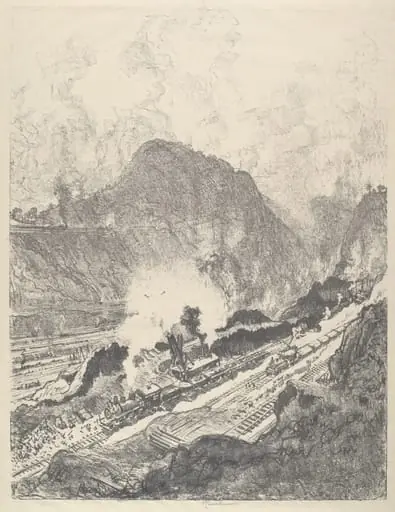
This drawing shows a winding train track cutting through a steep, rocky hillside. The mountain looms dark and jagged, while the tracks twist below like a ribbon. Tiny buildings and trees dot the slopes, and the whole scene feels rough and textured, almost like scratched paper.
The artist used quick, sketchy lines to show the train’s path climbing upward—no smooth curves here. This was made in 1912 to document the Panama Canal’s construction.
Next, check out The Cleveland Museum of Art to see more works like this.
Overview
The Cut from Culebra, Panama is a 1912 print by American draftsman Joseph Pennell. Executed during the height of Panama Canal construction, the work records a steep railway cut that winds through a rugged hillside. The composition balances stark rock faces with the sinuous line of the track, punctuated by modest structures and scattered vegetation, conveying the scale of engineering against a raw landscape.
Subject & Meaning
The image captures a railway trench carved into a jagged mountain, illustrating the formidable terrain that workers had to overcome to link the Atlantic and Pacific. By emphasizing the track’s twisting path and the looming cliffs, Pennell underscores the tension between human ambition and natural obstacles, offering a visual narrative of progress amid a harsh environment.
Technique & Style
Pennell employed rapid, sketch‑like lines that give the surface a textured, almost scratched appearance. The drawing relies on stark contrasts and angular strokes to render the rock’s roughness, while the track is rendered as a thin, meandering ribbon. This economical approach reflects his background in etching and lithography, favoring immediacy over polished finish.
History & Provenance
Created while Pennell was documenting the Panama Canal’s development, the print entered the Cleveland Museum of Art’s collection, where it remains accessible to the public. Pennell’s broader career included extensive travel in Europe and collaborations with his wife, writer Elizabeth Robins, but this work stands as a specific record of an American engineering project.
Context
Pennell’s training under James Lambdin, Thomas Eakins, and the influence of James McNeill Whistler informed his keen eye for architectural and industrial subjects. In the early twentieth century, such documentary prints served both artistic and archival purposes, providing contemporary audiences with visual accounts of large‑scale infrastructure projects like the Canal.
Own this work as a print
Artist & collection
Artist
Joseph Pennell (July 4, 1857 – April 23, 1926) was an American draftsman, etcher, lithographer, and illustrator for books and magazines.