Artwork
Magdalena penitente en la gruta de Sainte-Baume
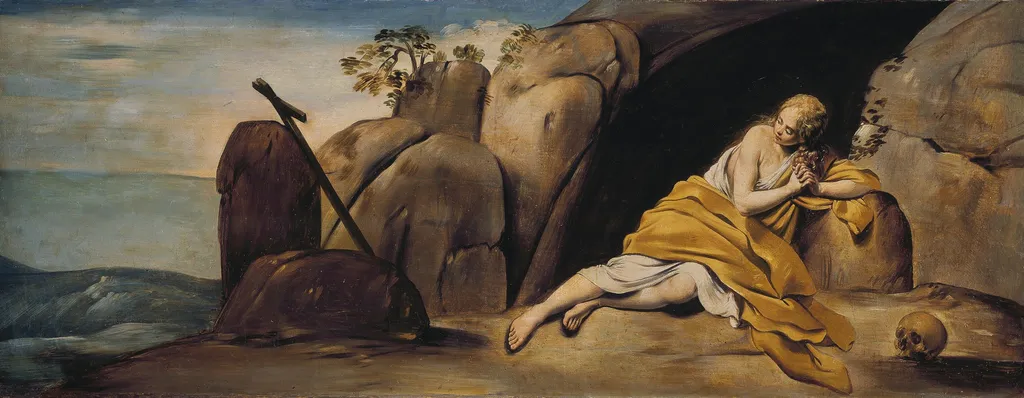
Magdalena penitente en la gruta de Sainte-Baume is an oil painting by the Early Baroque Italian artist Juan Bautista Maíno. It dates from 1612 and is held in the collection of the Museo del Prado.
About this work
Overview
Juan Bautista Maíno's 1612 oil painting, "Magdalena penitente en la gruta de Sainte-Baume," depicts Mary Magdalene in a moment of profound contemplation.
Juan Bautista Maíno's 1612 oil painting, "Magdalena penitente en la gruta de Sainte-Baume," depicts Mary Magdalene in a moment of profound contemplation. This religious work, now housed at the Museo del Prado, presents the saint kneeling within a rocky landscape, engaged in penitence. The composition highlights her spiritual devotion through symbolic elements and a dramatic visual treatment, characteristic of the period's religious art, inviting viewers to reflect on themes of faith and mortality.
Subject & Meaning
The painting centers on Mary Magdalene, shown kneeling on rugged terrain, clad in a yellow garment. She holds a cross while her gaze rests upon a human skull, traditional symbols of Christian devotion and mortality. The setting, a cave with a reclining figure, likely references the grotto of Sainte-Baume, where Magdalene is said to have spent her final years in solitary reflection and penance. These elements collectively convey themes of spiritual introspection and the transient nature of life.
Technique & Style
Maíno employs a dramatic interplay of light and shadow, known as chiaroscuro, to heighten the emotional intensity of the scene. Strong illumination picks out Mary Magdalene and the symbolic objects, contrasting sharply with the deep recesses of the cave and the surrounding environment. This technique not only creates a sense of depth and volume but also underscores the spiritual gravity of the moment, drawing the viewer's focus to the saint's profound contemplation and penitence.
Artist & collection