Artwork
Giraffe piano
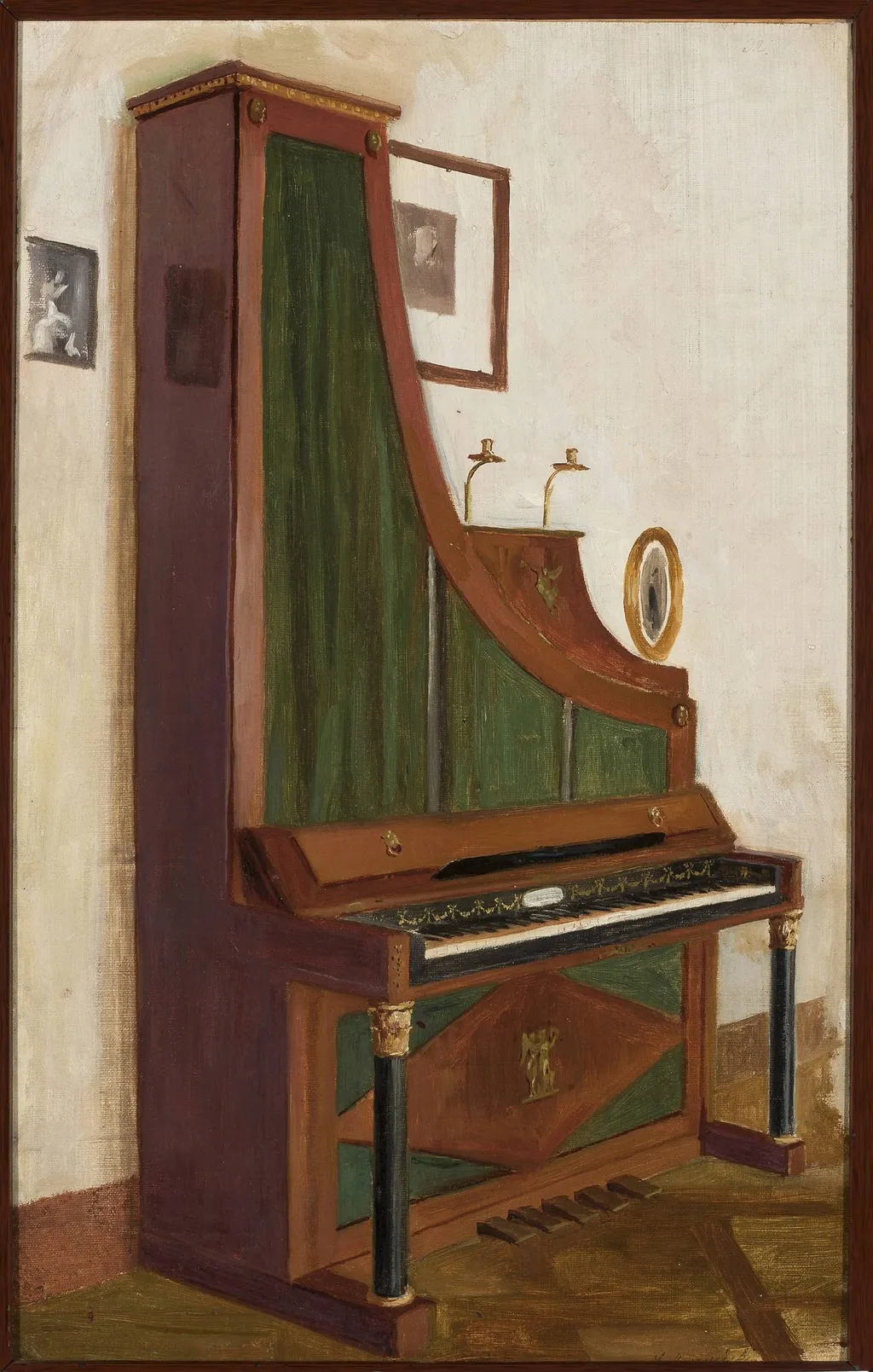
Giraffe piano is an oil painting by the Post-Impressionist artist Julian Maszyński. It dates from 1896 and is held in the collection of the National Museum in Warsaw.
About this work
Overview
The work presents an unusual domestic interior centered on a piano whose form evokes the silhouette of a giraffe—elongated neck, flat top, and sturdy frame.
Giraffe Piano is an 1896 oil painting by Polish artist Julian Maszyński, currently held in the collection of the National Museum in Warsaw. The work presents an unusual domestic interior centered on a piano whose form evokes the silhouette of a giraffe—elongated neck, flat top, and sturdy frame. The composition is restrained yet deliberate, with attention to spatial relationships and subtle tonal contrasts that ground the object in a quiet, lived-in environment.
Subject & Meaning
The painting’s subject—a piano shaped like a giraffe—blends the functional with the whimsical, suggesting a personal or symbolic gesture rather than a literal representation. The instrument, rendered with careful detail, may reflect the owner’s individuality or a playful response to conventional domestic furnishings. The inclusion of a small mirror and two indistinct wall pictures implies a private, intimate space, inviting contemplation over narrative clarity.
Technique & Style
Maszyński employs a muted palette of greens, browns, and warm neutrals to unify the scene. The piano’s green front and brown frame are rendered with soft modeling, suggesting volume without overt dramatic lighting. Subtle chiaroscuro defines the form’s contours and the wooden floor’s texture, while the flat white wall recedes to emphasize the object’s presence. Brushwork is controlled, favoring clarity over expressive gesture.
History & Provenance
Painted in 1896, the work entered the National Museum in Warsaw’s collection at an early stage, likely through acquisition or donation shortly after its creation. Its survival in institutional hands suggests it was recognized as a distinctive example of late 19th-century Polish genre painting, though it never achieved widespread public attention. Documentation of its early ownership remains limited.
Context
In the context of 19th-century Polish art, Maszyński’s work aligns with a quiet tradition of interior scenes that focus on everyday objects imbued with personal significance. While contemporaries often depicted grand historical or romantic themes, this painting offers a quiet, almost surreal meditation on domesticity. Its oddity may reflect broader European trends of symbolic or decorative object-making in the fin de siècle period.
Legacy
Giraffe Piano remains a singular work in Maszyński’s oeuvre and in Polish painting of the era. It is not widely reproduced or studied, but its persistence in the museum’s collection ensures its continued presence as an example of understated eccentricity in art. Scholars occasionally reference it as a curiosity that challenges conventional expectations of both musical instruments and interior painting.
Artist & collection