Artwork
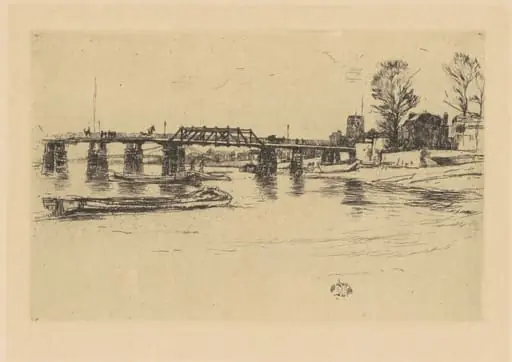
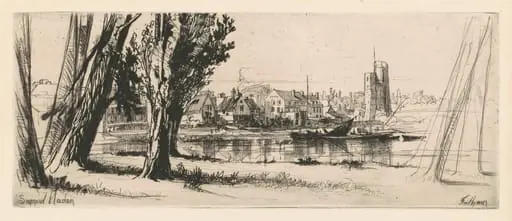
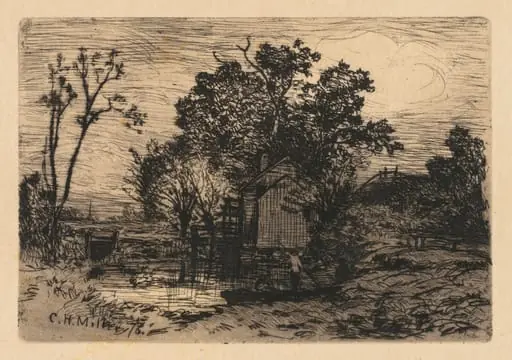
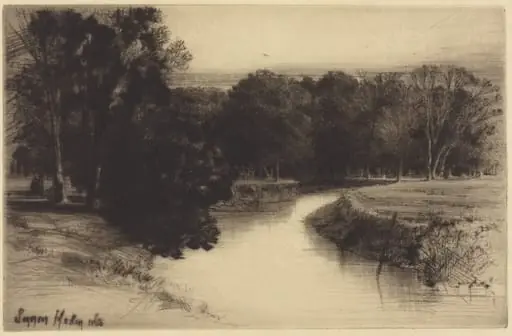
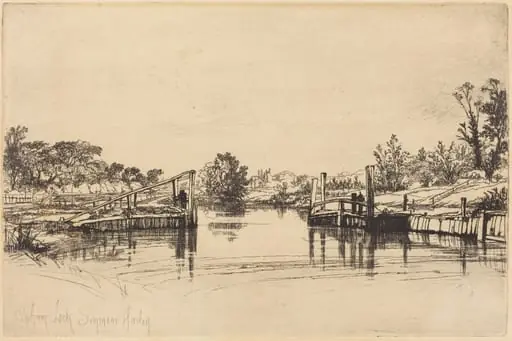
Lock on the Canal Near Watford
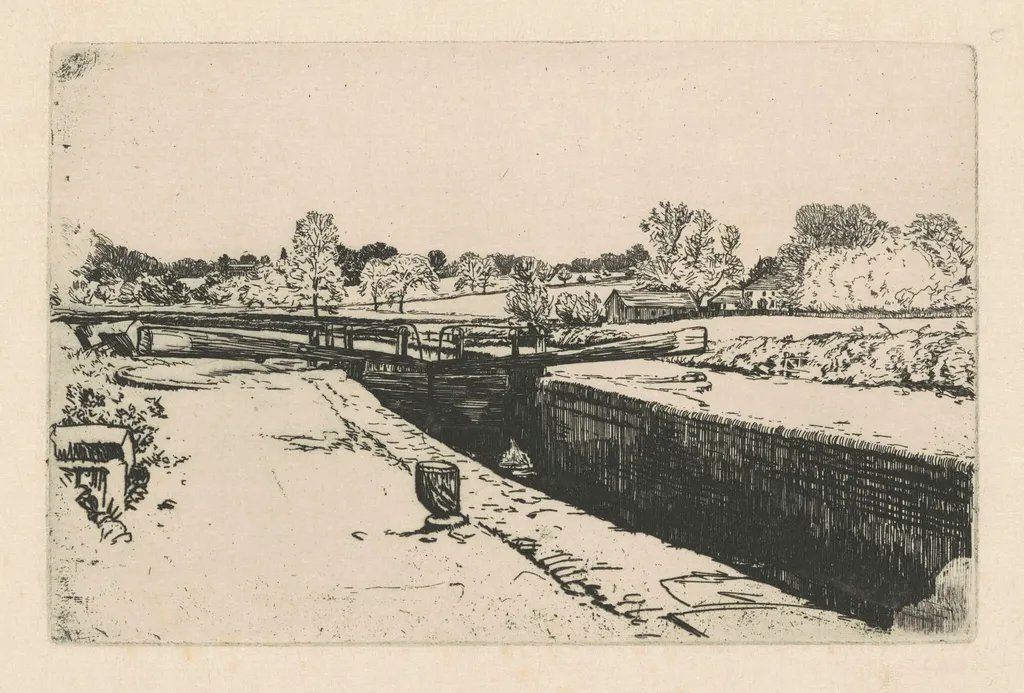
Lock on the Canal Near Watford is an ink print by the Romanticist artist Charles Samuel Keene. It dates from 1857 and is held in the collection of the National Gallery of Art.
About this work
Overview
Charles Samuel Keene created this 1857 etching as part of his focus on ordinary English landscapes. Unlike grand historical scenes, he turned his attention to quiet, unremarkable corners of the countryside. The work belongs to a series of prints documenting canal life, reflecting a growing interest in rural industry and leisure during the mid-nineteenth century.
Subject & Meaning
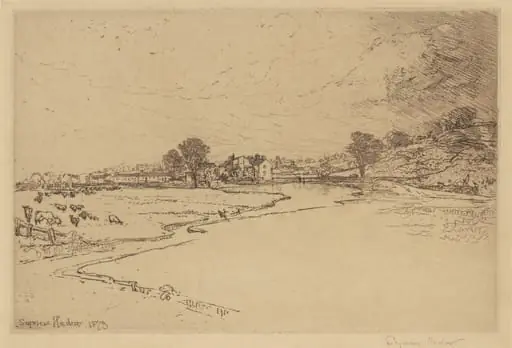
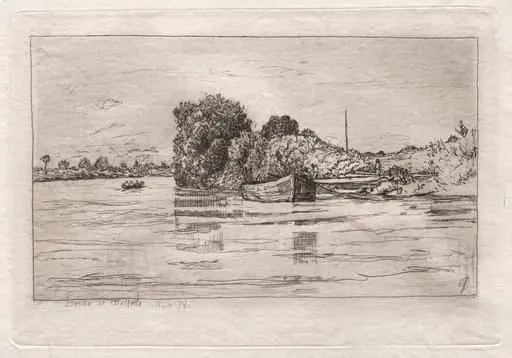
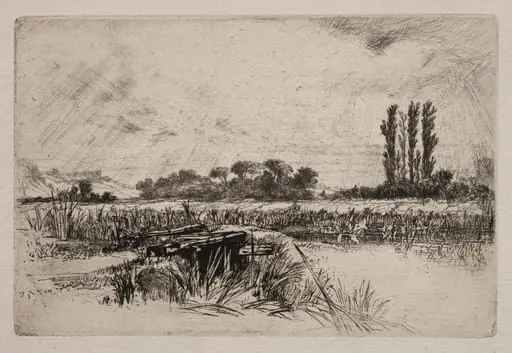
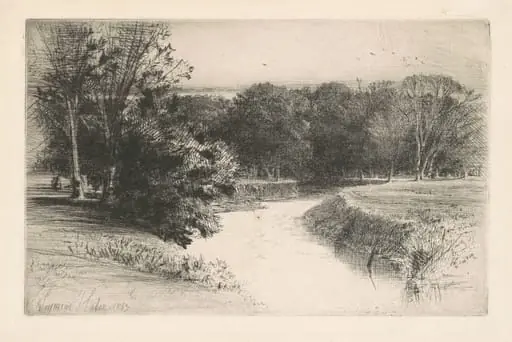
The scene captures a canal lock near Watford, a functional waterway structure used to manage water levels for boat traffic. A narrow wooden bridge spans the water, flanked by grassy banks and a footpath. Sparse trees and distant buildings suggest a modest, working landscape. There is no human activity visible, lending the image a stillness that emphasizes the quiet rhythm of rural infrastructure.
Technique & Style
Fine, controlled strokes define textures: the grain of the bridge planks, the roughness of tree bark, and the subtle gradations of foliage.
Keene employed etching, a printmaking process involving acid-bitten lines on a metal plate. Fine, controlled strokes define textures: the grain of the bridge planks, the roughness of tree bark, and the subtle gradations of foliage. The absence of tone or wash creates a crisp, linear quality, characteristic of his illustrative approach. The composition is restrained, avoiding dramatic perspective in favor of observational clarity.
History & Provenance
The print was produced during Keene’s early career, before his association with Punch magazine. It reflects his independent work as a topographical draftsman, documenting England’s canal networks. While no detailed ownership history is widely recorded, such prints were commonly circulated among collectors and artists interested in contemporary British life, often sold as individual sheets or in small portfolios.
Context
In the 1850s, Britain’s canal system was still vital for transport, though increasingly overshadowed by railways. Keene’s focus on these waterways aligns with a broader cultural interest in documenting industrial heritage. His choice of subject—unpopulated, functional, and unromanticized—contrasts with the picturesque traditions of landscape painting, offering instead a quiet record of everyday utility.
Legacy
Keene’s etchings, including this one, contributed to the revival of etching as a medium for modern subjects in Victorian Britain. His precise, unembellished style influenced later illustrators and printmakers who sought to capture ordinary life without sentimentality. Though not widely exhibited today, his works remain important examples of 19th-century British graphic art focused on the mundane.
Own this work as a print
Artist & collection

Artist
Charles Samuel Keene (10 August 1823 – 4 January 1891) was an English artist and illustrator, who worked in black and white.