Artwork
Eagham Lock
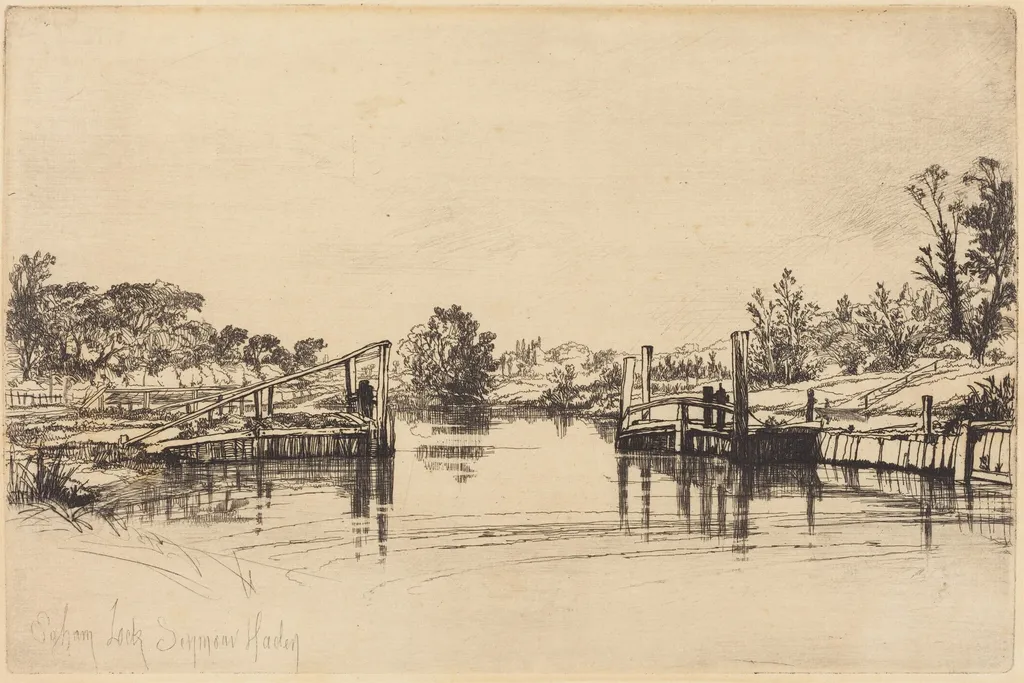
Eagham Lock is an ink print by the Impressionist artist Francis Seymour Haden. It dates from 1859 and is held in the collection of the National Gallery of Art.
About this work
Overview
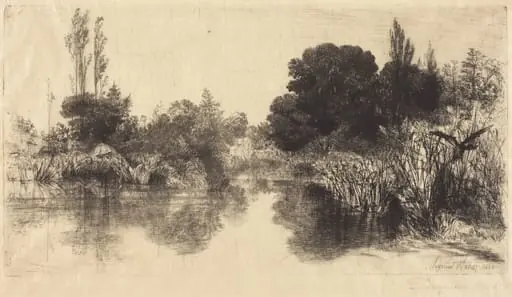
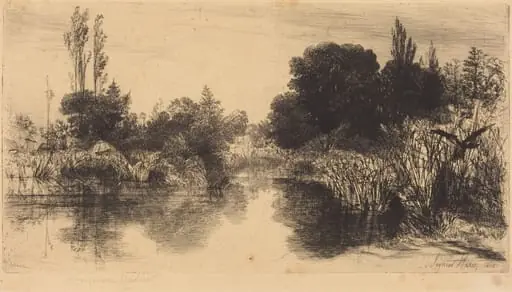
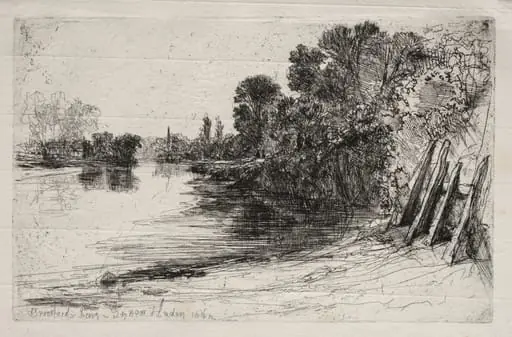
Eagham Lock is an 1859 print by Francis Seymour Haden, made using etching and drypoint on laid paper. It depicts a tranquil stretch of the River Thames near a lock structure, rendered with fine, controlled lines that emphasize stillness and quiet observation. The composition focuses on the interplay of water, vegetation, and human infrastructure, with minimal figures to underscore solitude.
Subject & Meaning
The scene captures a modest, everyday moment on the Thames— a wooden bridge spanning a lock, trees lining the banks, and fence posts dipping into the water. A single figure stands on the bridge, dwarfed by the landscape, suggesting contemplation rather than action. The work conveys a sense of calm endurance, reflecting the quiet rhythm of rural waterways in mid-19th century England.
Technique & Style
Haden employed etching and drypoint to achieve fine, incised lines with varying depth and texture. The water’s surface is rendered with delicate, meandering strokes to suggest gentle ripples, while the wooden structures are defined by sharp, angular marks. The laid paper’s subtle grain enhances the tactile quality of the print, reinforcing the naturalism of the scene without embellishment.
History & Provenance
Created in 1859, Eagham Lock was made during Haden’s active period as a practicing surgeon and amateur printmaker. He produced many Thames landscapes during this time, often sketching en plein air before translating them into prints. The work remained within private collections in Britain, largely unnoticed by the public until later recognition of his contribution to British etching.
Context
Haden’s work aligned with this shift, influenced by the English tradition of topographical drawing and the emerging interest in direct observation.
In the mid-1800s, British artists increasingly turned to landscape and everyday scenes as subjects for printmaking, moving away from grand historical narratives. Haden’s work aligned with this shift, influenced by the English tradition of topographical drawing and the emerging interest in direct observation. His prints were part of a quiet revolution in print culture, valuing intimacy over spectacle.
Legacy
Eagham Lock exemplifies Haden’s role in reviving etching as a serious artistic medium in Britain. Though not widely exhibited in his lifetime, his precise, restrained style influenced later generations of printmakers who sought authenticity in landscape representation. The work remains a quiet benchmark in the history of British printmaking for its understated observation and technical discipline.
Artist & collection