Artwork
Windmill near Burg on Fehmarn
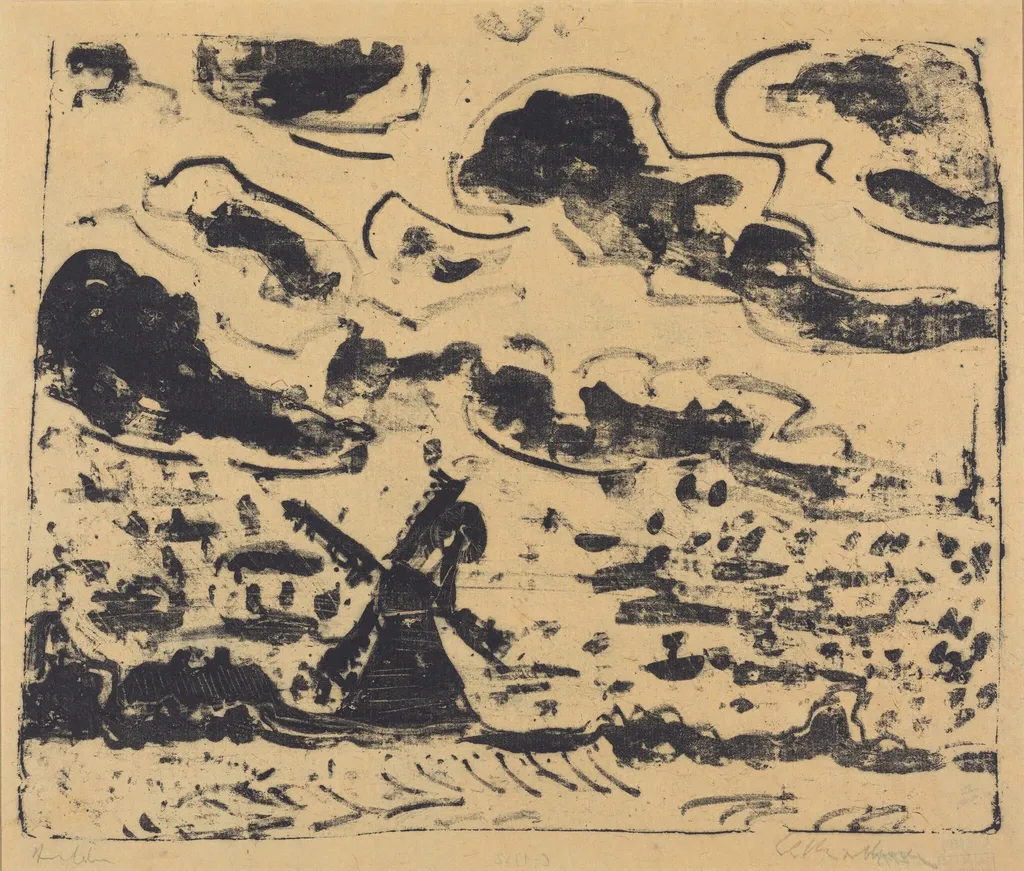
Windmill near Burg on Fehmarn is an ink print by Ernst Ludwig Kirchner. It dates from 1908 and is held in the collection of the National Gallery of Art.
About this work
Overview
Created in 1908, *Windmill near Burg on Fehmarn* is a lithograph by German artist Ernst Ludwig Kirchner, executed in black ink on delicate Japanese paper.
Created in 1908, *Windmill near Burg on Fehmarn* is a lithograph by German artist Ernst Ludwig Kirchner, executed in black ink on delicate Japanese paper. As a member of Die Brücke, Kirchner prioritized expressive force over naturalistic detail. The print captures a solitary windmill against a brooding sky, rendered with rapid, unrefined lines that convey immediacy and emotional intensity rather than precise representation.
Subject & Meaning
The windmill, isolated in a vast, flat landscape, becomes a symbol of resilience amid elemental forces. Dark, churning clouds dominate the upper half, while the blurred sails suggest motion under strong wind. The barren ground, marked by jagged strokes, reinforces a sense of exposure and tension. Kirchner does not idealize the scene; instead, he conveys the psychological weight of the environment, aligning with Expressionism’s focus on inner experience over external accuracy.
Technique & Style
Kirchner employed lithography to achieve a raw, spontaneous aesthetic. The technique allowed him to draw directly on stone, preserving the urgency of his hand. Thin Japan paper absorbed the ink unevenly, enhancing the texture of the lines. Only black ink and the paper’s pale tone are used, eliminating color to heighten contrast and emotional starkness. The sketch-like quality suggests a moment captured in passing, not a polished composition.
History & Provenance
Produced during Kirchner’s early years with Die Brücke, the print reflects his experimentation with printmaking as a medium for emotional expression. It was made on the island of Fehmarn, where Kirchner spent summers sketching rural scenes. The work remained in private collections after its creation and later entered institutional holdings, though its early circulation was limited due to the niche nature of print distribution at the time.
Context
In 1908, European art was shifting away from academic traditions toward subjective, emotionally charged forms. Die Brücke artists rejected naturalism, seeking to distill experience into bold, simplified forms. Kirchner’s choice of a rural windmill—a common motif in northern German landscapes—was not nostalgic but confrontational, reflecting anxieties about modernity and isolation. This print aligns with broader avant-garde efforts to redefine artistic purpose beyond representation.
Legacy
Though less known than Kirchner’s paintings, this lithograph exemplifies his contribution to modern printmaking. Its raw technique influenced later Expressionist and post-war artists who valued immediacy over finish. The work survives as a quiet but potent document of early 20th-century German art’s turn inward, capturing a moment where landscape became a vessel for psychological state rather than topographical record.
Artist & collection
Artist
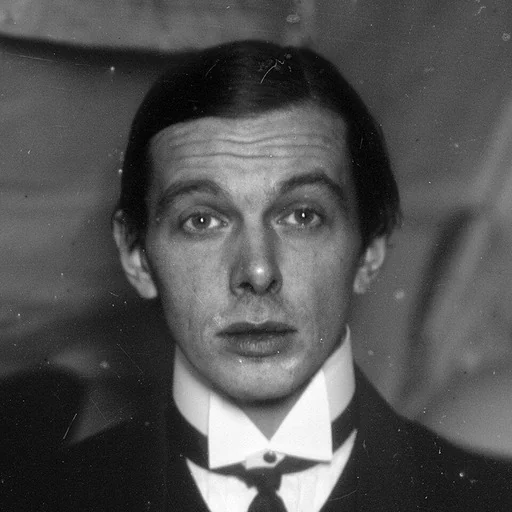
Ernst Ludwig Kirchner (6 May 1880 – 15 June 1938) was a German expressionist painter and printmaker.

![Dance Hall Bellevue [obverse], by Ernst Ludwig Kirchner](https://artifactworldgallery.com/img/ernst-ludwig-kirchner--dance-hall-bellevue-obverse--d1e14aac4297c69e-w320.webp)
![Nude Figure [reverse], by Ernst Ludwig Kirchner](https://artifactworldgallery.com/img/ernst-ludwig-kirchner--nude-figure-reverse--4b135f0364753e98-w320.webp)
![Two Nudes [obverse], by Ernst Ludwig Kirchner](https://artifactworldgallery.com/img/ernst-ludwig-kirchner--two-nudes-obverse--eb3914183f0bc96d-w320.webp)
![Dancing Couple in the Snow [reverse], by Ernst Ludwig Kirchner](https://artifactworldgallery.com/img/ernst-ludwig-kirchner--dancing-couple-in-the-snow-reverse--87ca007d7c05b553-w320.webp)
 Untitled
 Fisherman's thatched cottage
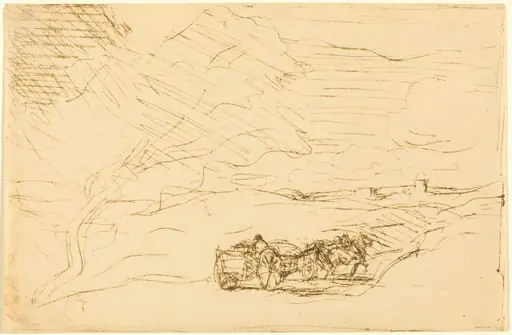 Wagon Going to Town (Le Charriot allant a la ville)
![Tahitian Shore [recto], by Paul Gauguin](https://artifactworldgallery.com/img/paul-gauguin--tahitian-shore-recto--d19dfa11db6e6101-w320.webp) Tahitian Shore [recto]
Tahitian Shore [recto]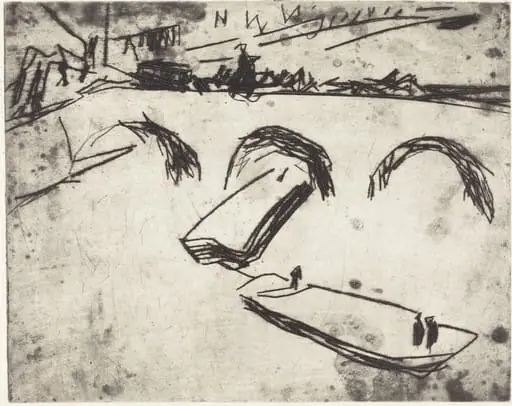 Bridge on Crown Prince Embankment (Brucke am Kronprinzenufer)
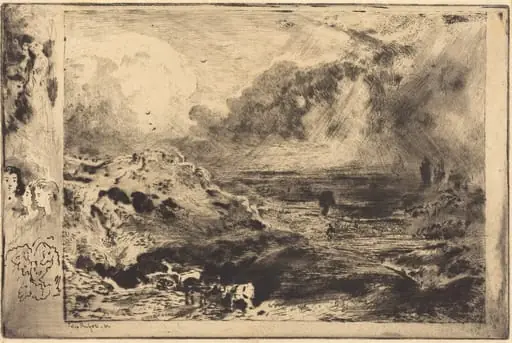 L'Orage (The Storm)
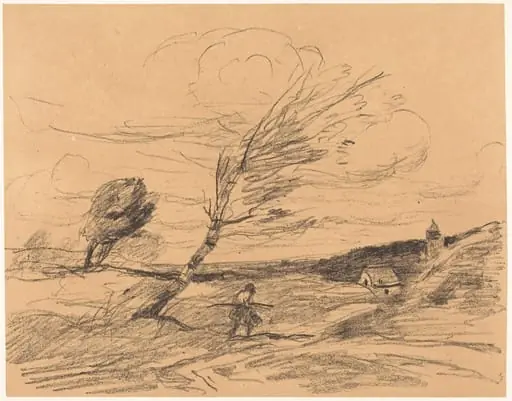 The Gust of Wind (Le Coup de vent)
 Chaumières anglaises (English Cottages)
![Landscape [Paesaggio], by Carlo Paolo Agazzi](https://artifactworldgallery.com/img/carlo-paolo-agazzi--landscape-paesaggio--e606f4ada87d2052-w320.webp) Landscape [Paesaggio]
Landscape [Paesaggio] Miami River, near Cincinnati, Ohio
 Plate with Sketches
 Cow and Its Keeper (La Vache et sa gardienne)