Artwork
Muhammed's carpet moving from Mecca to Cairo
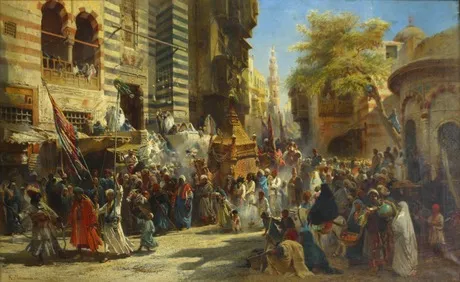
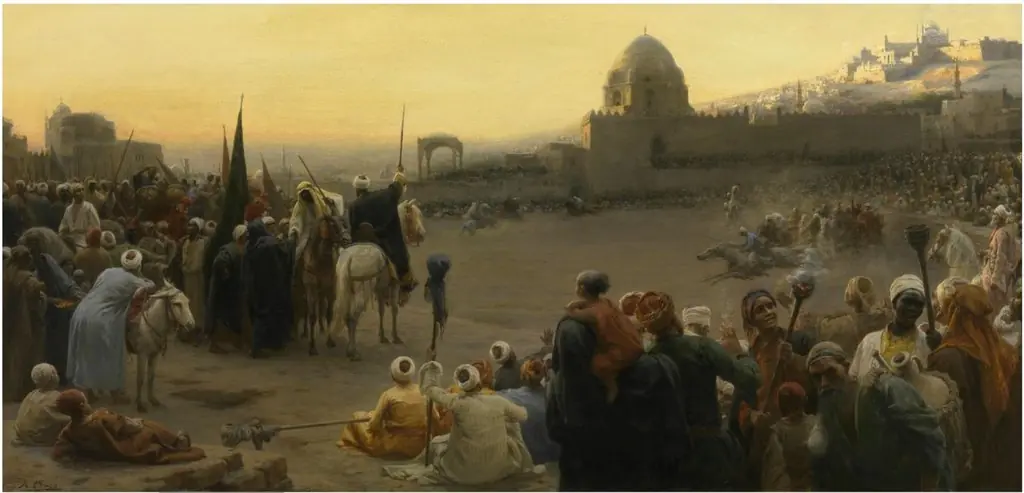
Muhammed's carpet moving from Mecca to Cairo is an oil painting by the Orientalist artist Konstantin Makovsky. It dates from 1875 and is held in the collection of the National Gallery of Armenia.
About this work
The artist has used a range of colors to bring the scene to life, from the deep blues and greens of the carpet to the warm tones of the buildings.
In this painting, a large crowd is gathered around a colorful carpet being carried through a bustling street. The scene is set against a backdrop of Middle Eastern architecture, with intricate arches and ornate details. The crowd is dressed in traditional attire, adding to the vibrant atmosphere.
The artist has used a range of colors to bring the scene to life, from the deep blues and greens of the carpet to the warm tones of the buildings. The level of detail is impressive, with each figure in the crowd rendered with care.
This painting is a great example of an orientalist painting, a style that was popular in the 19th century. If you're interested in learning more about this style, you might want to explore the subject of orientalist painting.
Overview
Painted in 1875 by Russian artist Konstantin Makovsky, this oil-on-canvas work depicts a legendary scene of a sacred carpet transported from Mecca to Cairo. Though rooted in Islamic tradition, the imagery is a fictionalized interpretation, typical of 19th-century Orientalist painting. Makovsky, trained in the Academic tradition, applied his skill in narrative composition to a subject far removed from his usual Russian themes, reflecting broader European fascination with the Islamic world.
Subject & Meaning
The painting illustrates a non-historical legend in which a miraculous carpet, said to bear a relic of the Prophet Muhammad, is carried through a city street by devoted followers. The scene blends religious reverence with theatrical spectacle, emphasizing awe and communal devotion. Rather than documenting actual practice, Makovsky constructs an idealized vision of piety and grandeur, aligning with Orientalist conventions that prioritized emotional resonance over ethnographic accuracy.
Technique & Style
Makovsky employed meticulous brushwork and rich, saturated colors to render the carpet’s intricate patterns and the varied textures of clothing and architecture. Figures are individually detailed, arranged in dynamic groupings that guide the viewer’s eye through the bustling street. The lighting is theatrical, enhancing the sense of movement and mystery. The style reflects Academic training, with polished surfaces and balanced composition, yet the subject matter leans into romanticized exoticism characteristic of Orientalist painting.
History & Provenance
Completed in 1875, the painting entered the collection of the National Gallery of Armenia, where it remains today. Its journey from Makovsky’s studio in Russia to Yerevan is undocumented, but its presence in Armenia likely stems from 20th-century cultural exchanges within the Soviet Union. The work was never widely exhibited in Western Europe or the United States, limiting its public recognition outside regional collections.
Context
In the late 19th century, European artists frequently turned to the Middle East and North Africa as subjects, often constructing scenes based on imagination rather than firsthand observation. Makovsky’s painting fits within this trend, responding to public appetite for exotic narratives. While Russian artists like him were developing realist depictions of domestic life, this work reveals a parallel engagement with imperial-era fantasies of the Orient, shaped more by literary and visual stereotypes than cultural understanding.
Legacy
The painting stands as a representative example of Academic Orientalism, illustrating how religious and cultural motifs from the Islamic world were reimagined through a European lens. Though not widely studied today, it contributes to the historical record of how non-Western societies were visually interpreted during a period of colonial expansion. Its preservation in Armenia offers a unique perspective on the circulation of Russian art within the broader Soviet cultural sphere.
Artist & collection
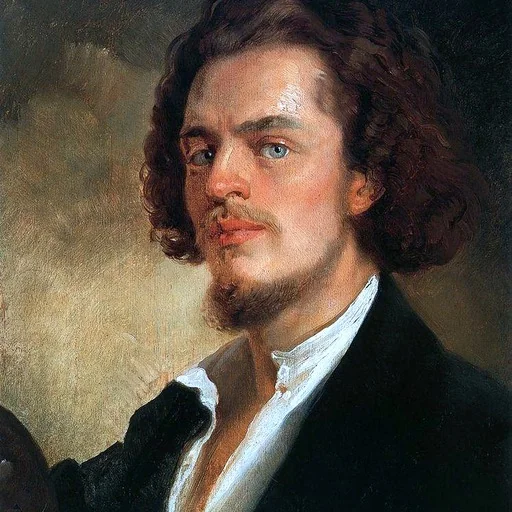
Artist
Konstantin Yegorovich Makovsky (Russian: Константи́н Его́рович Мако́вский; (20 June o.c.) 2 July n.c.