Artwork
Triumphal Arch for Henry II
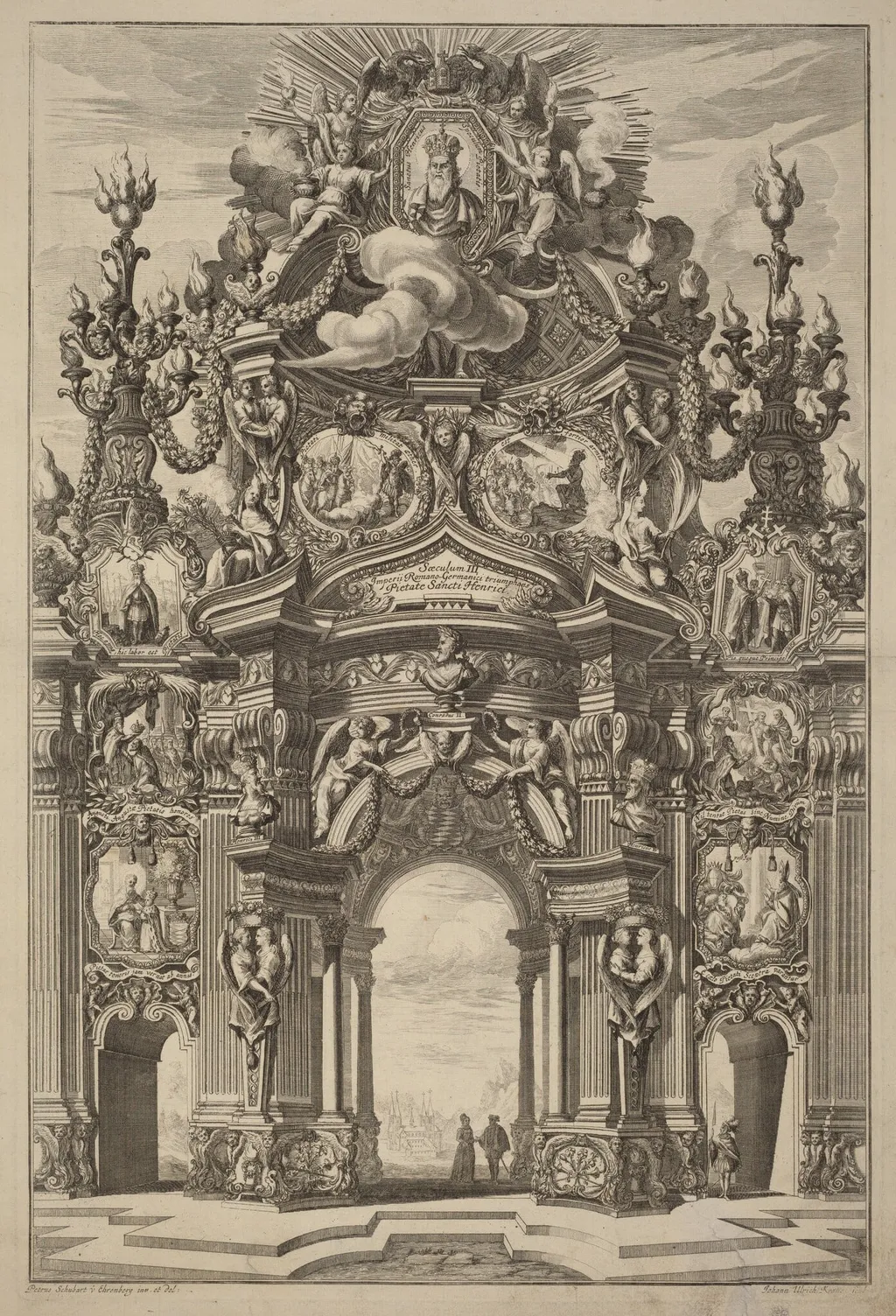
Triumphal Arch for Henry II is an ink print by the Baroque artist Johann Ulrich Kraus. It dates from 1725 and is held in the collection of the National Gallery of Art.
About this work
The tiny print text names a king—Henry II—and mentions "Seculum III," which likely means the 18th century.
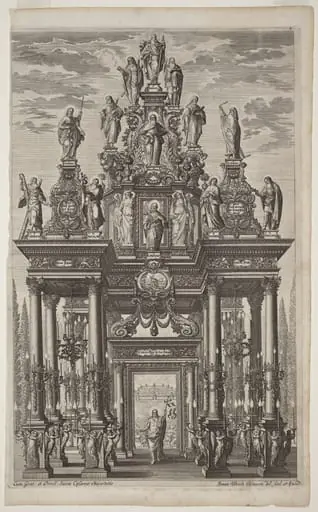
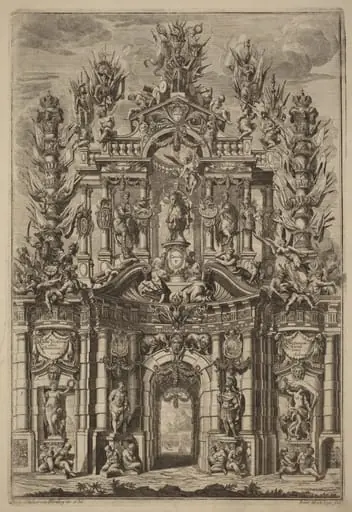
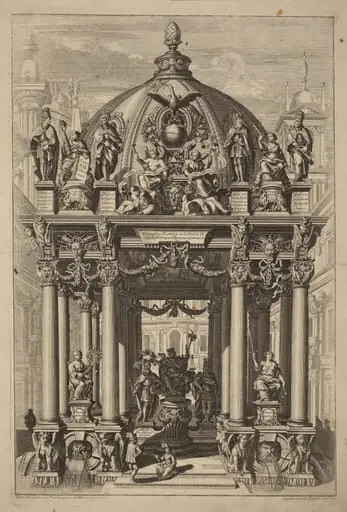
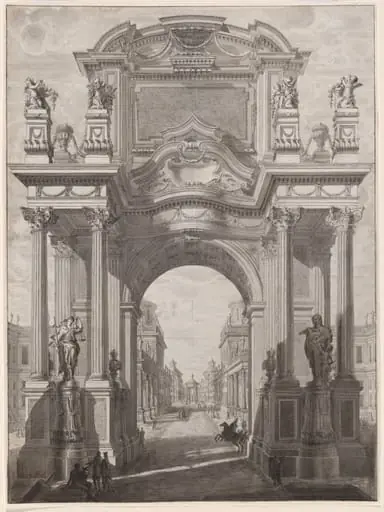
This is a busy black-and-white print of a fake triumphal arch. It looks like stone, packed with carvings, statues, and swirling decorations. At the top, a crowned figure sits in a cloud, surrounded by angels and scrolls. Below, smaller scenes show people and ships. The whole thing is framed like a stage set, with columns and arches.
The tiny print text names a king—Henry II—and mentions "Seculum III," which likely means the 18th century. This was made as a fancy design, not a real building.
Want to see more like this? Check out etching to learn how artists carve images into metal.
Overview
Johann Ulrich Kraus produced a black‑and‑white print titled *Triumphal Arch for Henry II* in 1725. Executed as an etching and engraving on laid paper, the work depicts an imagined monumental arch, richly ornamented with architectural elements, figures, and narrative scenes.
Subject & Meaning
The composition presents a fictitious triumphal arch dedicated to a monarch named Henry II, crowned and positioned within a celestial setting surrounded by angels and scrolls. Below, smaller vignettes illustrate human activity, including maritime vessels, suggesting celebration of royal power and conquest.
Technique & Style
Kraus combined etching and engraving to achieve a dense network of lines, rendering the stone‑like façade, intricate carvings, and swirling decorative motifs. The use of laid paper provides a textured surface that enhances the contrast between the heavily incised architectural forms and the finer details of figures and inscriptions.
History & Provenance
Created in the early eighteenth century, the print bears the inscription "Seculum III," indicating its production in the 1700s. It was intended as a decorative design rather than a blueprint for an actual structure, reflecting the period’s interest in commemorative architectural fantasies.
Context
During the Baroque era, prints of imagined triumphal arches were popular for celebrating rulers and disseminating idealized images of power. Kraus’s work aligns with this tradition, employing elaborate allegorical imagery to honor a historical king while appealing to collectors of ornamental prints.
Artist & collection