Artwork
Three Soldiers Discovering a Sleeping Woman
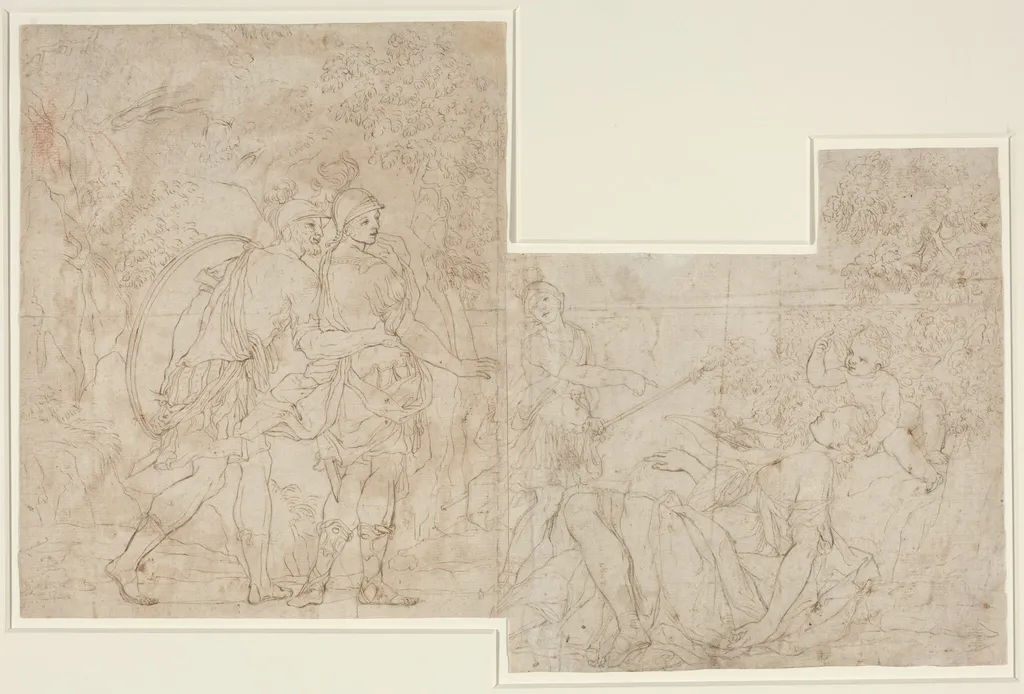
Three Soldiers Discovering a Sleeping Woman is an ink drawing by the Baroque artist Nicolas-Raymond de La Fage. It dates from 1673 and is held in the collection of the National Gallery of Art.
About this work
Overview
Created in 1673 by Nicolas-Raymond de La Fage, this drawing depicts three armored soldiers encountering a sleeping woman on the ground.
Created in 1673 by Nicolas-Raymond de La Fage, this drawing depicts three armored soldiers encountering a sleeping woman on the ground. Executed in pen and ink with red chalk and white highlights, it spans two sheets of laid paper. The composition is dynamic yet restrained, emphasizing posture and atmosphere over detailed realism. The medium’s spontaneity suggests a preparatory study or expressive sketch rather than a finished work.
Subject & Meaning
The scene captures a moment of quiet tension: three soldiers, their identities obscured by helmets and shadow, observe a vulnerable woman at rest. Their rigid stances and varied gestures—spear held aloft, shield propped, gaze lowered—suggest vigilance, curiosity, or hesitation. The sleeping figure, rendered with minimal detail, evokes innocence or helplessness, contrasting with the soldiers’ militarized presence. The ambiguity invites interpretation without prescribing a narrative.
Technique & Style
La Fage employs dense cross-hatching and rapid, overlapping strokes to model form and suggest texture, particularly in the soldiers’ armor and the tangled background. Red chalk adds warmth to skin and fabric, while white heightening defines edges and catches light. The woman’s drapery is rendered in loose, fluid lines, contrasting with the soldiers’ angular contours. The sketchy, almost chaotic background, composed of erratic lines, enhances the sense of unease and spatial disarray.
History & Provenance
The drawing is dated 1673 and attributed to Nicolas-Raymond de La Fage, a lesser-known French draftsman active in the late 17th century. Its survival suggests it was preserved within a private collection or artist’s studio, possibly as a study for a larger composition. No documented exhibition or public record exists prior to its modern acquisition, and its provenance remains largely untraced beyond institutional custody.
Context
Produced during the reign of Louis XIV, the work reflects the period’s interest in historical and allegorical subjects, often drawn from classical or military themes. While grand narratives dominated official art, this intimate sketch reveals a more personal, observational approach. Its sketch-like quality aligns with emerging trends in French draftsmanship that valued immediacy and expressive line over polished finish.
Legacy
Though not widely reproduced or studied, the drawing exemplifies the quiet intensity possible in 17th-century French figure studies. Its emphasis on gesture, mood, and economical line influenced later generations of draftsmen who valued emotional resonance over narrative clarity. Today, it stands as a testament to the expressive potential of the sketch as an independent artistic form.
Artist & collection


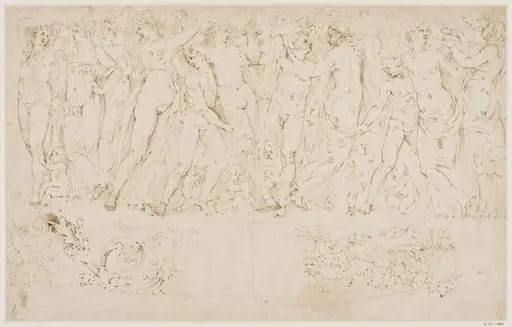 A Bacchic frieze; below, two studies of classical ornament
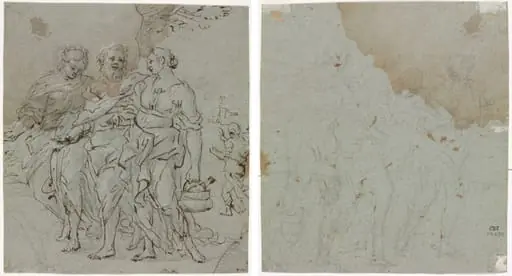 Lot and His Daughters (recto); Sketch for Lot and His Daughters (verso)
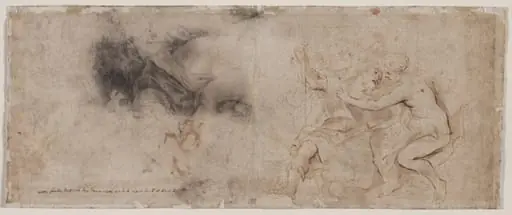 Venus Disarming Mars, Drapery Study (verso)
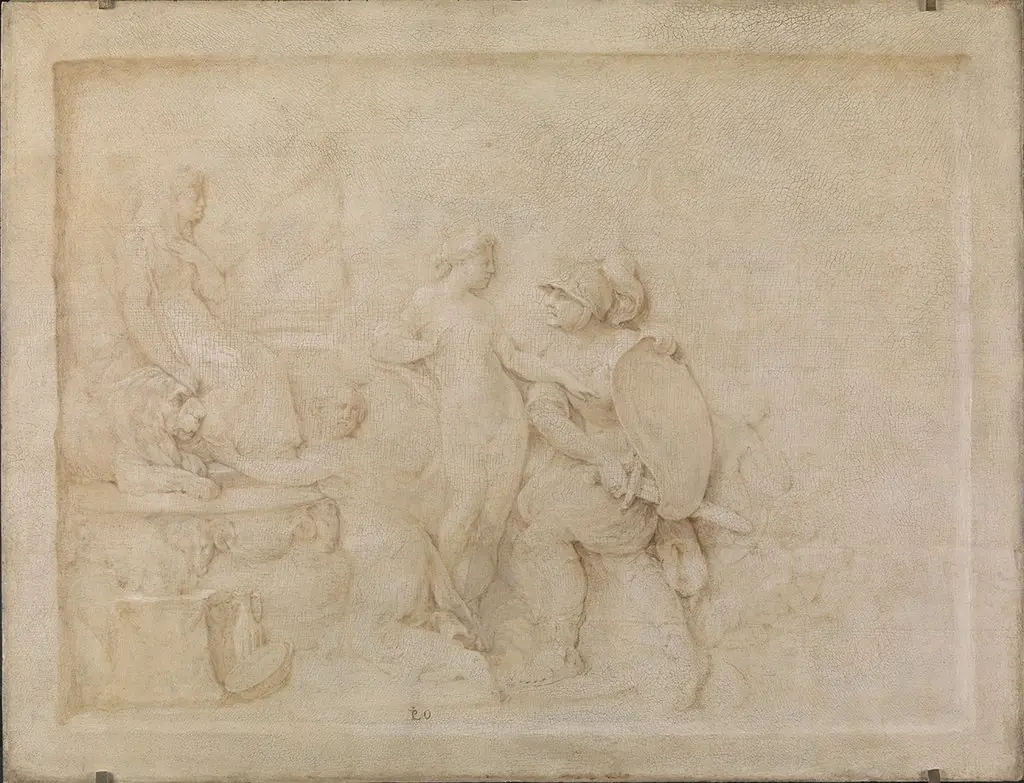 Aeneas hindres af Venus i sin hævn mod Helena, som har søgt tilflugt ved Cybeles alter
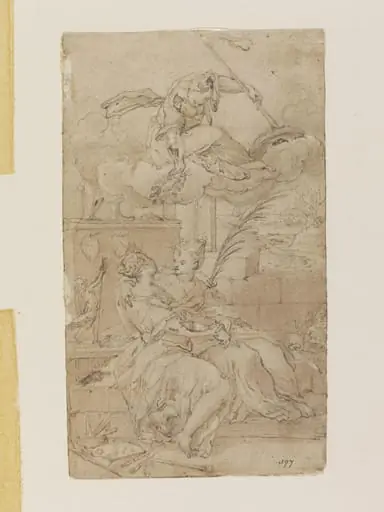 Allegory of the Union of Painting and Sculpture
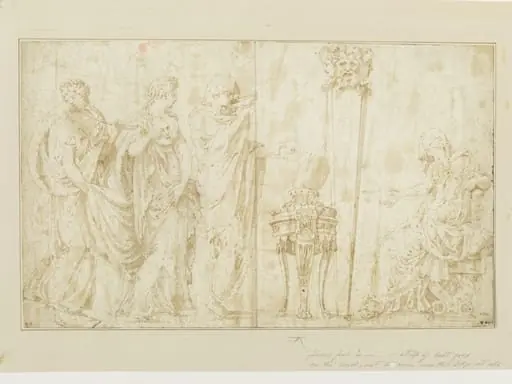 A sacrifice
 Untitled
![Seven Figures Witnessing an Ascension [verso], by Donato Creti](https://artifactworldgallery.com/img/donato-creti--seven-figures-witnessing-an-ascension-verso--e80b3c17c151416b-w320.webp) Seven Figures Witnessing an Ascension [verso]
Seven Figures Witnessing an Ascension [verso] Coriolanus before the Women of Rome
 Crucifixion of Saint Peter
 A Soldier on Horseback and Other Studies
 The Sacrifice of Iphigenia