Artwork
Allegory of the Union of Painting and Sculpture
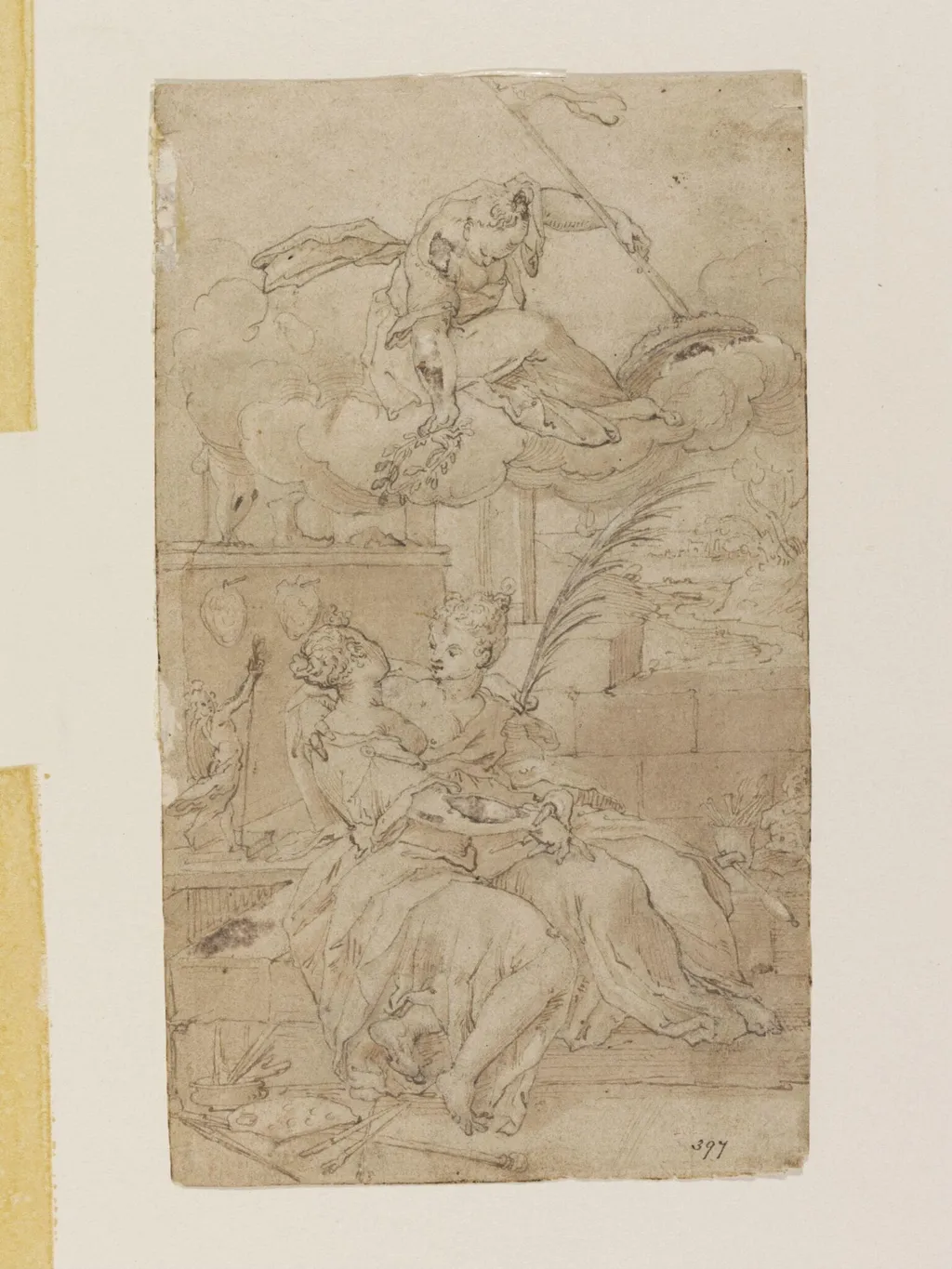
Allegory of the Union of Painting and Sculpture is a drawing by Unknown. It dates from 1550 and is held in the collection of the Victoria and Albert Museum. This drawing presents an allegorical representation of the union between Painting and Sculpture, rendered in fine linear detail.
About this work
Overview
The composition integrates symbolic attributes of each art form—tools, sculpted forms, and draped fabric—while the aerial figure suggests divine sanction.
This drawing presents an allegorical representation of the union between Painting and Sculpture, rendered in fine linear detail. A celestial figure hovers above two reclining female forms, bestowing a laurel crown. The composition integrates symbolic attributes of each art form—tools, sculpted forms, and draped fabric—while the aerial figure suggests divine sanction. Executed with precision, the work reflects a 17th-century tradition of allegorical draftsmanship.
Subject & Meaning
The two reclining women personify Painting and Sculpture, each holding objects associated with their respective arts: one with modeling tools and a bowl, the other with a sculpted form. Above them, a winged male figure—likely Minerva, goddess of wisdom and the arts—descends to crown the pair, symbolizing the harmonious convergence of the two disciplines under intellectual and divine authority. The scene elevates artistic practice to a sacred union.
Technique & Style
The artist employs delicate, continuous lines and subtle cross-hatching to model volume and texture, particularly in the folds of fabric and the contours of the figures. The smooth gradation of tone and the clarity of form suggest mastery of preparatory drawing techniques common in Renaissance and Baroque studios. The precision of detail, from tools scattered on the ground to the texture of the cloud, reveals a focus on tactile realism within an idealized composition.
History & Provenance
The drawing entered the collection of Rev. Alexander Dyce, a 19th-century scholar and art collector known for his interest in early artistic practices. Upon his death in 1869, it was bequeathed to a public museum, where it remains as part of a broader archive of Renaissance and Baroque drawings. Its survival in private hands before institutional acquisition reflects its status as a study of high artistic merit rather than a public commission.
Context
Created during a period when artistic theory emphasized the intellectual parity of Painting and Sculpture, this drawing aligns with humanist ideals that elevated the arts as liberal disciplines. Similar allegories appeared in treatises by artists like Leonardo and Vasari, who sought to elevate artistic practice beyond craft. The presence of Minerva underscores the classical lineage claimed by contemporary artists seeking legitimacy through antiquity.
Legacy
Though not widely exhibited, the drawing contributes to scholarly understanding of how allegory functioned in artistic education and theory. Its preservation in a public collection ensures continued access for study, offering insight into the visual language used to articulate the relationship between artistic media. It stands as a testament to the enduring practice of drawing as a medium for conceptual exploration.
Artist & collection

 Domestic Scene
 Giacomo and Cardinal Marco, investing Andrea, Abbot of San Zeno, with his Benefice
 The Nymph of Fontainebleau
 Portrait of a Woman
 Madonna and Child with Saints in the Enclosed Garden
 Venus and Minerva
 Family Group of Four on Sofa
 Wall painting from Room H of the Villa of P. Fannius Synistor at Boscoreale
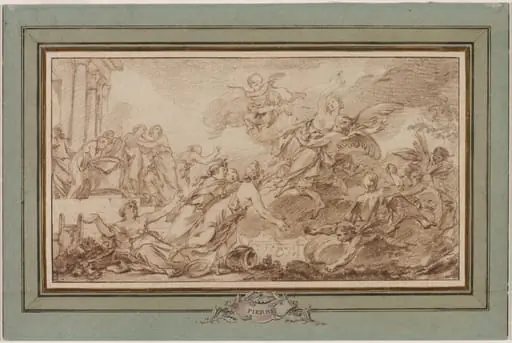 Boreas Abducting Oreithyia
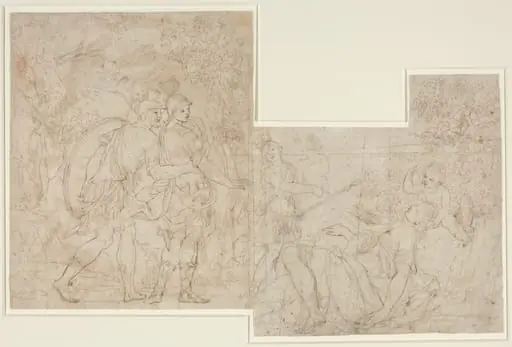 Three Soldiers Discovering a Sleeping Woman
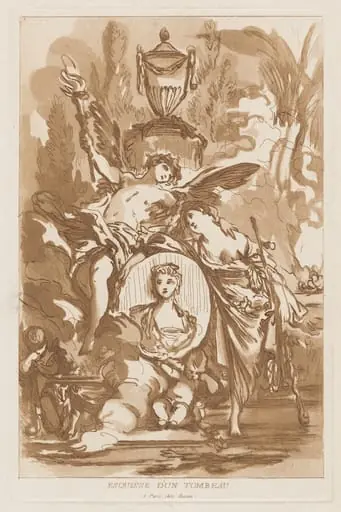 Esquisse d’un tombeau (Sketch for a Tomb)
 River God with Putti
 Panthea before Cyrus? (verso)
 The Holy Angels Protecting a Hermit from Evils
 Grotesque with a Satyr Feeding a Dragon (recto)
 A sacrifice
 Aurora and Cephalus
 The Ascension of the Virgin