Artwork
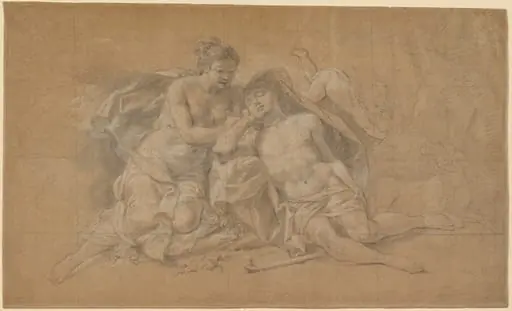
Two Young Women Seated on the Ground [recto]
![Two Young Women Seated on the Ground [recto], by Charles de La Fosse, chalk, 1698](https://artifactworldgallery.com/img/charles-de-la-fosse--two-young-women-seated-on-the-ground-recto--8bfe3b5a1028c9ea-w1024.webp)
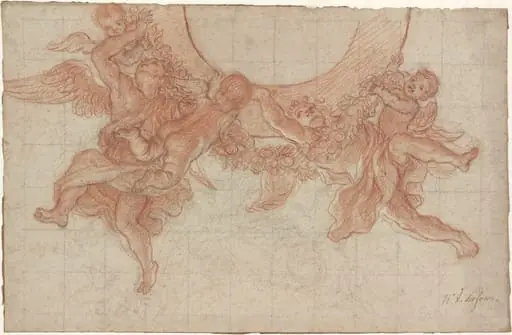
Two Young Women Seated on the Ground [recto] is a chalk drawing by the Baroque artist Charles de La Fosse. It dates from 1698 and is held in the collection of the National Gallery of Art.
About this work
Overview
Charles de La Fosse’s drawing, titled Two Young Women Seated on the Ground, dates to around 1698. Executed on a sheet of light‑brown laid paper that originally bore a blue hue, the work records a brief, informal study of two female figures positioned side by side on the floor. The composition is informal, suggesting a preparatory sketch rather than a finished piece.
Subject & Meaning
The drawing captures two young women in relaxed posture; one leans slightly forward while both rest their arms on their knees. Their garments are rendered with fluid, sweeping lines that convey the weight and movement of fabric. Though no narrative is explicit, the intimacy of the pose hints at a private moment or a study for a larger composition.
Technique & Style
Areas of the drawing remain loosely sketched, while other sections receive denser shading, creating a contrast between suggestion and definition.
La Fosse employed a combination of red and black chalk, heightened with white chalk, to model the figures against the paper’s muted background. Areas of the drawing remain loosely sketched, while other sections receive denser shading, creating a contrast between suggestion and definition. The use of colored chalks and the swift, gestural handling align with the exploratory practices of late‑Baroque draftsmanship.
History & Provenance
The sheet was originally coated in a blue tone that has since faded, a characteristic often seen in aged laid paper. The work is catalogued as a recto drawing, indicating it occupies the front side of a double‑sided sheet. Its provenance traces back to the artist’s studio, where it likely served as a preparatory study for a larger, finished composition.
Context
Created at the close of the 17th century, the drawing reflects the Baroque period’s interest in dynamic poses and expressive gesture. La Fosse, a French painter active in the court of Louis XIV, frequently produced such studies to refine the anatomy and drapery of figures before committing them to oil paintings or tapestries.
Artist & collection


![Young Woman Kneeling and Reaching Forward [verso], by Charles de La Fosse](https://artifactworldgallery.com/img/charles-de-la-fosse--young-woman-kneeling-and-reaching-forward-verso--dad9d34b84dadb6d-w320.webp)
![Three Studies of a Woman's Head and a Study of Hands [recto], by Jean Antoine Watteau](https://artifactworldgallery.com/img/jean-antoine-watteau--three-studies-of-a-woman-s-head-and-a-study-of-hands-recto--e8d8dc404a1e0512-w320.webp)
![Young Peasant Seated on the Ground [recto], by Giuseppe Maria Crespi](https://artifactworldgallery.com/img/giuseppe-maria-crespi--young-peasant-seated-on-the-ground-recto--4f17490e41fbab4c-w320.webp)