Artwork
Campagna di Roma
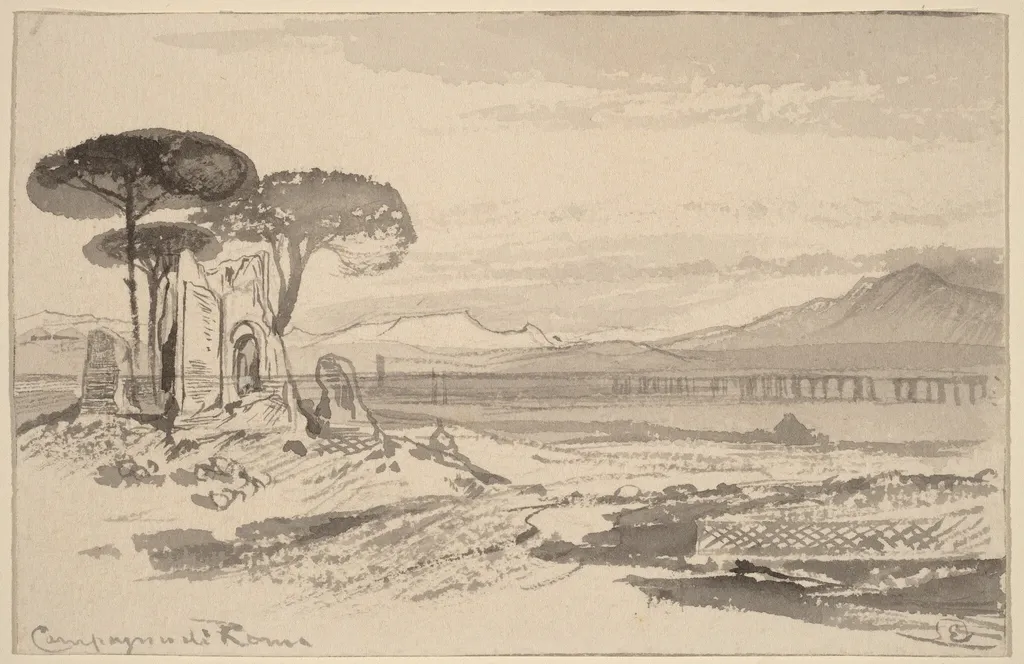
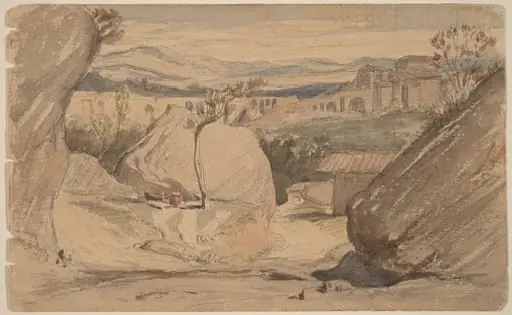
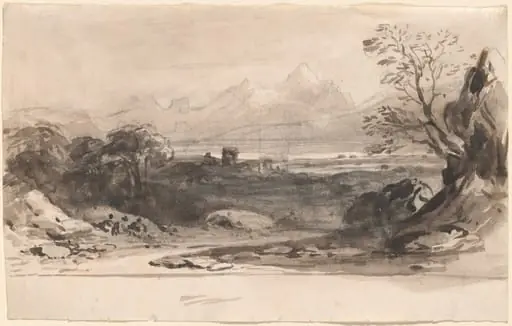
Campagna di Roma is a graphite drawing by the Impressionist artist Edward Lear. It dates from 1884 and is held in the collection of the National Gallery of Art.
About this work
Overview
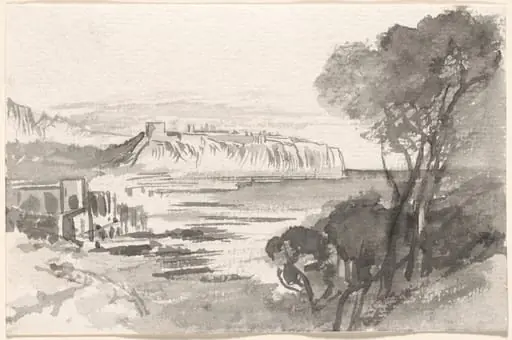
Created in 1884, *Campagna di Roma* is a delicate drawing executed in gray wash over faint graphite lines on card stock.
Created in 1884, *Campagna di Roma* is a delicate drawing executed in gray wash over faint graphite lines on card stock. It reflects Edward Lear’s sustained engagement with landscape observation during his travels in Italy. Unlike his more famous literary works, this piece belongs to a body of topographical studies that document the Italian countryside with quiet precision, emphasizing atmosphere over narrative.
Subject & Meaning
The scene captures a tranquil stretch of the Roman countryside, centered on a weathered stone archway partially obscured by towering trees. A distant bridge spans a broad river, while faint mountain contours dissolve into a pale sky. The composition conveys a sense of solitude and temporal erosion, suggesting the quiet persistence of ancient structures amid natural decay. There is no human presence—only the lingering trace of human history in the landscape.
Technique & Style
Lear employed soft, layered gray washes to model form and suggest atmospheric depth, allowing the underlying graphite to guide structure without dominating. Edges are blurred, tones muted, and details minimized, creating a hazy, almost ethereal quality. The technique avoids sharp definition, favoring tonal gradations that evoke early photographic effects and a meditative stillness, aligning with his interest in capturing transient light and mood.
History & Provenance
This drawing emerged from Lear’s later years, during which he made repeated journeys through Italy, producing hundreds of sketches as records of places he visited. *Campagna di Roma* was likely made on-site, as part of a personal archive rather than for public display. It remained in private hands after his death, eventually entering institutional collections as part of broader efforts to preserve his non-literary work.
Context
In the 1880s, Lear was increasingly focused on landscape documentation as a form of personal reflection, distinct from his earlier commercial illustrations. His Italian sketches were influenced by Romantic traditions of travel writing and the growing interest in topographical accuracy among amateur artists. This work aligns with contemporaneous European practices that valued the sketch as a direct, unembellished encounter with place.
Legacy
Though overshadowed by his nonsense verse, Lear’s travel drawings are now recognized as significant contributions to 19th-century British topographical art. *Campagna di Roma* exemplifies his ability to convey emotional resonance through restraint. These works influenced later generations of artists seeking to capture landscape not as spectacle, but as a quiet, enduring presence shaped by time and weather.
Artist & collection
Artist
Edward Lear (12 May 1812 – 29 January 1888) was an English artist, illustrator, musician, author and poet, who is known mostly for his literary nonsense in poetry and prose and especially his limericks, a form he popularised but which term…