Artwork
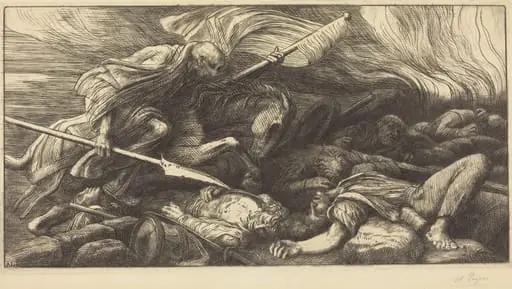
Death and Its Horse
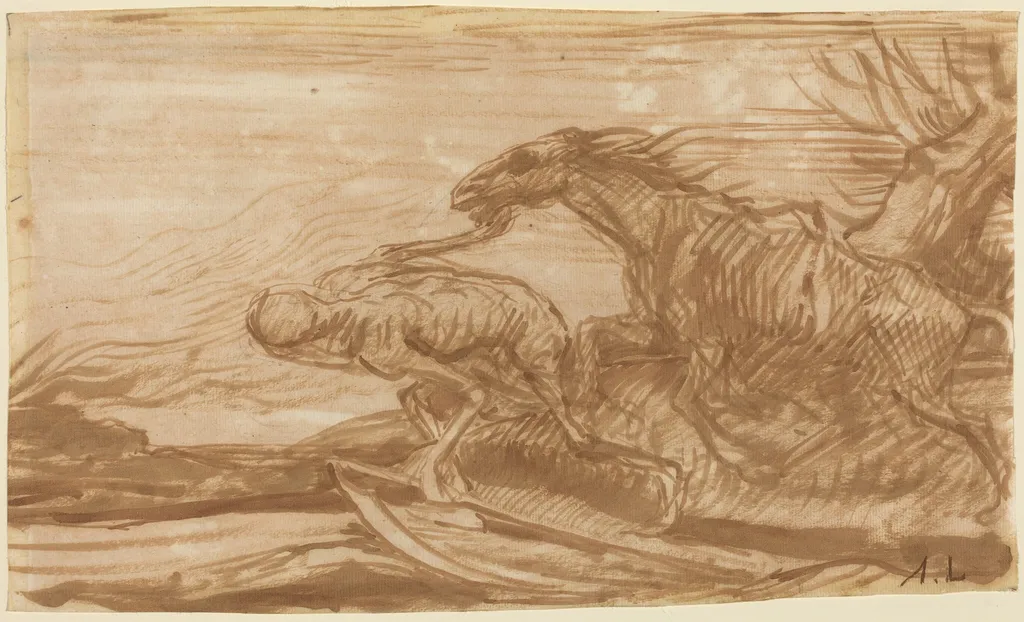
Death and Its Horse is an ink drawing by the Romanticist artist Alphonse Legros. It dates from 1874 and is held in the collection of the National Gallery of Art.
About this work
Overview
It belongs to a body of work that bridges his French training with his later influence in British art circles.
Created in 1874, *Death and Its Horse* is a drawing by Alphonse Legros, a French artist who spent much of his career in Britain after settling there in the 1860s. Executed in brush and brown ink over graphite on laid paper, the work exemplifies Legros’s mastery of linear expression and his interest in somber, symbolic themes. It belongs to a body of work that bridges his French training with his later influence in British art circles.
Subject & Meaning
The drawing portrays a skeletal rider mounted on a horse, evoking the traditional imagery of the Four Horsemen of the Apocalypse. The figure is not grotesque but austere, suggesting inevitability rather than horror. The minimal detail and restrained composition emphasize the universality of mortality, aligning with 19th-century preoccupations with death as a quiet, inescapable force rather than a theatrical spectacle.
Technique & Style
Legros employed fluid brushwork over a light graphite underdrawing to achieve a sense of movement and economy. The ink flows with deliberate spontaneity, defining form through contour and shadow rather than heavy modeling. The use of laid paper, with its subtle texture, enhances the tactile quality of the ink, reinforcing the drawing’s intimate, hand-crafted character and its connection to printmaking traditions.
History & Provenance
The drawing was made during Legros’s time in London, where he was active as a teacher and printmaker. It remained in private hands for much of the 20th century before entering a public collection. Its survival as a standalone work reflects its status as a study or independent piece rather than a preparatory sketch, underscoring Legros’s view of drawing as a finished artistic statement.
Context
In the 1870s, Legros was instrumental in promoting etching as a serious art form in Britain, countering prevailing tastes for polished oil paintings. His interest in medieval and Gothic themes, combined with a preference for direct, unadorned expression, placed him at odds with academic conventions. *Death and Its Horse* reflects this broader cultural shift toward introspective, symbolic imagery in late 19th-century British art.
Legacy
Though less known today than his contemporaries, Legros’s drawings like this one influenced a generation of British artists through his teaching at the Slade School. His emphasis on line, structure, and thematic gravity helped shape the revival of drawing as a discipline. *Death and Its Horse* remains a quiet testament to his belief in art’s capacity to confront fundamental human conditions without embellishment.
Artist & collection

Artist
Alphonse Legros (French pronunciation: ; 8 May 1837 – 8 December 1911) was a French, later British, painter, etcher, sculptor, and medallist.

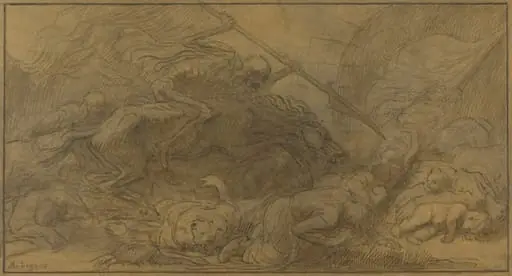 After the Battle
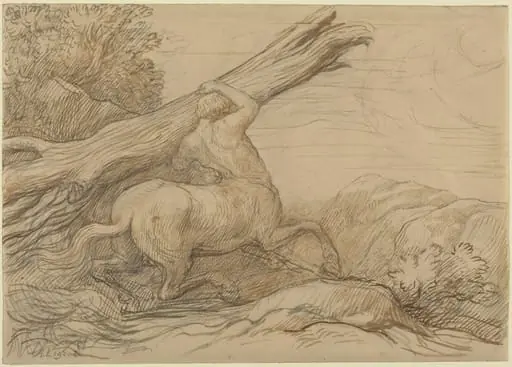 Centaur Carrying a Tree Trunk
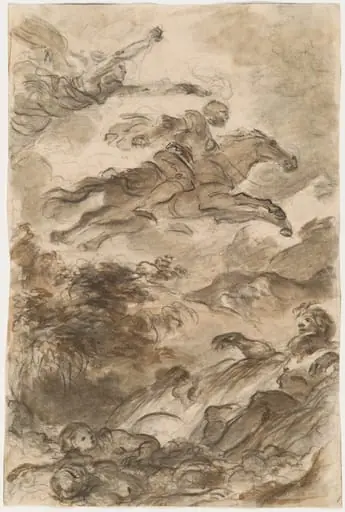 Rinaldo, Astride Baiardo, Flies Off in Pursuit of Angelica
 Fragment of a Lion Bas-Relief (verso)
 Sandstorm in the Desert Overtaking a Caravan
 The Sacrifice of Marcus Curtius
 Sketches of Animals (verso)
 The Triumph of Death: After the Battle (Le triomphe de la mort: Apres le combat)
 Arab Horseman at the Gallop
 Father, Son, and Donkey