Artwork
Landscape (Paysage)
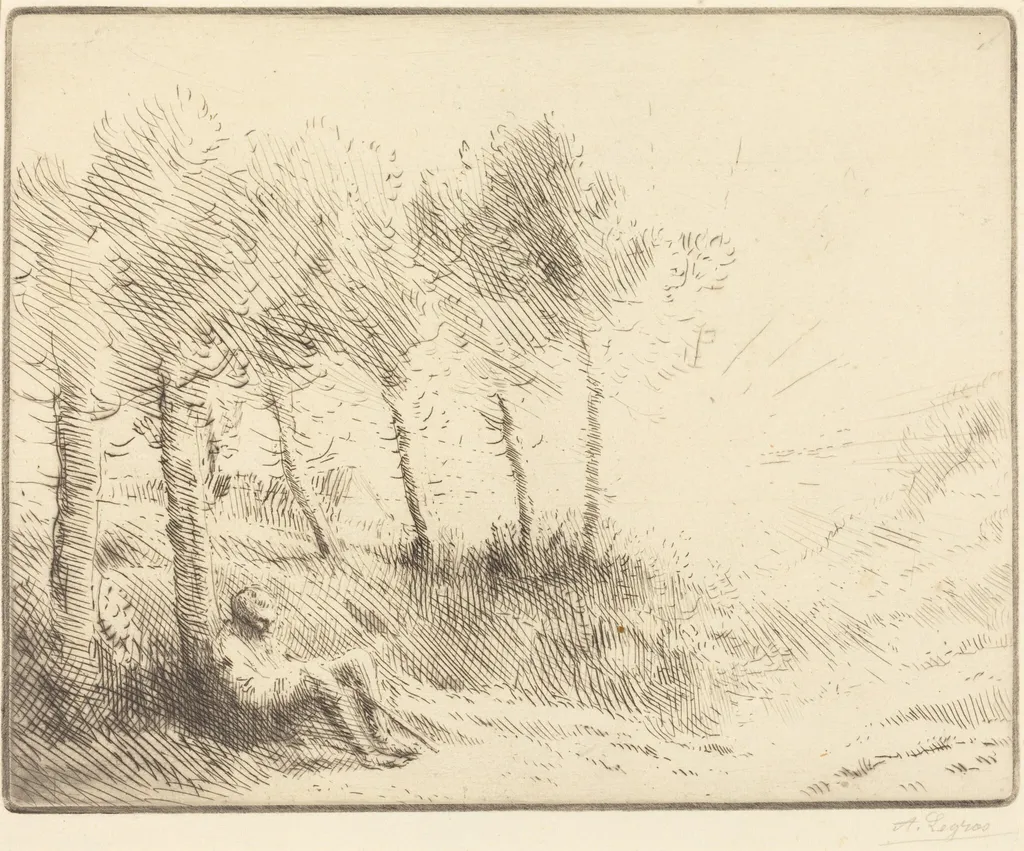
Landscape (Paysage) is an ink print by the Romanticist artist Alphonse Legros. It dates from 1874 and is held in the collection of the National Gallery of Art.
About this work
Overview
Legros employed the technique to capture natural forms with immediacy, favoring expressive line over polished finish.
Created in 1874, *Landscape (Paysage)* is an etching by Alphonse Legros, a French artist who moved to London in 1863 and became influential in British printmaking. The work belongs to a broader revival of etching as a serious artistic medium in the 19th century. Legros employed the technique to capture natural forms with immediacy, favoring expressive line over polished finish. This piece exemplifies his commitment to printmaking as a vehicle for direct observation.
Subject & Meaning
The scene portrays a quiet, wintry rural landscape dominated by bare, twisted trees rising from uneven ground. There is no human presence, and the absence of detail suggests a focus on atmosphere rather than narrative. The composition evokes solitude and the quiet persistence of nature, reflecting Legros’s interest in unidealized, everyday environments. The work resists romanticism, instead offering a restrained, almost austere view of the countryside.
Technique & Style
Legros used etching to create loose, gestural lines scratched into a metal plate, allowing ink to pool in the grooves and transfer to paper. The marks are irregular and spontaneous—wavy, jagged, and uneven—conveying texture through variation rather than precision. This approach prioritizes tactile sensation over realism, emphasizing the physicality of the medium. The pale background and sparse ground elements enhance the sense of openness and silence.
History & Provenance
Produced during Legros’s early years in Britain, the etching reflects his engagement with the British art scene after his relocation from France. He taught at the Slade School and helped elevate etching’s status among artists and collectors. While the specific early ownership of this print is undocumented, its existence aligns with his broader efforts to promote etching as a legitimate art form, distinct from reproductive prints.
Context
In the 1870s, European artists were re-examining printmaking as a means of personal expression, moving away from commercial reproduction. Legros was part of this shift, influenced by the directness of Japanese woodcuts and the realism of French naturalism. His etchings, including this one, responded to a growing interest in the artist’s hand and the integrity of the medium, contrasting with the polished finishes of academic painting.
Legacy
Legros’s etchings, including *Landscape (Paysage)*, contributed to the reestablishment of etching as a respected medium in Britain. His emphasis on spontaneous line and natural subject matter influenced a generation of printmakers who valued process over polish. Though less widely known today, his work remains a touchstone in the history of 19th-century print revival, particularly for its quiet, unembellished observation of the natural world.
Own this work as a print
Artist & collection

Artist
Alphonse Legros (French pronunciation: ; 8 May 1837 – 8 December 1911) was a French, later British, painter, etcher, sculptor, and medallist.

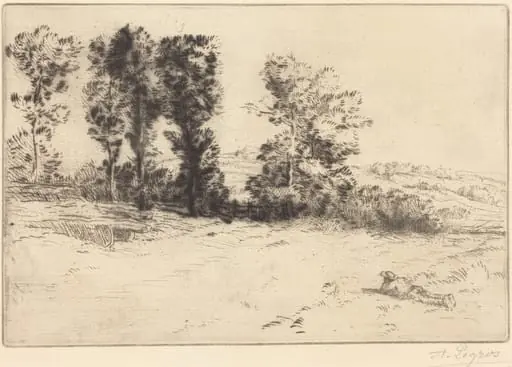 Meadow in Sunshine (Le pre ensoleille)
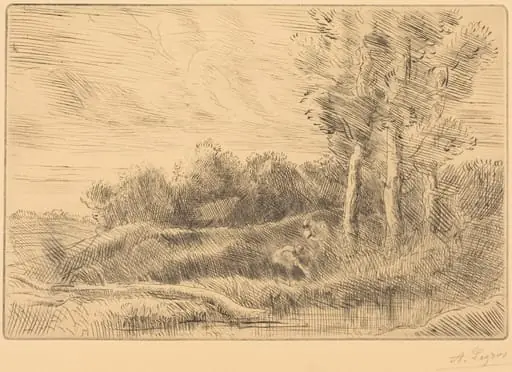 The House of the Well (La maison du puits)
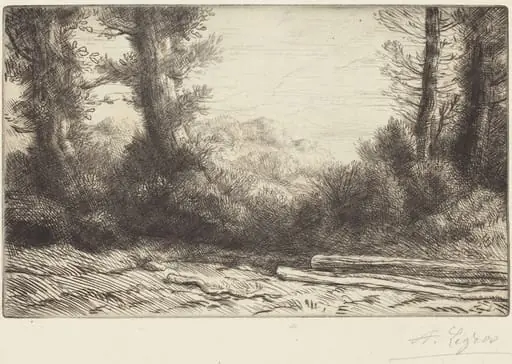 Edge of a Wood (Lisiere de bois)
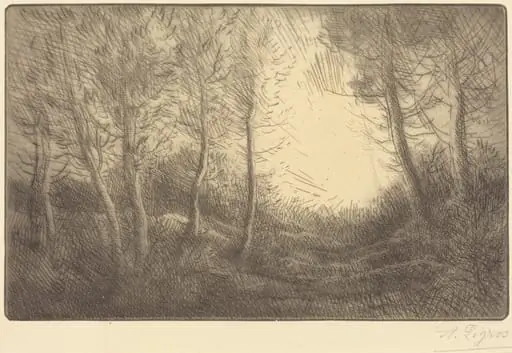 Sunrise, Woods of Clamard (Lever du soleil, bois de Clamard)
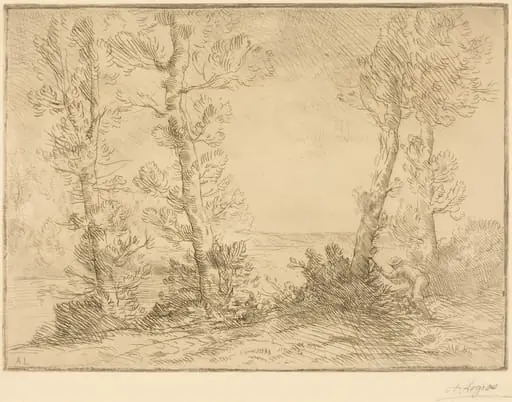 Salmon Fisher (Le pecheur du saumon)
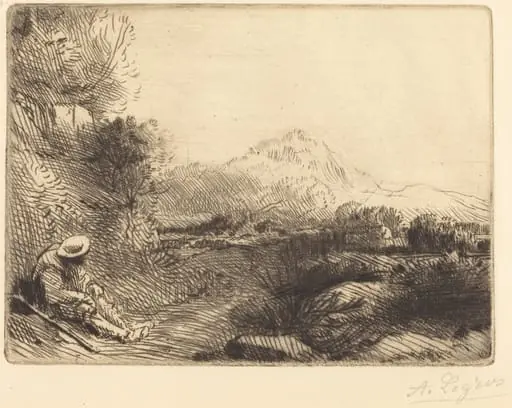 Traveler Resting (Repos du voyageur)
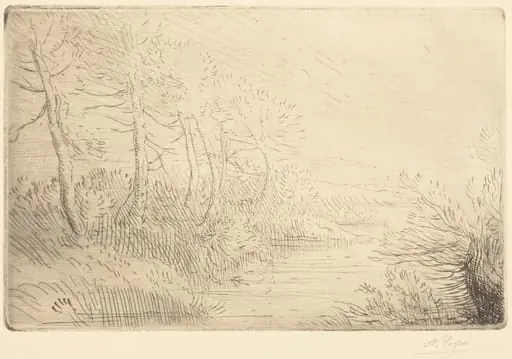 Riverbank (Bord de la riviere)
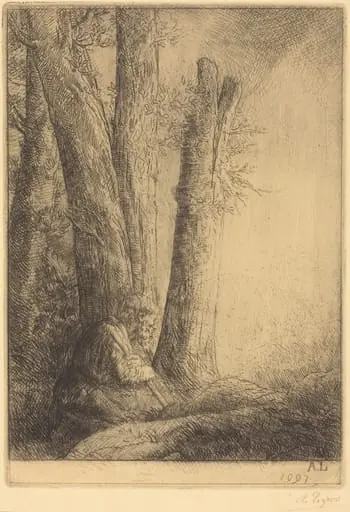 Study for the Prodigal Son (Etude pour L'enfant prodigue)
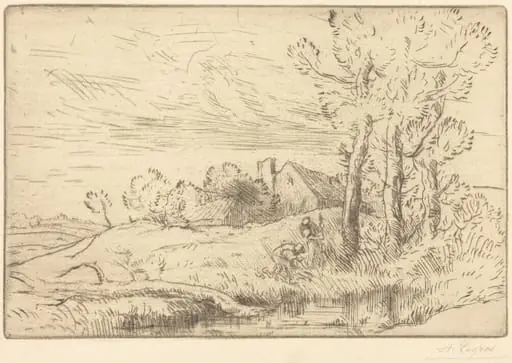 The House of the Well (La maison du puits)