Artwork
Landscape with Peat-bog; In the Marsh (Paysage des tourbieres; Dans les marais)
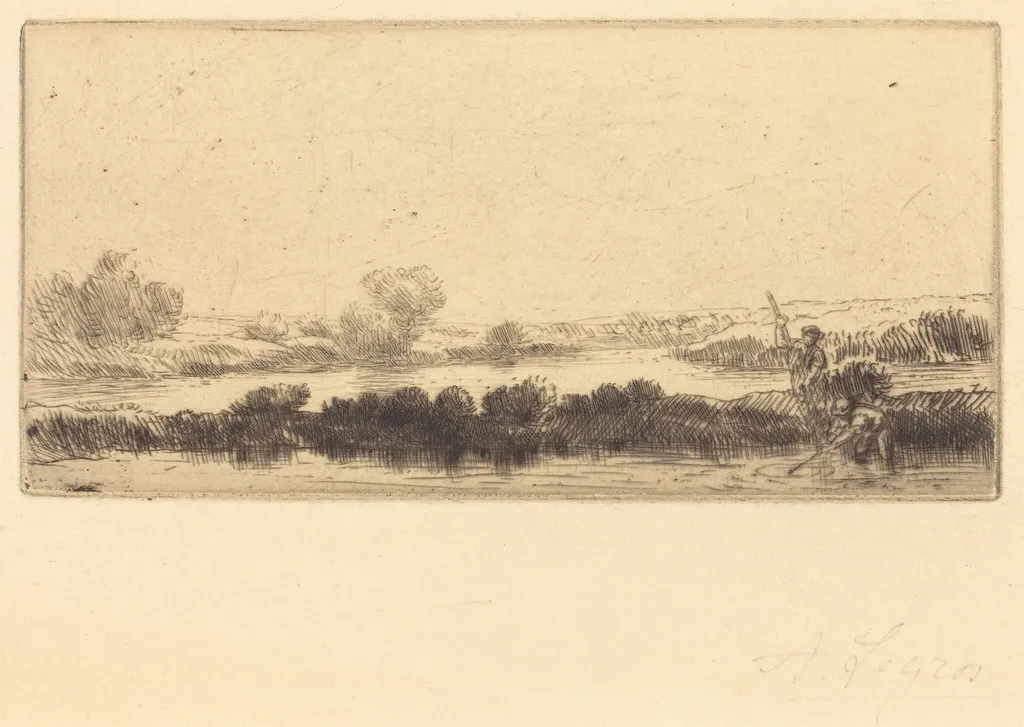
Landscape with Peat-bog; In the Marsh (Paysage des tourbieres; Dans les marais) is an ink print by the Romanticist artist Alphonse Legros. It dates from 1874 and is held in the collection of the National Gallery of Art.
About this work
Overview
Created in 1874 by Alphonse Legros, this print combines etching and drypoint to capture a desolate marshland in northern Europe.
Created in 1874 by Alphonse Legros, this print combines etching and drypoint to capture a desolate marshland in northern Europe. Though French by birth, Legros had settled in London by 1863 and became a central figure in the British print revival. His engagement with printmaking as both art and pedagogy shaped a generation of artists, and this work reflects his commitment to expressive, hand-crafted imagery over mechanical reproduction.
Subject & Meaning
The scene portrays a solitary figure moving through a waterlogged, root-choked marsh, surrounded by sparse vegetation and distant trees. The absence of human settlement and the muted sky amplify a sense of isolation. Rather than idealizing nature, Legros presents it as austere and indifferent, emphasizing the quiet endurance of life within harsh, marginal terrain. The figure’s small scale underscores human vulnerability against the vast, untamed landscape.
Technique & Style
Legros employed drypoint for its rich, fuzzy lines and etching for controlled tonal gradations, layering both to build the marsh’s dense, uneven texture. The scratchy, irregular strokes mimic tangled roots and wet earth, while areas of deep shadow contrast with faint, atmospheric backgrounds. The medium’s immediacy lends the scene a sketchlike quality, preserving the spontaneity of observation without sacrificing structural coherence.
History & Provenance
The print was made during Legros’s tenure at the Slade School of Fine Art, where he influenced British artists through his emphasis on direct observation and technical discipline. While specific early ownership records are sparse, the work aligns with his broader output of landscape prints from the 1870s, many of which were circulated among collectors and students. It remains part of institutional collections focused on 19th-century British printmaking.
Context
In the 1870s, British art was undergoing a shift toward realism and the revival of intaglio printmaking, moving away from industrial-era mass reproduction. Legros’s focus on rural, unromanticized landscapes resonated with contemporary interests in naturalism and the sublime in everyday environments. His work paralleled French Barbizon painters but was distinct in its emphasis on the tactile qualities of the print medium.
Legacy
Legros’s prints, including this one, helped reestablish etching and drypoint as serious artistic media in Britain. His technical rigor and commitment to depicting ordinary landscapes influenced later generations of printmakers, including those in the New English Art Club. Though less widely known today, his contributions laid groundwork for the 20th-century resurgence of hand-printed imagery as a vehicle for personal expression.
Artist & collection

Artist
Alphonse Legros (French pronunciation: ; 8 May 1837 – 8 December 1911) was a French, later British, painter, etcher, sculptor, and medallist.

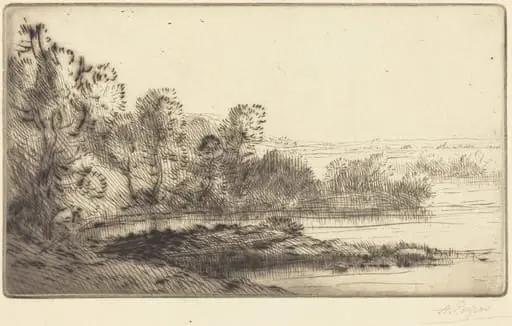 Along the Terne (Sur la terne)
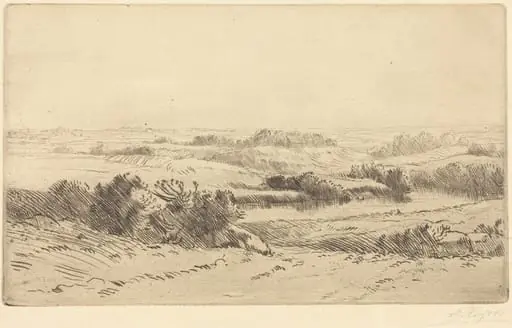 Banks of the Yanne (Les bords de la Yanne)
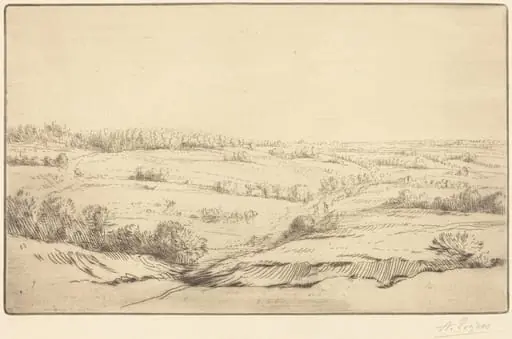 Plain (La plaine)
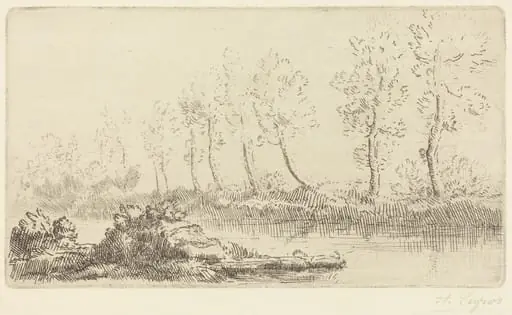 Banks of the Adour (Bord de l'Adour)
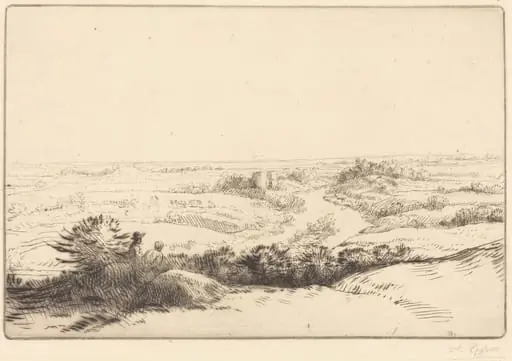 Prospect (Le point de vue)
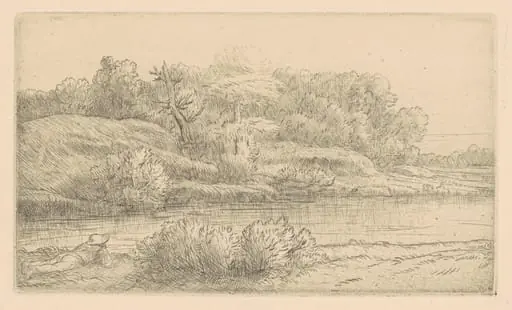 Banks of the Venelle (Bord de la Venelle)
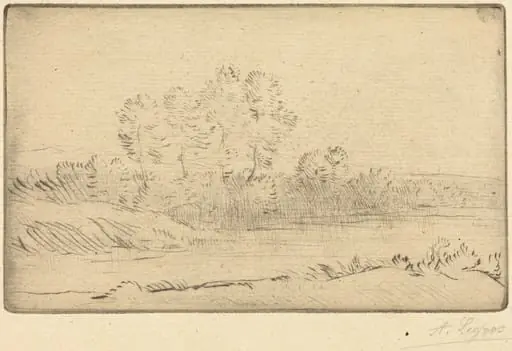 Near Nordkerque (Pres de Nordkerque)
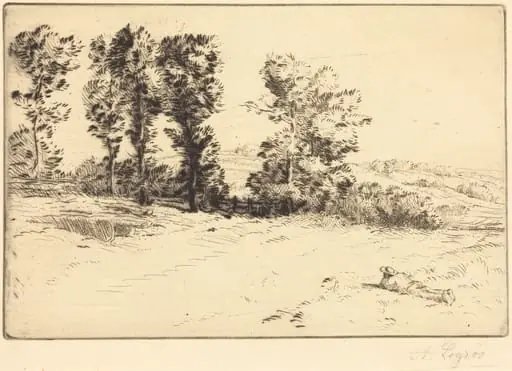 Meadow in Sunshine (Le pre ensoleille)
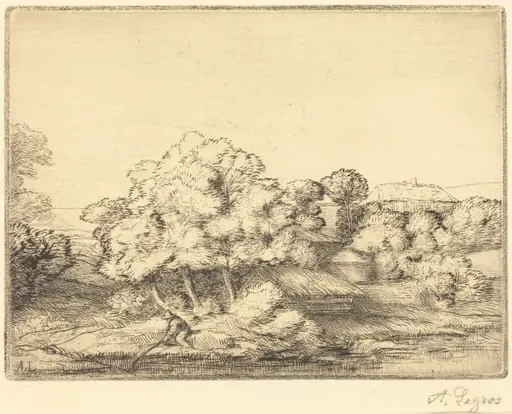 Hamlet near the Lake (Le hameau pres du lac)
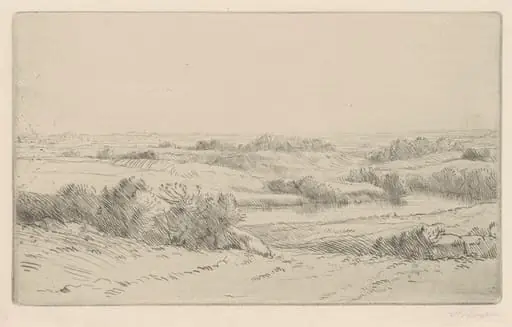 Banks of the Yanne (Les Bord de la Yanne)