Artwork
Hamlet near the Lake (Le hameau pres du lac)
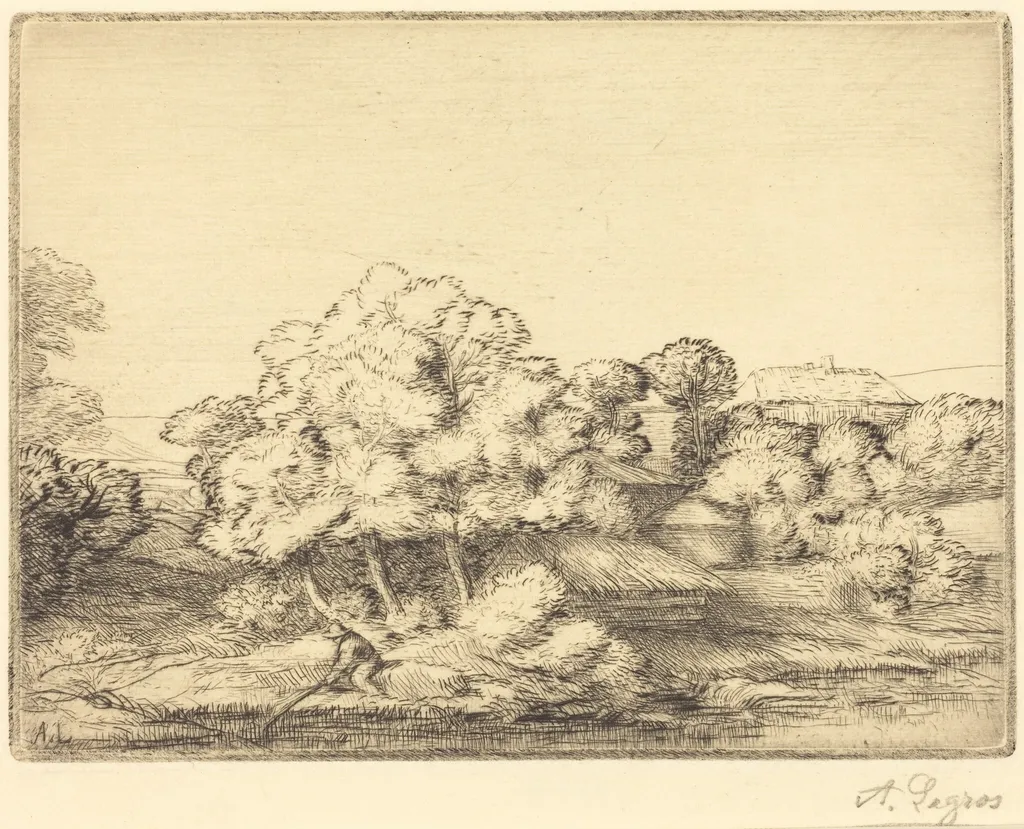
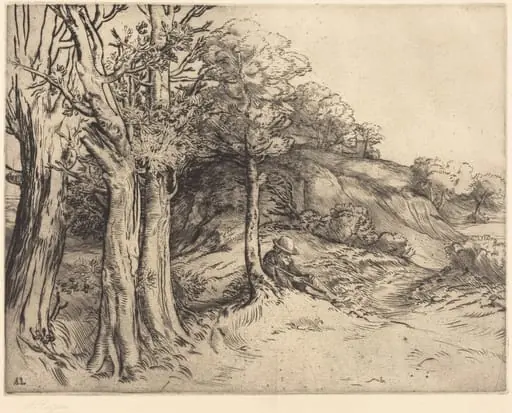
Hamlet near the Lake (Le hameau pres du lac) is an ink print by the Romanticist artist Alphonse Legros. It dates from 1874 and is held in the collection of the National Gallery of Art.
About this work
Overview
Alphonse Legros produced *Hamlet near the Lake* in 1874 as an etching and drypoint on paper. Though born in France, he had been based in London since 1863 and was deeply involved in the British printmaking revival. This work exemplifies his technical focus on intaglio methods, capturing a quiet rural scene with minimal detail but strong atmospheric presence.
Subject & Meaning
The scene depicts a secluded hamlet nestled among dense woodland, with a single structure barely visible through the tangle of trees. No human figures are present, and the title’s reference to Hamlet suggests a literary allusion rather than a literal depiction. The mood is contemplative, evoking solitude and the quiet persistence of nature over human habitation.
Technique & Style
Legros employed drypoint to carve fine, scratchy lines directly into the plate, creating rich, velvety blacks, and etching for finer tonal gradations.
Legros employed drypoint to carve fine, scratchy lines directly into the plate, creating rich, velvety blacks, and etching for finer tonal gradations. The composition relies on layered textures—dense tree trunks, irregular foliage, and undulating ground lines—to suggest depth without perspective. The hand-worked surface gives the image a tactile, almost haptic quality, characteristic of his intimate approach to printmaking.
History & Provenance
Created during Legros’s tenure at the Slade School of Fine Art, the print reflects his influence on British artists through his emphasis on direct, handcrafted print techniques. It was likely made for private circulation or teaching, not mass reproduction. No public record of early ownership exists, but it aligns with his broader body of landscape prints from the 1870s.
Context
In the 1870s, photography was reshaping visual documentation, but Legros and his circle championed etching as a deliberate, expressive medium. His work stood in contrast to industrialized imagery, favoring the artist’s hand and the materiality of ink on paper. This print belongs to a wave of revivalist prints that valued craftsmanship over mechanical reproduction.
Legacy
Legros’s prints, including this one, helped reestablish etching as a serious artistic practice in Britain. His technical rigor and focus on naturalistic, unidealized landscapes influenced a generation of printmakers. Though less widely known today, his contributions laid groundwork for the 20th-century resurgence of hand-printed imagery.
Own this work as a print
Artist & collection

Artist
Alphonse Legros (French pronunciation: ; 8 May 1837 – 8 December 1911) was a French, later British, painter, etcher, sculptor, and medallist.

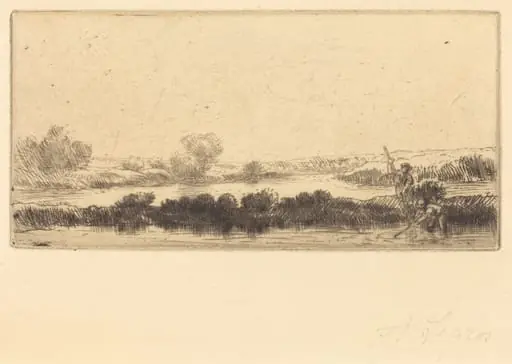 Landscape with Peat-bog; In the Marsh (Paysage des tourbieres; Dans les marais)
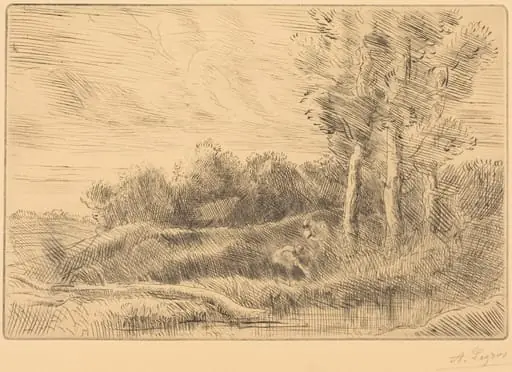 The House of the Well (La maison du puits)
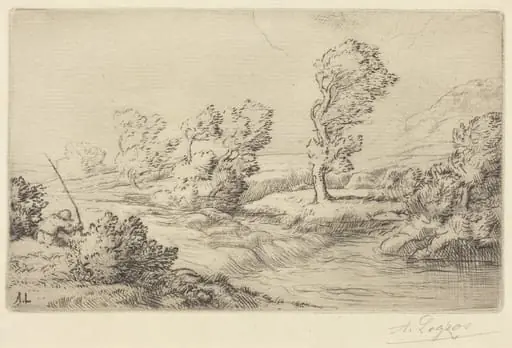 Banks of the Marne (Bord de la Marne)
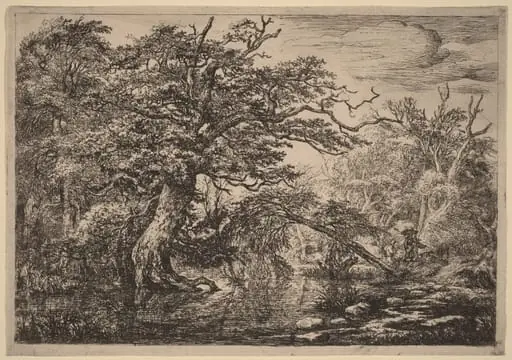 A Forest Marsh with Travelers on a Bank (The Travelers)
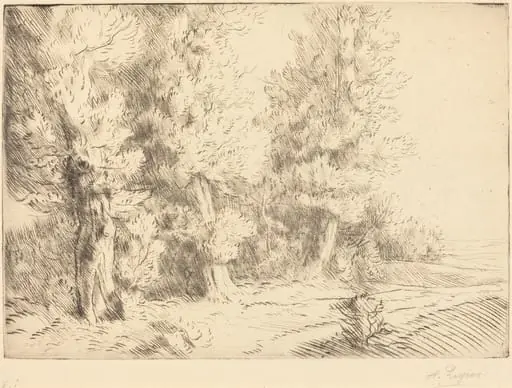 In the Forest of Fontainebleau (Dans la foret de Fontainebleau)
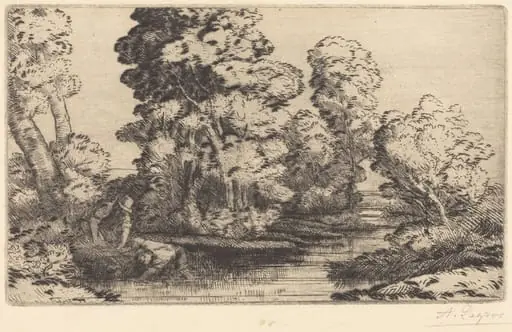 Valley in Bourgogne (Une vallee en Bourgogne)
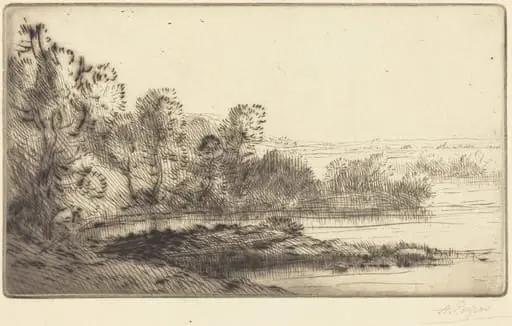 Along the Terne (Sur la terne)
 Solitude (Solitude (Paysage))